10.5 Defensive Shields
Explains the Deep Space 9 defensive shield system, including its three boom-arm graviton generators and Docking Ring short-range emitters of Cardassian origin with Starfleet power upgrades, the polarized-graviton field mechanism and electromotive rebound physics, the generator housing and EPS power supply with EM backflash, the capacitance-bank boosting and predictive-adaptive computer control, the redundancy requirements and single-generator endurance, the waveguide emitter blocks and randomized shield frequencies, the heat dissipation system, and the shield's triggering modes and combat performance limits.
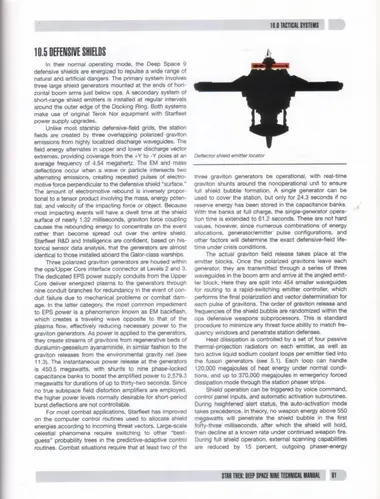
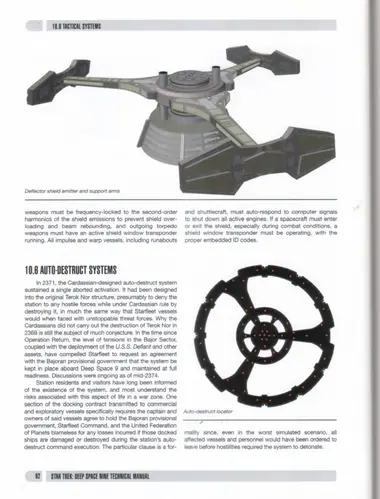
In their normal operating mode, the Deep Space 9 defensive shields are energized to repulse a wide range of natural and artificial dangers. The primary system involves three large shield generators mounted at the ends of horizontal boom arms just below ops. A secondary system of short-range shield emitters is installed at regular intervals around the outer edge of the Docking Ring. Both systems make use of original Terok Nor equipment with Starfleet power supply upgrades.
Unlike most starship defensive-field grids, the station fields are created by three overlapping polarized graviton emissions from highly localized discharge waveguides. The field energy alternates in upper and lower discharge vector extremes, providing coverage from the +Y to -Y poles at an average frequency of 4.54 megahertz. The EM and mass deflections occur when a wave or particle intersects two alternating emissions, creating repeated pulses of electromotive force perpendicular to the defensive shield "surface." The amount of electromotive rebound is inversely proportional to a tensor product involving the mass, energy potential, and velocity of the impacting force or object. Because most impacting events will have a dwell time at the shield surface of nearly 1.32 milliseconds, graviton force coupling causes the rebounding energy to concentrate on the event rather than become spread out over the entire shield. Starfleet R&D and Intelligence are confident, based on historical sensor data analysis, that the generators are almost identical to those installed aboard the Galor-class warships.
Three polarized graviton generators are housed within the ops/Upper Core interface connector at Levels 2 and 3. The dedicated EPS power supply conduits from the Upper Core deliver energized plasma to the generators through nine conduit branches for redundancy in the event of conduit failure due to mechanical problems or combat damage. In the latter category, the most common impediment to EPS power is a phenomenon known as EM backflash, which creates a traveling wave opposite to that of the ops plasma flow, effectively reducing necessary power to the graviton generators. As power is applied to the generators, they create streams of gravitons from regenerative beds of duralumin-gesselium ayanaminide, in similar fashion to the graviton releases from the environmental gravity net (see 11.3). The instantaneous power release at the generators is 450.5 megawatts, with shunts to nine phase-locked capacitance banks to boost the amplified power to 2,579.3 megawatts for durations of up to thirty-two seconds. Since no true subspace field distortion amplifiers are employed, the higher power levels normally desirable for short-period burst deflections are not controllable.
For most combat applications, Starfleet has improved on the computer control routines used to allocate shield energies according to incoming threat vectors. Large-scale celestial phenomena require switching to other "best-guess" probability trees in the predictive-adaptive control routines. Combat situations require that at least two of the three graviton generators be operational, with real-time graviton shunts around the nonoperational unit to ensure full shield bubble formation. A single generator can be used to cover the station, but only for 24.3 seconds if no reserve energy has been stored in the capacitance banks. With the banks at full charge, the single-generator operation time is extended to 61.2 seconds. These are not hard values, however, since numerous combinations of energy allocations, generator/emitter pulse configurations, and other factors will determine the exact defensive-field lifetime under crisis conditions.
The actual graviton field release takes place at the emitter blocks. Once the polarized gravitons leave each generator, they are transmitted through a series of three waveguides in the boom arm and arrive at the angled emitter block. Here they are split into 454 smaller waveguides for routing to a rapid-switching emitter controller, which performs the final polarization and vector determination for each pulse of gravitons. The order of graviton release and frequencies of the shield bubble are randomized within the ops defensive weapons subprocessors. This is standard procedure to minimize any threat force ability to match frequency windows and penetrate station defenses.
Heat dissipation is controlled by a set of four passive thermal-projection radiators on each emitter, as well as two active liquid sodium coolant loops per emitter tied into the fusion generators (see 5.1). Each loop can handle 120,000 megajoules of heat energy under normal conditions, and up to 370,000 megajoules in emergency forced dissipation mode through the station phaser strips.
Shield operation can be triggered by voice command, control panel inputs, and automatic activation subroutines. During heightened alert status, the auto-activation mode takes precedence. In theory, no weapon energy above 550 megawatts will penetrate the shield bubble in the first forty-three milliseconds, after which the shield will hold, then decline at a known rate under continued weapon fire. During full shield operation, external scanning capabilities are reduced by 15 percent, outgoing phaser-energy weapons must be frequency-locked to the second-order harmonics of the shield emissions to prevent shield overloading and beam rebounding, and outgoing torpedo weapons must have an active shield window transponder running. All impulse and warp vessels, including runabouts and shuttlecraft, must auto-respond to computer signals to shut down all active engines. If a spacecraft must enter or exit the shield, especially during combat conditions, a shield window transponder must be operating, with the proper embedded ID codes.