12.6 Turbolift Transport Systems
Describes the powered intrastation transportation accomplished by the turbolift system, comprising the personnel turbo system and the cargo transfer system, the levels and pylons reached by the open-cage personnel platforms and the cargo network's twin magrail guideways, the personnel network's 16.54 kilometers of energized tube guides arranged in three interconnected main pathways, the longest pathway and its travel time and peak velocity, the rapid reassignment of cabs to evacuation stations and the multicab trains in the rings and bridges, the construction of each personnel turbo cab from kelindide, toranium, and duranium with open occupied areas, the synchronized maglev motors drawing EPS power by induction, the conversion of EPS energy to multiphase current driving fifteen maglev coils under onboard isolinear control, the cabs' collision-avoidance and standby behavior and pseudo-IDF protection from polarized gravitons, the wartime passcode access since replaced with thermal, retinal, and voice-data scanners, and the voice or manual operation and startup acceleration of the cab.
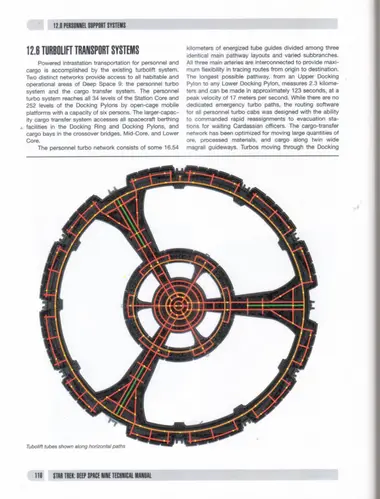
Powered intrastation transportation for personnel and cargo is accomplished by the existing turbolift system. Two distinct networks provide access to all habitable and operational areas of Deep Space 9: the personnel turbo system and the cargo transfer system. The personnel turbo system reaches all 34 levels of the Station Core and 252 levels of the Docking Pylons by open-cage mobile platforms with a capacity of six persons. The larger-capacity cargo transfer system accesses all spacecraft berthing facilities in the Docking Ring and Docking Pylons, and cargo bays in the crossover bridges, Mid-Core, and Lower Core.
The personnel turbo network consists of some 16.54 kilometers of energized tube guides divided among three identical main pathway layouts and varied subbranches. All three main arteries are interconnected to provide maximum flexibility in tracing routes from origin to destination. The longest possible pathway, from an Upper Docking Pylon to any Lower Docking Pylon, measures 2.3 kilometers and can be made in approximately 123 seconds, at a peak velocity of 17 meters per second. While there are no dedicated emergency turbo paths, the routing software for all personnel turbo cabs was designed with the ability to commanded rapid reassignments to evacuation stations for waiting Cardassian officers. The cargo-transfer network has been optimized for moving large quantities of ore, processed materials, and cargo along twin wide magrail guideways. Turbos moving through the Docking Ring and crossover bridges were often formed into multicab trains working in opposite directions. These were essentially all horizontal in the local gravity frame. Vertical movement within the Docking Pylons, which contained the ore-processing facilities, required the trains of turbo cabs to separate and travel in sequence along the perpendicular guideways.
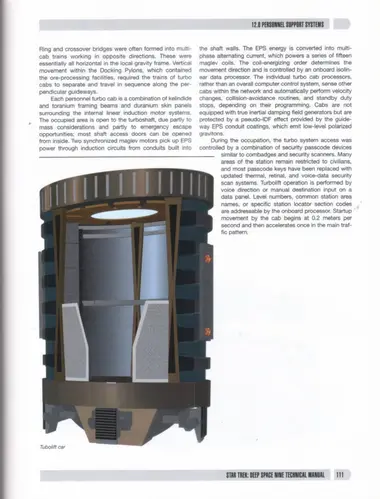
Each personnel turbo cab is a combination of kelindide and toranium framing beams and duranium skin panels surrounding the internal linear induction motor systems. The occupied area is open to the turboshaft, due partly to mass considerations and partly to emergency escape opportunities; most shaft access doors can be opened from inside. Two synchronized maglev motors pick up EPS power through induction circuits from conduits built into the shaft walls. The EPS energy is converted into multiphase alternating current, which powers a series of fifteen maglev coils. The coil-energizing order determines the movement direction and is controlled by an onboard isolinear data processor. The individual turbo cab processors, rather than an overall computer control system, sense other cabs within the network and automatically perform velocity changes, collision-avoidance routines, and standby duty stops, depending on their programming. Cabs are not equipped with true inertial damping field generators but are protected by a pseudo-IDF effect provided by the guideway EPS conduit coatings, which emit low-level polarized gravitons.
During the occupation, the turbo system access was controlled by a combination of security passcode devices similar to combadges and security scanners. Many areas of the station remain restricted to civilians, and most passcode keys have been replaced with updated thermal, retinal, and voice-data security scan systems. Turbolift operation is performed by voice direction or manual destination input on a data panel. Level numbers, common station area names, or specific station locator section codes are addressable by the onboard processor. Startup movement by the cab begins at 0.2 meters per second and then accelerates once in the main traffic pattern.