1.6 Station Construction Milestones and Upgrades
Traces the assembly sequence by which Terok Nor was constructed and details the Starfleet and Bajoran upgrades made to the station's power, atmospheric, computer, weapons, docking, and communications systems after the occupation ended.
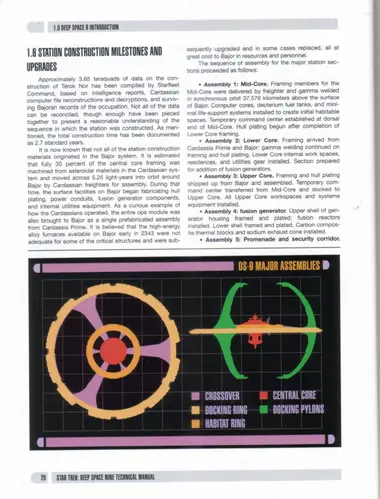
Approximately 3.65 teraquads of data on the construction of Terok Nor has been compiled by Starfleet Command, based on intelligence reports, Cardassian computer file reconstructions and decryptions, and surviving Bajoran records of the occupation. Not all of the data can be reconciled, though enough have been pieced together to present a reasonable understanding of the sequence in which the station was constructed. As mentioned, the total construction time has been documented as 2.7 standard years.
It is now known that not all of the station construction materials originated in the Bajor system. It is estimated that fully 30 percent of the central core framing was machined from asteroidal materials in the Cardassian system and moved across 5.25 light-years into orbit around Bajor by Cardassian freighters for assembly. During that time, the surface facilities on Bajor began fabricating hull plating, power conduits, fusion generator components, and internal utilities equipment. As a curious example of how the Cardassians operated, the entire ops module was also brought to Bajor as a single prefabricated assembly from Cardassia Prime. It is believed that the high-energy alloy furnaces available on Bajor early in 2343 were not adequate for some of the critical structures and were subsequently upgraded and in some cases replaced, all at great cost to Bajor in resources and personnel.
The sequence of assembly for the major station sections proceeded as follows:
- Assembly 1: Mid-Core. Framing members for the Mid-Core were delivered by freighter and gamma welded in synchronous orbit 37,576 kilometers above the surface of Bajor. Computer cores, deuterium fuel tanks, and minimal life-support systems installed to create initial habitable spaces. Temporary command center established at dorsal end of Mid-Core. Hull plating begun after completion of Lower Core framing.
- Assembly 2: Lower Core. Framing arrived from Cardassia Prime and Bajor; gamma welding continued on framing and hull plating. Lower Core internal work spaces, residences, and utilities gear installed. Section prepared for addition of fusion generators.
- Assembly 3: Upper Core. Framing and hull plating shipped up from Bajor and assembled. Temporary command center transferred from Mid-Core and docked to Upper Core. All Upper Core workspaces and systems equipment installed.
- Assembly 4: fusion generator. Upper shell of generator housing framed and plated; fusion reactors from Cardassia Prime installed. Lower shell framed and plated. Carbon composite thermal blocks and sodium exhaust cone installed.
- Assembly 5: Promenade and security corridor. Temporary command center dismantled to allow for Promenade framing and hull plating. Reactive shield armor installed. Complete station atmospheric pressure integrity established. All remaining core systems installed.
- Assembly 6: Ops. Permanent Cardassian command center (now ops) docked to structural core; gamma welded. Turbolift connections established. Defensive shield generators and emitters installed.
- Assembly 7: Habitat Ring. Framing and plating shipped from Bajor and assembled. Minor crossover bridges and horizontal turbolift paths established. Weapon sails fabricated in nearby orbit and attached.
- Assembly 8: Docking Ring and pylons. Large crossover bridges framed and plated. Turbolift and cargo paths established. Pylons erected from crossovers prior to Docking Ring framing. Ore refining equipment installed in pylons. Pylon docking ports installed. Docking Ring framed and plated. All remaining systems installed.
Starfleet and Bajoran Upgrades
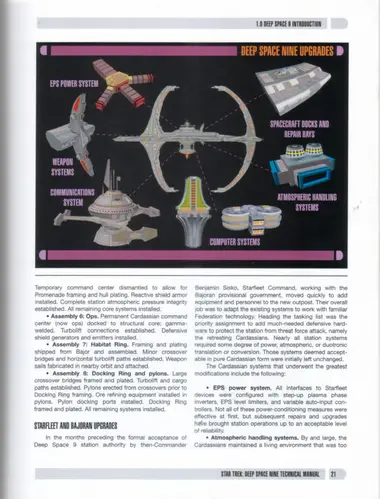
In the months preceding the formal acceptance of Deep Space 9 station authority by then-Commander Benjamin Sisko, Starfleet Command, working with the Bajoran provisional government, moved quickly to add equipment and personnel to the new outpost. Their overall job was to adapt the existing systems to work with familiar Federation technology. Heading the tasking list was the priority assignment to add much-needed defensive hardware to protect the station from threat force attack, namely the retreating Cardassians. Nearly all station systems required some degree of power, atmospheric, or duotronic translation or conversion. Those systems deemed acceptable in pure Cardassian form were initially left unchanged. The Cardassian systems that underwent the greatest modifications include the following:
- EPS power system. All interfaces to Starfleet devices were configured with step-up plasma phase inverters, EPS level limiters, and variable auto-input controllers. Not all of these power-conditioning measures were effective at first, but subsequent repairs and upgrades brought station operations up to an acceptable level of reliability.
- Atmospheric handling systems. By and large, the Cardassians maintained a living environment that was too hot and too dry as compared to that deemed comfortable by other humanoid species. Starfleet and Bajoran engineers reconfigured the environmental control systems for the station's common areas to produce twenty-two degrees Celsius and 18 percent humidity conditions, and left the remaining controls in private residences and secure work areas to be regulated by individual users.
- Computer systems. As in the case of the power conversions, the onboard isolinear-based computer systems required a complex set of adaptive interface devices to work with Starfleet systems and programming. In most cases, the Cardassian computer control circuitry that maintained the station on a basic level worked without translation, provided the operators understood the Cardassian language, 243-bit programming code, and how the equipment functioned (see 4.1). While the majority of the computer-controlled systems were not sabotaged, enough hazardous security devices, deeply buried programs, and computer viruses were left to warrant staying on guard against continued dangers.
- Weapons systems. Large-scale Starfleet shield energy generators were installed as backups for the existing defensive shield system. These generators could produce a variety of field and particle types and were interfaced with the Cardassian systems via redundant step-up EPS couplings. New phaser emitters were installed into the existing weapon sail towers, as were magazines and launchers for standard photon torpedoes. Rotary phaser and torpedo launchers were subsequently installed in spaces once used as monitoring and observation facilities (see 10.0).
- Spacecraft docks and repair bays. Since not all starships operating in the galaxy conform to all docking ports, modifications had to be made to many of the berthing facilities on Deep Space 9 to accept Starfleet hatch fittings (see 6.2, 6.3). The most extensive work was done on the six pylon docking ports, three large Docking Ring ports, and the new runabout launch bays. The runabouts required six large volumes cut into the Habitat Ring to accommodate the pressurized bays and electrohydraulic pads (see 14.2).
- Communications systems. New subspace radio transceiver assemblies and ops-mounted antennae were installed to provide secure voice and data communications between Deep Space 9 and neighboring star systems, starships, and Starfleet Command (see 7.0). Numerous intrastation transceivers were also installed, either interfaced with Cardassian components or bypassing them to talk directly to Starfleet systems.