3.6 System Diagnostics
Describes the periodic systems-check regime, contrasting the Cardassian 1-to-12 priority scale with the Starfleet 1-to-5 diagnostic scale, the adaptation of that scale to the station, and the specific monitoring schedules for fusion power, weapons, communications, and environmental control.
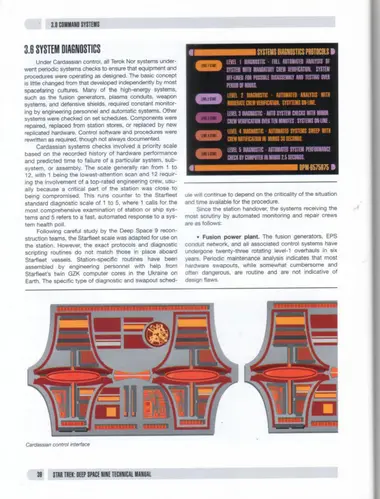
Under Cardassian control, all Terok Nor systems underwent periodic systems checks to ensure that equipment and procedures were operating as designed. The basic concept is little changed from that developed independently by most spacefaring cultures. Many of the high-energy systems, such as the fusion generators, plasma conduits, weapon systems, and defensive shields, required constant monitoring by engineering personnel and automatic systems. Other systems were checked on set schedules. Components were repaired, replaced from station stores, or replaced by new replicated hardware. Control software and procedures were rewritten as required, though not always documented.
Cardassian systems checks involved a priority scale based on the recorded history of hardware performance and predicted time to failure of a particular system, subsystem, or assembly. The scale generally ran from 1 to 12, with 1 being the lowest-attention scan and 12 requiring the involvement of a top-rated engineering crew, usually because a critical part of the station was close to being compromised. This runs counter to the Starfleet standard diagnostic scale of 1 to 5, where 1 calls for the most comprehensive examination of station or ship systems and 5 refers to a fast, automated response to a system health poll.
Following careful study by the Deep Space 9 reconstruction teams, the Starfleet scale was adapted for use on the station. However, the exact protocols and diagnostic scripting routines do not match those in place aboard Starfleet vessels. Station-specific routines have been assembled by engineering personnel with help from Starfleet’s twin GZK computer cores in the Ukraine on Earth. The specific type of diagnostic and swapout schedule will continue to depend on the criticality of the situation and time available for the procedure.
Since the station handover, the systems receiving the most scrutiny by automated monitoring and repair crews are as follows:
- Fusion power plant. The fusion generators, EPS conduit network, and all associated control systems have undergone twenty-three rotating level-1 overhauls in six years. Periodic maintenance analysis indicates that most hardware swapouts, while somewhat cumbersome and often dangerous, are routine and are not indicative of design flaws.
- Weapons systems. The nature of the ordnance and energy weapons deployed on the station requires constant twenty-six-hour monitoring at level-3, since specialists tending these Starfleet assets must make certain that the systems will work if called upon (see 10.0). Certain existing Cardassian systems, such as the defensive shields, are maintained with level-3 polling once each hour unless more frequent checks are ordered.
- Communications. Most monitored components of the subspace and intrastation communications systems receive continuous level-5 rapid scans, level-3 diagnostics on alternate redundant sets of transceiver equipment once per hour, and level-2 swapouts and analysis of critical components to avoid any com dropouts.
- Environmental control. Computer control circuitry, mechanical airflow hardware, heat transfer and water vapor loop systems, and other life support devices are polled at level-4 once each hour, and at level-3 once each day, unless circumstances warrant more detailed examination.