6.7 Tractor Beams
Describes the Deep Space 9 tractor beam emitters in both their benign mass-handling role and their defensive role, locating the six primary emitters in the weapon sail towers and the six lower-power secondaries in the Docking Pylons, explaining the subspace/graviton interference-pattern principle and how energy spread determines motive force, detailing the six variable-phase polarized graviton generators with subspace field amplifiers and mononkium-himenite emitter blocks, the power source and capacitance storage, the structural coupling to the sail hull plating and the resulting load capacity, the range-dependent motive capacity, the gasket isolation and shield interference issues, and the limited guidance capability of the secondary emitters.
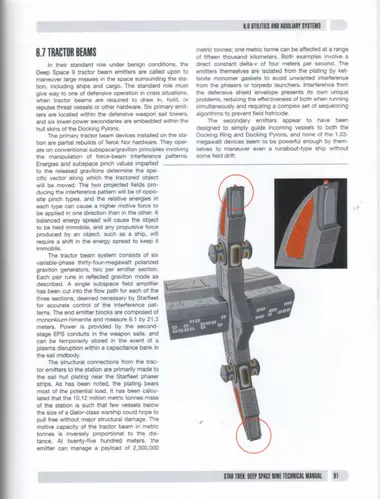
In their standard role under benign conditions, the Deep Space 9 tractor beam emitters are called upon to maneuver large masses in the space surrounding the station, including ships and cargo. The standard role must give way to one of defensive operation in crisis situations, when tractor beams are required to draw in, hold, or repulse threat vessels or other hardware. Six primary emitters are located within the defensive weapon sail towers, and six lower-power secondaries are embedded within the hull skins of the Docking Pylons.
The primary tractor beam devices installed on the station are partial rebuilds of Terok Nor hardware. They operate on conventional subspace/graviton principles involving the manipulation of force-beam interference patterns. Energies and subspace pinch values imparted to the released gravitons determine the specific vector along which the tractored object will be moved. The two projected fields producing the interference pattern will be of opposite pinch types, and the relative energies in each type can cause a higher motive force to be applied in one direction than in the other. A balanced energy spread will cause the object to be held immobile, and any propulsive force produced by an object, such as a ship, will require a shift in the energy spread to keep it immobile.
The tractor beam system consists of six variable-phase thirty-four-megawatt polarized graviton generators, two per emitter section. Each pair runs in reflected graviton mode as described. A single subspace field amplifier has been cut into the flow path for each of the three sections, deemed necessary by Starfleet for accurate control of the interference patterns. The end emitter blocks are composed of mononkium-himenite and measure 6.1 by 21.3 meters. Power is provided by the second-stage EPS conduits in the weapon sails, and can be temporarily stored in the event of a plasma disruption within a capacitance bank in the sail midbody.
The structural connections from the tractor emitters to the station are primarily made to the sail hull plating near the Starfleet phaser strips. As has been noted, the plating bears most of the potential load. It has been calculated that the 10.12 million metric tonnes mass of the station is such that few vessels below the size of a Galor-class warship could hope to pull free without major structural damage. The motive capacity of the tractor beam in metric tonnes is inversely proportional to the distance. At twenty-five hundred meters, the emitter can manage a payload of 2,300,000 metric tonnes; one metric tonne can be affected at a range of fifteen thousand kilometers. Both examples involve a direct constant delta-v of four meters per second. The emitters themselves are isolated from the plating by kettenite monomer gaskets to avoid unwanted interference from the phasers or torpedo launchers. Interference from the defensive shield envelope presents its own unique problems, reducing the effectiveness of both when running simultaneously and requiring a complex set of sequencing algorithms to prevent field fratricide.
The secondary emitters appear to have been designed to simply guide incoming vessels to both the Docking Ring and Docking Pylons, and none of the 1.03-megawatt devices seem to be powerful enough by themselves to maneuver even a runabout-type ship without some field drift.