6.8 Replicator Systems
Describes the industrial and food replicator systems aboard Deep Space 9, distinguishing the Starfleet-origin industrial replicators optimized for inorganic substances from the mostly Cardassian food replicators, the range of industrial replicator sizes including the large Starfleet unit at Utopia Planitia and the smaller transportable units on starbases and ships, the two replicators handed to the Bajoran government and four given to the Cardassian Union, the unit's dimensions, mass, and component assembly, the matter-conditioning and analysis of input elements, the periodic-scale-dependent power requirements and unreplicable substances such as latinum, the matrix algorithm processor and field manipulator that break and recombine molecular bonds in a localized subspace domain, the deuterium consumption and maintenance, and the limited effect of the replicators on the Bajoran industrial base.
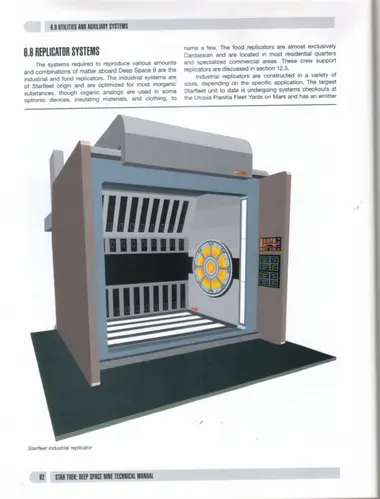
The systems required to reproduce various amounts and combinations of matter aboard Deep Space 9 are the industrial and food replicators. The industrial systems are of Starfleet origin and are optimized for most inorganic substances, though organic analogs are used in some optronic devices, insulating materials, and clothing, to name a few. The food replicators are almost exclusively Cardassian and are located in most residential quarters and specialized commercial areas. These crew support replicators are discussed in section 12.5.
Industrial replicators are constructed in a variety of sizes, depending on the specific application. The largest Starfleet unit to date is undergoing systems checkouts at the Utopia Planitia Fleet Yards on Mars and has an emitter delivery pad measuring 50.3 meters by 72.6 meters. The device is being considered to produce large starship framing assemblies. Smaller, transportable units have been installed on starbases and fleet vessels and are used mainly to produce original and replacement hardware for space and planetary operations.
Two industrial replicators have been handed over to the Bajoran government to aid in the planet's reconstruction following the Cardassian retreat. The units were supplied with an extensive built-in database of materials and structures and enough programmable isolinear memory for all possible near-term Bajoran requirements. Four additional industrial replicators were given to the Cardassian Union as a goodwill gesture, in 2372. Each unit measures 2.3 by 4.7 by 6.1 meters and masses 12.4 metric tonnes. The complete assembly includes two matter-input conditioners, a molecular-matrix algorithm processor, matter-assembly field manipulator, matrix-beam emitter, central memory-storage bank, and power supply. The matter conditioners accept material in all states, and sensors within these sections detect and analyze the elements and compounds being received. A comparison between the input and output matter as to atomic weights and numbers will determine the power requirements for the particular transformations requested. Substances closely related on the periodic scale (Standard, Extended 1, and Extended 2) will require less raw power than those which are not. Some materials included in the Extended 3 and 4 scales, including latinum ditensenide, will not replicate due to their high false-vacuum energy potential. No replication technology either existing or predicted is able to detect the exact proportion of matter in latinum existing in present four-space.
The matrix algorithm processor prepares the mathematical template of quantum states of the atoms in the item to be replicated and reads this template off in real-time to the matter assembly field manipulator. If the template exists in the database, it is read from isolinear storage. The field manipulator uses the allocated power determined by the processor to alternately break and recombine the molecular and atomic bonds of the input matter into the final replicated forms. The quantum resolution is variable; most inorganic objects require a less precise reconstruction than that required for edible foodstuffs. Structural density is also variable and is useful in research or test replications. The field manipulator works in concert with the beam emitter to perform the final molecular assembly on the delivery pad. Once the basic form of the object is locked, the transformed elements and compounds are added until the correct density is reached. The early stages of the assembly are conducted in a localized subspace domain, which is ramped down to a final emergence into normal four-space.
The units supplied to the Bajorans consume an average of 3.41 kilograms of deuterium per minute operating time. The system is primarily self-maintained by onboard diagnostic and test gear. Major hardware alignments and replacements can be accomplished by Bajoran engineers, with yearly checks by Starfleet personnel. The arrival of the replicators has not significantly altered the Bajoran industrial base and has not produced a cascade of replicated products, including the often-assumed prospect for additional replicators. The total energy budget required for operation is high enough to offset the continuous use of the mechanisms and, in most cases, traditional fabrication methods prove more economically viable.