7.1 Intrastation Communications
Describes the two primary intrastation com systems for commercial and Starfleet traffic, the dedicated ODN data line and RF backup hardware configuration, the construction of the Cardassian and Starfleet terminal node devices, and the voice operation protocols routed through the CPG.
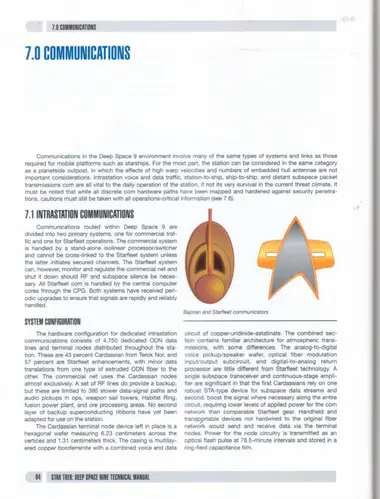
Communications routed within Deep Space 9 are divided into two primary systems, one for commercial traffic and one for Starfleet operations. The commercial system is handled by a stand-alone isolinear processor/switcher and cannot be cross-linked to the Starfleet system unless the latter initiates secured channels. The Starfleet system can, however, monitor and regulate the commercial net and shut it down should RF and subspace silence be necessary. All Starfleet com is handled by the central computer cores through the CPG. Both systems have received periodic upgrades to ensure that signals are rapidly and reliably handled.
System Configuration
The hardware configuration for dedicated intrastation communications consists of 4,750 dedicated ODN data lines and terminal nodes distributed throughout the station. These are 43 percent Cardassian from Terok Nor, and 57 percent are Starfleet enhancements, with minor translations from one type of extruded ODN fiber to the other. The commercial net uses the Cardassian nodes almost exclusively. A set of RF lines do provide a backup, but these are limited to 395 slower data-signal paths and audio pickups in ops, weapon sail towers, Habitat Ring, fusion power plant, and ore processing areas. No second layer of backup superconducting ribbons have yet been adapted for use on the station.
The Cardassian terminal node device left in place is a hexagonal wafer measuring 6.23 centimeters across the vertices and 1.31 centimeters thick. The casing is multilayered copper boroferrenite with a combined voice and data circuit of copper-uridinide-astatinate. The combined section contains familiar architecture for atmospheric transmissions, with some differences. The analog-to-digital voice pickup/speaker wafer, optical fiber modulation input/output subcircuit, and digital-to-analog return processor are little different from Starfleet technology. A single subspace transceiver and continuous-stage amplifier are significant in that the first Cardassians rely on one robust STA-type device for subspace data streams and second, boost the signal where necessary along the entire circuit, requiring lower levels of applied power for the com network than comparable Starfleet gear. Handheld and transportable devices not hardwired to the original fiber network would send and receive data via the terminal nodes. Power for the node circuitry is transmitted as an optical flash pulse at 78.5-minute intervals and stored in a ring-field capacitance film.
The Starfleet terminal node modification is an upgraded disk device reduced to 7.53 centimeters in diameter and 1.2 centimeters thick. The casing remains molded polykelyurium, and the internal arrangement continues with separate voice and data section architecture. The data relay section now contains three nested circuits within a standard STA for increased capacity and transmission speed.
Operation
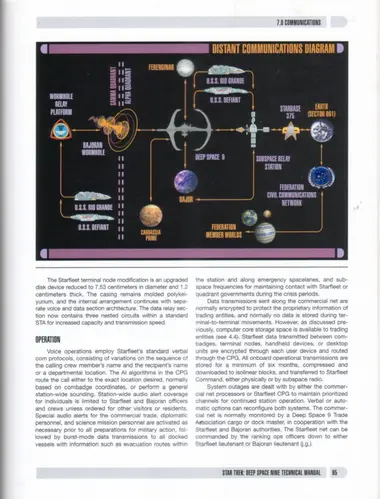
Voice operations employ Starfleet's standard verbal com protocols, consisting of variations on the sequence of the calling crew member's name and the recipient's name or a departmental location. The AI algorithms in the CPG route the call either to the exact location desired, normally based on combadge coordinates, or perform a generic station-wide sounding. Station-wide audio alert coverage for individuals is limited to Starfleet and Bajoran officers and crews unless ordered for other visitors or residents. Special audio alerts for the commercial trade, diplomatic personnel, and science mission personnel are activated as necessary prior to all preparations for military action, followed by burst-mode data transmissions to all docked vessels with information such as evacuation routes within the station and along emergency spacelanes, and subspace frequencies for maintaining contact with Starfleet or quadrant governments during the crisis periods.
Data transmissions sent along the commercial net are normally encrypted to protect the proprietary information of trading entities, and normally no data is stored during terminal-to-terminal movements. However, as discussed previously, computer core storage space is available to trading entities (see 4.4). Starfleet data transmitted between com units are encrypted through each user device and routed through the CPG. All onboard operational transmissions are stored for a minimum of six months, compressed and downloaded to isolinear blocks, and transferred to Starfleet Command, either physically or by subspace radio.
System outages are dealt with by either the commercial net processors or Starfleet CPG to maintain prioritized channels for continued station operation. Verbal or automatic options can reconfigure both systems. The commercial net is normally monitored by a Deep Space 9 Trade Association cargo or dock master, in cooperation with the Starfleet and Bajoran authorities. The Starfleet net can be commanded by the ranking ops officers down to either Starfleet lieutenant or Bajoran lieutenant (j.g.).