11.2 Atmospheric System
Describes the oxygen-nitrogen atmospheric system aboard Deep Space 9, including its nominal pressure, temperature, humidity, and composition values, the retained Cardassian charged-stream airflow units and their operation, the silenced inflow and return ducting, crowd-control gas provisions, the carbon dioxide scrubbing and gas recovery of the return airflow, and the emergency supplies and procedures for isolating sections, controlling breathing gas, and supporting personnel during decompression with EPG and CASM hardware.
Like most class-M-compatible systems aboard starships and starbases, the atmospheric system aboard Deep Space 9 maintains an oxygen-nitrogen atmosphere at a prescribed pressure, temperature, and humidity. Nominal atmospheric values for the common areas of the station differs slightly from Starfleet Standard 102.19, at 25° Celsius, 45% relative humidity, with pressure maintained at 99.7 kilopascals (748 millimeters of mercury). Atmospheric composition also differs, to accommodate most Bajoran nationals, at 77% nitrogen, 21% oxygen, and 2% trace gases, mostly argon, helium, and xenon. The new conditions have been added to the SFRA database as Standard 104.12.
All of the original Cardassian charged-stream airflow units remain in place with minor modifications to the electrostatic grids with Starfleet EPS regulators. The grid devices temporarily charge the air in the unit, apply a motive force to the air mass via an eight-stage magnetic coil assembly, and recycle the charge before the gases leave the unit. The overall exit pressure is regulated by a combination of physical constrictor valves and magnetic-coil power level. Large units in the core assemblies, Habitat Ring, and Docking Ring are designed to handle up to 80 m³ per minute. Smaller units can move up to 43 m³ per minute. The air handlers also control temperature and humidity via a series of EPS warmers and chillers, and water vaporizers and dehumidifiers. Supply gas analyzers check the safety of the air being transferred. Temperature and humidity levels are computer controlled by room, section, level, or entire assembly, and most areas can be configured by voice command. Specific areas requiring critical environmental control are configurable only by authorized crew members.
Silenced inflow vents are present in all habitable spaces and are organized upstream into ducting from 8.3 centimeters across to as large as 1.2 meters across. Return ducting is similar in size and organization; in some cases, both directions are handled within a single divided duct. Most ducting is protected from outgassing migration from adjacent systems as well as resistant to medium-level radiation effects. Additions of stored gas can be made at computer-controlled valve inputs along the ducting or incorporated into the airflow handlers. Some provisions were made for crowd control gas input, using anesthezine analogs. These input ports were located mainly in the Promenade, Lower Core, and ore processing facilities in the pylons.
Return airflow enters the system via the return vent plates in most areas. Prior to being reintroduced into the supply ducting, the air within each loop is channeled through a carbon dioxide scrubber, return gas analyzer, suspended particulate filter, and organics removal grid. Waste gases are separated by molecular type, condensed, liquefied, and either stored or vented overboard. In some cases, molecularly bound oxygen and nitrogen is uncoupled and returned to the general breathing gas supply.
Emergency Supplies and Procedures
In emergency conditions, designated sections of the station can be isolated as emergency shelters, a practice that has worked well with most starbases and fleet vessels. Supply and return ducting can be closed off for a number of possible scenarios, either preventing unwanted flow into an area or preventing atmosphere from escaping. Inbound flows containing chemical or biological agents can be stopped automatically or by crew command. Hull breaches in adjacent sections, through which air can escape, can be closed off by a combination of barometrically activated valves and force fields.
Controlled breathing gas infusions can be accessed by console, padd, or voice command, or with manual valves. Scrubbers and overboard pressure-relief valves for each emergency shelter can also be activated by the same methods. Because the total station atmospheric volume versus interior pressure is high, most predicted decompression dangers will allow crew and residents up to two hours to head to shelters or evacuation spacecraft. This is more than adequate time for repair crews to converge on the breach internally with EVA suits and externally with Work Bee pods (see 14.3).
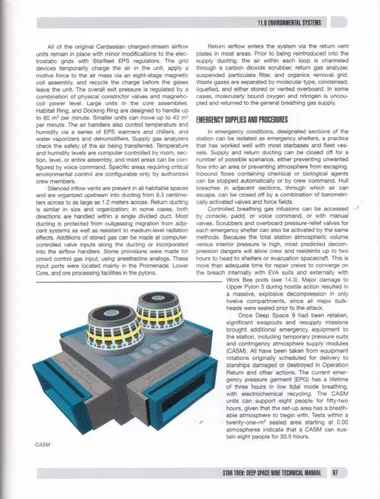
Major damage to Upper Pylon 3 during hostile action resulted in a massive, explosive decompression in only twelve compartments, since all major bulkheads were sealed prior to the attack. Once Deep Space 9 had been retaken, significant swapouts and resupply missions brought additional emergency equipment to the station, including temporary pressure suits and contingency atmosphere supply modules (CASM). All have been taken from equipment rotations originally scheduled for delivery to starships damaged or destroyed in Operation Return and other actions. The current emergency pressure garment (EPG) has a lifetime of three hours in low tidal mode breathing, with electrochemical recycling. The CASM units can support eight people for fifty-two hours, given that the set-up area has a breathable atmosphere to begin with. Tests within a twenty-one-m³ sealed area starting at 0.00 atmospheres indicate that a CASM can sustain eight people for 30.5 hours.