5.3 Power Distribution Network
Details how fusion power is distributed through 651 stepped-energy EPS conduits feeding the station's major and minor subsystems, describing the first-stage toranium-durmanite conduits and their one-way plasma flow constrictors, the second- and third-stage branches routing power to weapons, shields, and ore processing, the fourth- and fifth-stage user grid and step-down conduits, the higher-energy holosuite plasma, and the installation, loss, and replacement of Starfleet power-conditioning equipment along with planned upgrades.
Fusion power produced by the large central generators is distributed through the station over a series of 651 stepped-energy EPS conduits feeding all 24 major and 53 minor subsystems. The first-stage conduits, formed from multilayer toranium-durmanite, measure 1.89 meters in diameter and 1,103.62 meters in length. They emerge from the six fusion energy chambers and are controlled by a set of five one-way plasma flow constrictors. These devices act as baffles to prevent frequent reaction surges in the fusion generators from affecting downstream segments of the system, including the final-stage user grid. By the time the plasma has reached the fifth constrictor, the temperature has been stabilized at 215,000 kelvins and remains at that level throughout the first three energy steps. Plasma flow controllers and cross-feeds link all six first-stage conduits in the event of power drains or unbalanced demand, particularly evident in weapon and shield usage.
External to the fusion generator housing, six second-stage EPS conduits carry energy outboard of the generator's structural attach point on the Lower Core. They average 1.09 meters in diameter and are 85.23 meters in length. It is known that the individual conduits were spread out in a measure to minimize damage in the event of hostile action or catastrophic failure, which might have jeopardized the entire station had the conduits been clustered together. The second-stage conduits are also fabricated from toranium-durmanite and are hardened against radiation interference and structural impacts. The main subassemblies of each conduit include an energy polarization bed, emergency venting and cooling jackets, and flow accelerator coils to maintain directional plasma pressure toward critical systems.
The junctions to the third-stage conduits split to form eighteen large and twenty-seven smaller branches within the Lower Core and up into the Mid-Core. Nine of the large EPS branches spread out within the Mid-Core and reconverge at the minor crossover bridges to power the weapon sail towers and defensive shield generators directly. Another nine take different paths within the Mid-Core to power the ore processing centers in the pylons. The twenty-seven smaller branches, moving lower-temperature and lower-pressure plasma, form the multiuse pregrid for the Docking Ring, Habitat Ring, Promenade, and ops. One hundred sixty-two fourth-stage conduits carry power from the pregrid to plasma circuitry junctions, through embedded wall nets and access tunnels in all areas of the station. The majority of fourth-stage conduits terminate in multiphase alternating-current taps, and are available for most medium to heavy industrial applications. Induction-type user equipment requiring up to 8,192 kelvin plasma make use of fifth-stage step-down conduits within residences, laboratories, cargo bays, commercial facilities, and offices. Holosuites are an exception, utilizing higher-energy 12,500 kelvin plasma for their operation.
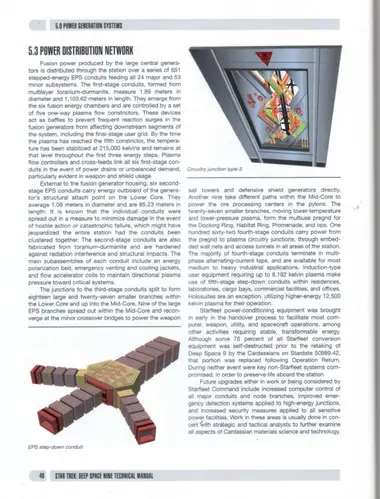
Starfleet power-conditioning equipment was brought in early in the handover process to facilitate most computer, weapon, utility, and spacecraft operations, among other activities requiring stable, transformable energy. Although some 75 percent of all Starfleet conversion equipment was self-destructed prior to the retaking of Deep Space 9 by the Cardassians on Stardate 50989.42, that portion was replaced following Operation Return. During neither event were key non-Starfleet systems compromised, in order to preserve life aboard the station. Future upgrades either in work or being considered by Starfleet Command include increased computer control of all major conduits and node branches, improved emergency detection systems applied to high-energy junctions, and increased security measures applied to all sensitive power facilities. Work in these areas is usually done in concert with strategic and tactical analysts to further examine all aspects of Cardassian materials science and technology.