10.7 Specialized Ordnance
Describes the self-replicating mine developed at the Deep Space 9 weapons facilities, including its origin with Rom and its deployment against the impending Jem'Hadar invasion in 2373, its cargo-container shell and stripped-down photon-torpedo warhead with toroidal magnetic field driver, its station-keeping thrusters and neutrino-source counter, its replicator system and bucket-brigade mass distribution with zero-point vacuum replenishment, and the eventual takedown of the minefield by antigraviton beams under Gul Dukat's control.
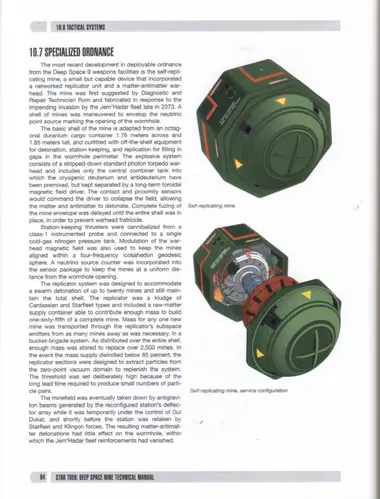
The most recent development in deployable ordnance from the Deep Space 9 weapons facilities is the self-replicating mine, a small but capable device that incorporated a networked replicator unit and a matter-antimatter warhead. The mine was first suggested by Diagnostic and Repair Technician Rom and fabricated in response to the impending invasion by the Jem'Hadar fleet late in 2373. A shell of mines was maneuvered to envelop the neutrino point source marking the opening of the wormhole.
The basic shell of the mine is adapted from an octagonal duranium cargo container 1.76 meters across and 1.85 meters tall, and outfitted with off-the-shelf equipment for detonation, station keeping, and replication for filling in gaps in the wormhole perimeter. The explosive system consists of a stripped-down standard photon torpedo warhead and includes only the central combiner tank into which the cryogenic deuterium and antideuterium have been premixed, but kept separated by a long-term toroidal magnetic field driver. The contact and proximity sensors would command the driver to collapse the field, allowing the matter and antimatter to detonate. Complete fuzing of the mine envelope was delayed until the entire shell was in place, in order to prevent warhead fratricide.
Station-keeping thrusters were cannibalized from a class-1 instrumented probe and connected to a single cold-gas nitrogen pressure tank. Modulation of the warhead magnetic field was also used to keep the mines aligned within a four-frequency icosahedron geodesic sphere. A neutrino source counter was incorporated into the sensor package to keep the mines at a uniform distance from the wormhole opening.
The replicator system was designed to accommodate a swarm detonation of up to twenty mines and still maintain the total shell. The replicator was a kludge of Cardassian and Starfleet types and included a raw-matter supply container able to contribute enough mass to build one-sixty-fifth of a complete mine. Mass for any one new mine was transported through the replicator's subspace emitters from as many mines away as was necessary, in a bucket-brigade system. As distributed over the entire shell, enough mass was stored to replace over 2,500 mines. In the event the mass supply dwindled below 85 percent, the replicator sections were designed to extract particles from the zero-point vacuum domain to replenish the system. The threshold was set deliberately high because of the long lead time required to produce small numbers of particle pairs.
The minefield was eventually taken down by antigraviton beams generated by the reconfigured station's deflector array while it was temporarily under the control of Gul Dukat, and shortly before the station was retaken by Starfleet and Klingon forces. The resulting matter-antimatter detonations had little effect on the wormhole, within which the Jem'Hadar fleet reinforcements had vanished.