10.2 Photon Torpedoes and Operations
Covers the photon torpedo carried aboard Deep Space 9, including its role in warp-velocity combat and nonstandard warhead delivery, its largely unchanged external configuration and updated casing dimensions and yield, its internal components and warp sustainer range, and the station's twelve sail-tower launchers, reactant loading and magazine storage, command-and-targeting handoff, volley and reload performance, and modified defensive subroutines for stationary launch.
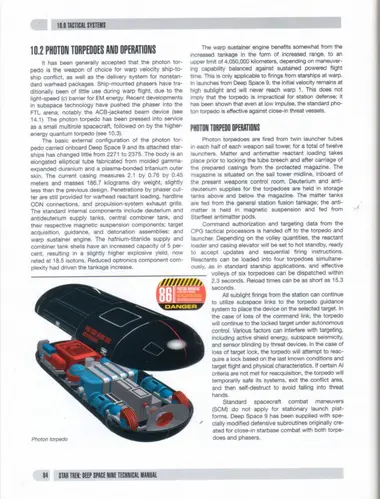
It has been generally accepted that the photon torpedo is the weapon of choice for warp velocity ship-to-ship conflict, as well as the delivery system for nonstandard warhead packages. Ship-mounted phasers have traditionally been of little use during warp flight, due to the light-speed (c) barrier for EM energy. Recent developments in subspace technology have pushed the phaser into the FTL arena, notably the ACB-jacketed beam device (see 14.1). The photon torpedo has been pressed into service as a small multirole spacecraft, followed on by the higher-energy quantum torpedo (see 10.3).
The basic external configuration of the photon torpedo carried onboard Deep Space 9 and its attached starships has changed little from 2271 to 2375. The body is an elongated elliptical tube fabricated from molded gamma-expanded duranium and a plasma-bonded tritanium outer skin. The current casing measures 2.1 by 0.76 by 0.45 meters and masses 186.7 kilograms dry weight, slightly less than the previous design. Penetrations by phaser cutter are still provided for warhead reactant loading, hardline ODN connections, and propulsion-system exhaust grills. The standard internal components include deuterium and antideuterium supply tanks, central combiner tank, and their respective magnetic suspension components; target acquisition, guidance, and detonation assemblies; and warp sustainer engine. The hafnium-titanide supply and combiner tank shells have an increased capacity of 5 percent, resulting in a slightly higher explosive yield, now rated at 18.5 isotons. Reduced optronics component complexity had driven the tankage increase.
The warp sustainer engine benefits somewhat from the increased tankage in the form of increased range, to an upper limit of 4,050,000 kilometers, depending on maneuvering capability balanced against sustained powered flight time. This is only applicable to firings from starships at warp. In launches from Deep Space 9, the initial velocity remains at high sublight and will never reach warp 1. This does not imply that the torpedo is impractical for station defense; it has been shown that even at low impulse, the standard photon torpedo is effective against close-in threat vessels.
Photon Torpedo Operations
Photon torpedoes are fired from twin launcher tubes in each half of each weapon sail tower, for a total of twelve launchers. Matter and antimatter reactant loading takes place prior to locking the tube breech and after carriage of the prepared casings from the protected magazine. The magazine is situated on the sail tower midline, inboard of the present weapons control room. Deuterium and antideuterium supplies for the torpedoes are held in storage tanks above and below the magazine. The matter tanks are fed from the general station fusion tankage; the antimatter is held in magnetic suspension and fed from Starfleet antimatter pods.
Command authorization and targeting data from the CPG tactical processors is handed off to the torpedo and launcher. Depending on the volley quantities, the reactant loader and casing elevator will be set to hot standby, ready to accept updates and sequential firing instructions. Reactants can be loaded into four torpedoes simultaneously, as in standard starship applications, and effective volleys of six torpedoes can be dispatched within 2.3 seconds. Reload times can be as short as 15.3 seconds.
All sublight firings from the station can continue to utilize subspace links to the torpedo guidance system to place the device on the selected target. In the case of loss of the command link, the torpedo will continue to the locked target under autonomous control. Various factors can interfere with targeting, including active shield energy, subspace seismicity, and sensor blinding by threat devices. In the case of loss of target lock, the torpedo will attempt to reacquire a lock based on the last known conditions and target flight and physical characteristics. If certain AI criteria are not met for reacquisition, the torpedo will temporarily safe its systems, exit the conflict area, and then self-destruct to avoid falling into threat hands.
Standard spacecraft combat maneuvers (SCM) do not apply for stationary launch platforms. Deep Space 9 has been supplied with specially modified defensive subroutines originally created for close-in starbase combat with both torpedoes and phasers.