14.1 U.S.S. Defiant
Describes the U.S.S. Defiant, a heavily armored limited-role escort developed in response to the Borg threat, covering its mission objectives, spacecraft structures, command, computer, propulsion, science, tactical, utility, communications, transporter, environmental, crew-support, auxiliary-craft, flight, and emergency systems.
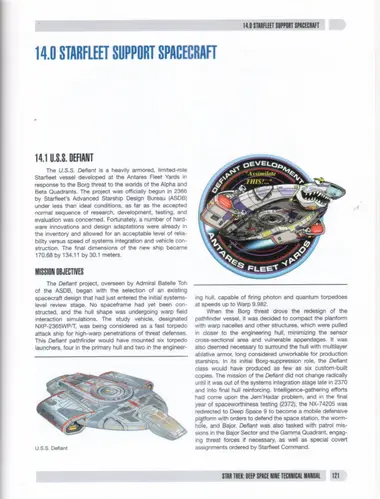
The U.S.S. Defiant is a heavily armored, limited-role Starfleet vessel developed at the Antares Fleet Yards in response to the Borg threat to the worlds of the Alpha and Beta Quadrants. The project was officially begun in 2366 by Starfleet's Advanced Starship Design Bureau (ASDB) under less than ideal conditions, as far as the accepted normal sequence of research, development, testing, and evaluation was concerned. Fortunately, a number of hardware innovations and design adaptations were already in the inventory and allowed for an acceptable level of reliability versus speed of systems integration and vehicle construction. The final dimensions of the new ship became 170.68 by 134.11 by 30.1 meters.
Mission Objectives
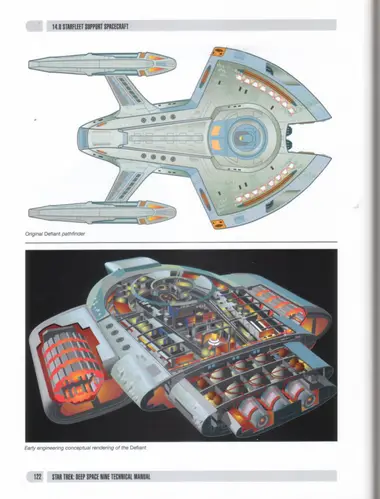
The Defiant project, overseen by Admiral Batelle Toh of the ASDB, began with the selection of an existing spacecraft design that had just entered the initial systems-level review stage. No spaceframe had yet been constructed, and the hull shape was undergoing warp field interaction simulations. The study vehicle, designated NXP-2365WP/T, was being considered as a fast torpedo attack ship for high-warp penetrations of threat defenses. This Defiant pathfinder would have mounted six torpedo launchers, four in the primary hull and two in the engineering hull, capable of firing photon and quantum torpedoes at speeds up to Warp 9.982.
When the Borg threat drove the redesign of the pathfinder vessel, it was decided to compact the planform with warp nacelles and other structures, which were pulled in closer to the engineering hull, minimizing the sensor cross-sectional area and vulnerable appendages. It was also deemed necessary to surround the hull with multilayer ablative armor, long considered unworkable for production starships. In its initial Borg-suppression role, the Defiant class would have produced as few as six custom-built copies. The mission of the Defiant did not change radically until it was out of the systems integration stage late in 2370 and into final hull reinforcing. Intelligence-gathering efforts had come upon the Jem'Hadar problem, and in the final year of spaceworthiness testing (2372), the NX-74205 was redirected to Deep Space 9 to become a mobile defensive platform with orders to defend the space station, the wormhole, and Bajor. Defiant was also tasked with patrol missions in the Bajor Sector and the Gamma Quadrant, engaging threat forces if necessary, as well as special covert assignments ordered by Starfleet Command.
Spacecraft Structures
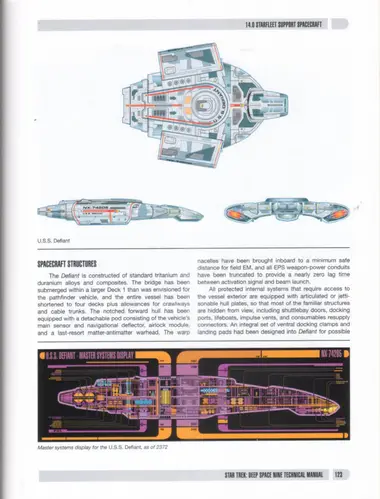
The Defiant is constructed of standard tritanium and duranium alloys and composites. The bridge has been submerged within a larger Deck 1 than was envisioned for the pathfinder vehicle, and the entire vessel has been shortened to four decks plus allowances for crawlways and cable trunks. The notched forward hull has been equipped with a detachable pod consisting of the vehicle's main sensor and navigational deflector, airlock module, and a last-resort matter-antimatter warhead. The warp nacelles have been brought inboard to a minimum safe distance for field EM, and all EPS weapon-power conduits have been truncated to provide a nearly zero lag time between activation signal and beam launch.
All protected internal systems that require access to the vessel exterior are equipped with articulated or jettisonable hull plates, so that most of the familiar structures are hidden from view, including shuttlebay doors, docking ports, lifeboats, impulse vents, and consumables resupply connectors. An integral set of ventral docking clamps and landing pads had been designed into Defiant for possible ditching operations as well as for recoverable planetary landings. No practical demonstration has been attempted, though simulations indicate that if the impulse and reaction control thrusters are fully operational, a successful liftoff to orbital velocity is likely.
Command Systems
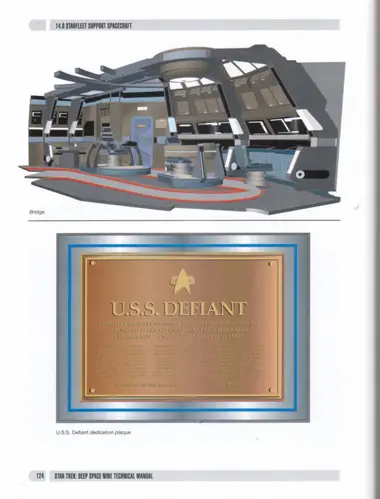
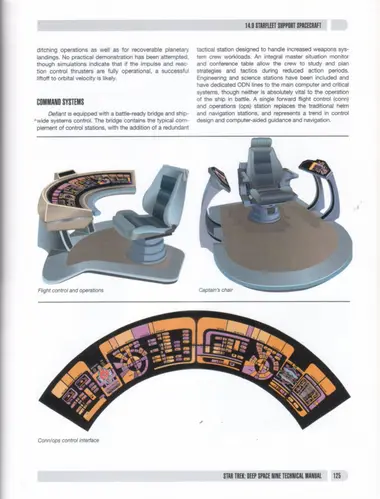
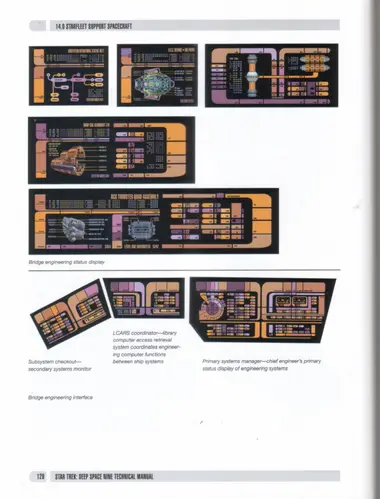
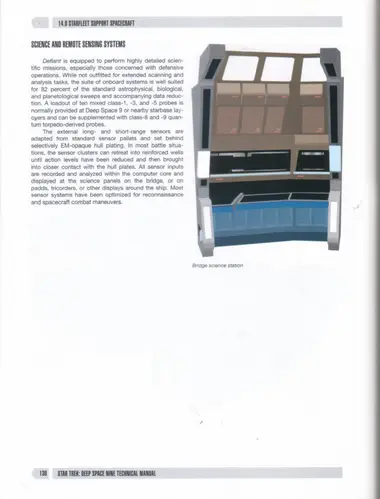
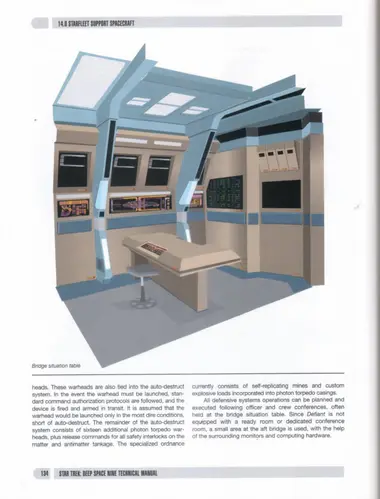
Defiant is equipped with a battle-ready bridge and ship-wide systems control. The bridge contains the typical complement of control stations, with the addition of a redundant tactical station designed to handle increased weapons system crew workloads. An integral master situation monitor and conference table allow the crew to study and plan strategies and tactics during reduced action periods. Engineering and science stations have been included and have dedicated ODN lines to the main computer and critical systems, though neither is absolutely vital to the operation of the ship in battle. A single forward flight control (conn) and operations (ops) station replaces the traditional helm and navigation stations, and represents a trend in control design and computer-aided guidance and navigation.
Computer Systems
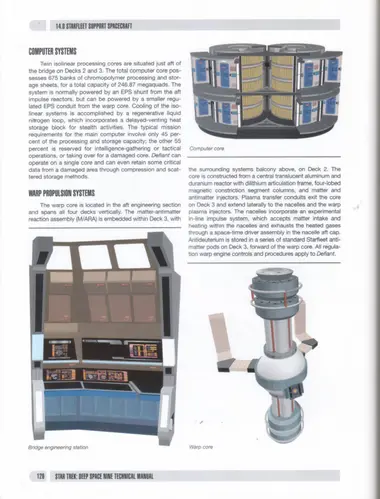
Twin isolinear processing cores are situated just aft of the bridge on Decks 2 and 3. The total computer core possesses 675 banks of chromopolymer processing and storage sheets, for a total capacity of 246.87 megaquads. The system is normally powered by an EPS shunt from the aft impulse reactors, but can be powered by a smaller regulated EPS conduit from the warp core. Cooling of the isolinear systems is accomplished by a regenerative liquid nitrogen loop, which incorporates a delayed-venting heat storage block for stealth activities. The typical mission requirements for the main computer involve only 45 percent of the processing and storage capacity; the other 55 percent is reserved for intelligence-gathering or tactical operations, or taking over for a damaged core. Defiant can operate on a single core and can even retain some critical data from a damaged area through compression and scattered storage methods.
Warp Propulsion Systems
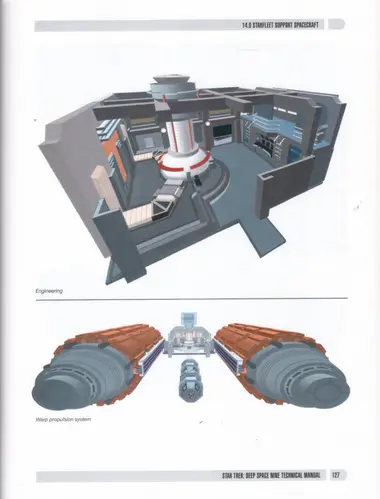
The warp core is located in the aft engineering section and spans all four decks vertically. The matter-antimatter reaction assembly (M/ARA) is embedded within Deck 3, with the surrounding systems balcony above, on Deck 2. The core is constructed from a central translucent aluminum and duranium reactor with dilithium articulation frame, four-lobed magnetic constriction segment columns, and matter and antimatter injectors. Plasma transfer conduits exit the core on Deck 3 and extend laterally to the nacelles and the warp plasma injectors. The nacelles incorporate an experimental in-line impulse system, which accepts matter intake and heating within the nacelles and exhausts the heated gases through a space-time driver assembly in the nacelle aft cap. Antideuterium is stored in a series of standard Starfleet antimatter pods on Deck 3, forward of the warp core. All regulation warp engine controls and procedures apply to Defiant.
Impulse Propulsion Systems
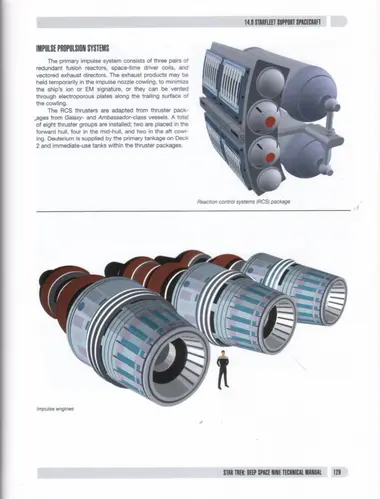
The primary impulse system consists of three pairs of redundant fusion reactors, space-time driver coils, and vectored exhaust directors. The exhaust products may be held temporarily in the impulse nozzle cowling, to minimize the ship's ion or EM signature, or they can be vented through electroporous plates along the trailing surface of the cowling.
The RCS thrusters are adapted from thruster packages from Galaxy- and Ambassador-class vessels. A total of eight thruster groups are installed; two are placed in the forward hull, four in the mid-hull, and two in the aft cowling. Deuterium is supplied by the primary tankage on Deck 2 and immediate-use tanks within the thruster packages.
Science and Remote Sensing Systems
Defiant is equipped to perform highly detailed scientific missions, especially those concerned with defensive operations. While not outfitted for extended scanning and analysis tasks, the suite of onboard systems is well suited for 82 percent of the standard astrophysical, biological, and planetological sweeps and accompanying data reduction. A loadout of ten mixed class-1, -3, and -5 probes is normally provided at Deep Space 9 or nearby starbase layovers and can be supplemented with class-8 and -9 quantum torpedo-derived probes.
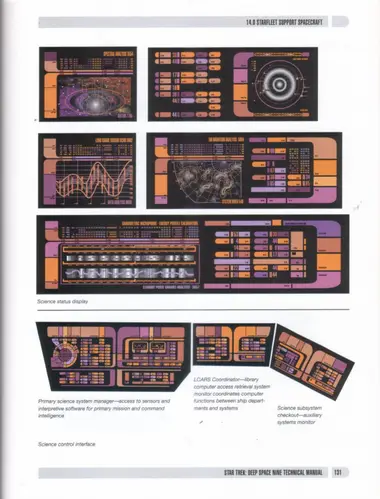
The external long- and short-range sensors are adapted from standard sensor pallets and set behind selectively EM-opaque hull plating. In most battle situations, the sensor clusters can retreat into reinforced wells until action levels have been reduced and then brought into closer contact with the hull plates. All sensor inputs are recorded and analyzed within the computer core and displayed at the science panels on the bridge, or on padds, tricorders, or other displays around the ship. Most sensor systems have been optimized for reconnaissance and spacecraft combat maneuvers.
Tactical Systems
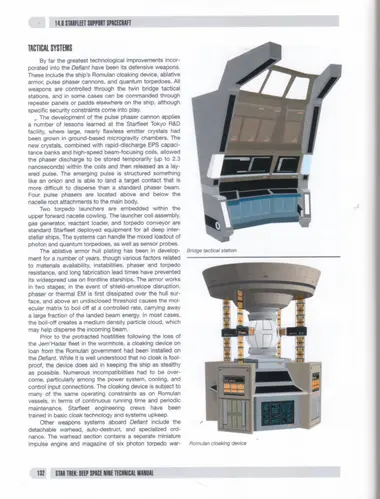
By far the greatest technological improvements incorporated into the Defiant have been its defensive weapons. These include the ship's Romulan cloaking device, ablative armor, pulse phaser cannons, and quantum torpedoes. All weapons are controlled through the twin bridge tactical stations, and in some cases can be commanded through repeater panels or padds elsewhere on the ship, although specific security constraints come into play.
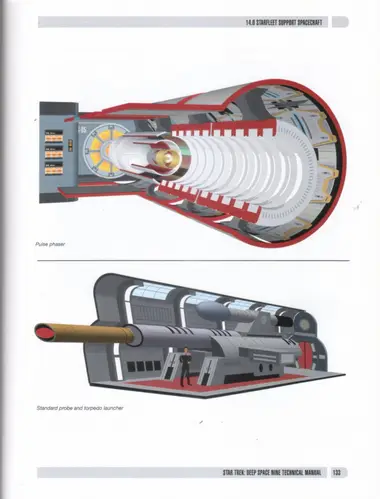
The development of the pulse phaser cannon applies a number of lessons learned at the Starfleet Tokyo R&D facility, where large, nearly flawless emitter crystals had been grown in ground-based microgravity chambers. The new crystals, combined with rapid-discharge EPS capacitance banks and high-speed beam-focusing coils, allowed the phaser discharge to be stored temporarily (up to 2.3 nanoseconds) within the coils and then released as a layered pulse. The emerging pulse is structured something like an onion and is able to land a target contact that is more difficult to disperse than a standard phaser beam. Four pulse phasers are located above and below the nacelle root attachments to the main body.
Two torpedo launchers are embedded within the upper forward nacelle cowling. The launcher coil assembly, gas generator, reactant loader, and torpedo conveyor are standard Starfleet deployed equipment for all deep interstellar ships. The systems can handle the mixed loadout of photon and quantum torpedoes, as well as sensor probes.
The ablative armor hull plating has been in development for a number of years, though various factors related to materials availability, instabilities, phaser and torpedo resistance, and long fabrication lead times have prevented its widespread use on frontline starships. The armor works in two stages; in the event of shield-envelope disruption, phaser or thermal EM is first dissipated over the hull surface, and above an undisclosed threshold causes the molecular matrix to boil off at a controlled rate, carrying away a large fraction of the landed beam energy. In most cases, the boil-off creates a medium density particle cloud, which may help disperse the incoming beam.
Prior to the protracted hostilities following the loss of the Jem'Hadar fleet in the wormhole, a cloaking device on loan from the Romulan government had been installed on the Defiant. While it is well understood that no cloak is foolproof, the device does aid in keeping the ship as stealthy as possible. Numerous incompatibilities had to be overcome, particularly among the power system, cooling, and control input connections. The cloaking device is subject to many of the same operating constraints as on Romulan vessels, in terms of continuous running time and periodic maintenance. Starfleet engineering crews have been trained in basic cloak technology and systems upkeep.
Other weapons systems aboard Defiant include the detachable warhead, auto-destruct, and specialized ordnance. The warhead section contains a separate miniature impulse engine and magazine of six photon torpedo warheads. These warheads are also tied into the auto-destruct system. In the event the warhead must be launched, standard command authorization protocols are followed, and the device is fired and armed in transit. It is assumed that the warhead would be launched only in the most dire conditions, short of auto-destruct. The remainder of the auto-destruct system consists of sixteen additional photon torpedo warheads, plus release commands for all safety interlocks on the matter and antimatter tankage. The specialized ordnance currently consists of self-replicating mines and custom explosive loads incorporated into photon torpedo casings.
All defensive systems operations can be planned and executed following officer and crew conferences, often held at the bridge situation table. Since Defiant is not equipped with a ready room or dedicated conference room, a small area at the aft bridge is used, with the help of the surrounding monitors and computing hardware.
Utilities and Auxiliary Systems
All standard EPS, fluid transfer, ODN lines, atmospheric, and other energetic and consumable systems are installed aboard Defiant. The EPS conduits and ODN fiber bundles have been reinforced with jackets of multilayer woven polyduranium. Onboard gravity is provided by 153 improved stator-rotor gravity generators. Solid waste disposal is handled by compaction-desiccation units. Replicators are furnished for crew foodstuff and inorganic-object production, and are connected to raw matter and recycling tankage.
Cryogenic fuels are moved by standard magnetic-peristaltic conduits. Limited-capacity turbolifts provide access to key locations on the ship, primarily along its length. A small number of Jefferies tubes provide access to systems between and behind major compartments and deck structures.
Communications
All standard RF and subspace communications systems are installed, with additional capacity for narrow-beam and encrypted signal transmission and reception. Stealth com is possible through modulated impulse exhaust streams and navigational deflector beams. A set of three primary and three backup subspace distress beacons is provided for emergency use.
Transporter Systems
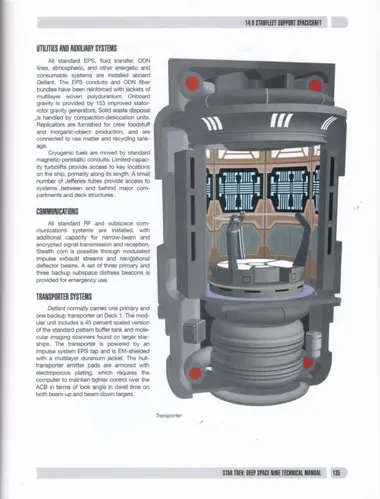
Defiant normally carries one primary and one backup transporter on Deck 1. The modular unit includes a 45 percent scaled version of the standard pattern buffer tank and molecular imaging scanners found on larger starships. The transporter is powered by an impulse system EPS tap and is EM-shielded with a multilayer duranium jacket. The hull-transporter emitter pads are armored with electroporous plating, which requires the computer to maintain tighter control over the ACB in terms of look angle in dwell time on both beam-up and beam-down targets.
Environmental Systems
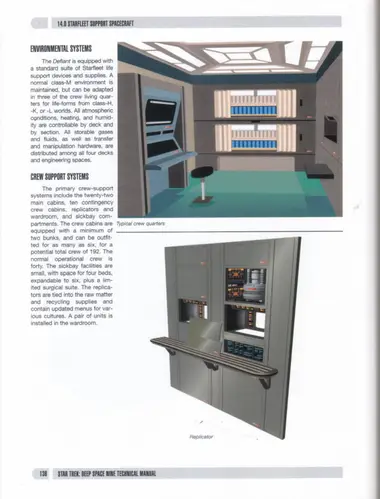
The Defiant is equipped with a standard suite of Starfleet life support devices and supplies. A normal class-M environment is maintained, but can be adapted in three of the crew living quarters for life-forms from class-H, -K, or -L worlds. All atmospheric conditions, heating, and humidity are controllable by deck and by section. All storable gases and fluids, as well as transfer and manipulation hardware, are distributed among all four decks and engineering spaces.
Crew Support Systems
The primary crew-support systems include the twenty-two main cabins, ten contingency crew cabins, replicators and wardroom, and sickbay compartments. The crew cabins are equipped with a minimum of two bunks, and can be outfitted for as many as six, for a potential total crew of 192. The normal operational crew is forty. The sickbay facilities are small, with space for four beds, expandable to six, plus a limited surgical suite. The replicators are tied into the raw matter and recycling supplies and contain updated menus for various cultures. A pair of units is installed in the wardroom.
Auxiliary Spacecraft Systems
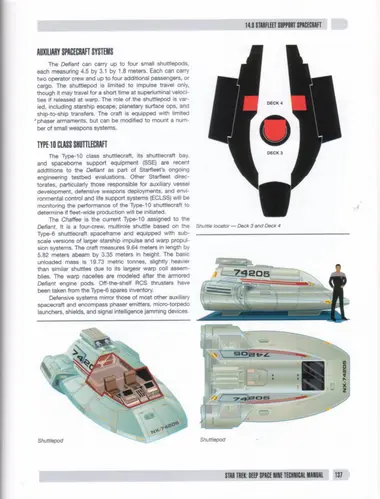
The Defiant can carry up to four small shuttlepods, each measuring 4.5 by 3.1 by 1.8 meters. Each can carry two operator crew and up to four additional passengers, or cargo. The shuttlepod is limited to impulse travel only, though it may travel for a short time at superluminal velocities if released at warp. The role of the shuttlepod is varied, including starship escape, planetary surface ops, and ship-to-ship transfers. The craft is equipped with limited phaser armaments, but can be modified to mount a number of small weapons systems.
Type-10 Class Shuttlecraft
The Type-10 class shuttlecraft, its shuttlecraft bay, and spaceborne support equipment (SSE) are recent additions to the Defiant as part of Starfleet's ongoing engineering testbed evaluations. Other Starfleet directorates, particularly those responsible for auxiliary vessel development, defensive weapons deployments, and environmental control and life support systems (ECLSS) will be monitoring the performance of the Type-10 shuttlecraft to determine if fleet-wide production will be initiated.
The Chaffee is the current Type-10 assigned to the Defiant. It is a four-crew, multirole shuttle based on the Type-6 shuttlecraft spaceframe and equipped with subscale versions of larger starship impulse and warp propulsion systems. The craft measures 9.64 meters in length by 5.82 meters abeam by 3.35 meters in height. The basic unloaded mass is 19.73 metric tonnes, slightly heavier than similar shuttles due to its larger warp coil assemblies. The warp nacelles are modeled after the armored Defiant engine pods. Off-the-shelf RCS thrusters have been taken from the Type-6 spares inventory.
Defensive systems mirror those of most other auxiliary spacecraft and encompass phaser emitters, micro-torpedo launchers, shields, and signal intelligence jamming devices. Onboard computer systems include a shortened version of the Danube-class runabout computer core, partitioned into five polled processor segments for optimum decision-making. Provisions have been made for bio-neural gel pack peripherals and upgrades.
Planetary landing systems include both fixed and deployable surface pads. All other required hardware, such as formation lights, emergency beacons, transporter, pressure suits, and surface survival packs, are present in this model.
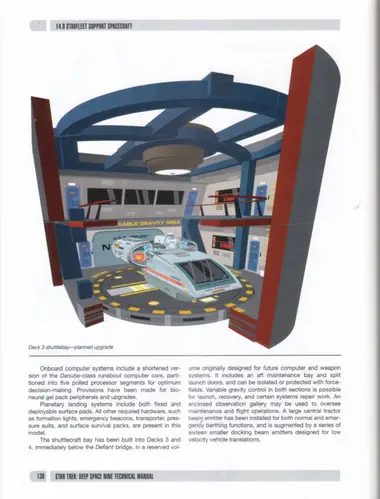
The shuttlecraft bay has been built into Decks 3 and 4, immediately below the Defiant bridge, in a reserved volume originally designed for future computer and weapon systems. It includes an aft maintenance bay and split launch doors, and can be isolated or protected with forcefields. Variable gravity control in both sections is possible for launch, recovery, and certain systems repair work. An enclosed observation gallery may be used to oversee maintenance and flight operations. A large central tractor beam emitter has been installed for both normal and emergency berthing functions, and is augmented by a series of sixteen smaller docking beam emitters designed for low velocity vehicle translations.
U.S.S. Defiant Flight Operations
All standard flight operational rules are in effect for Defiant, as a single, nonseparable interstellar vessel. The current mission types include tactical and defense, emergency and rescue, and secondary scientific investigations. The operating modes include cruise, yellow alert, red alert, external support, and reduced power.
Emergency Operations
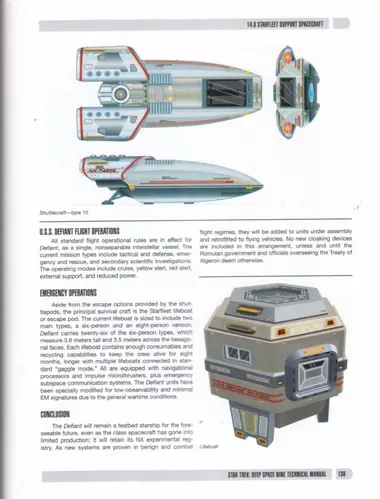
Aside from the escape options provided by the shuttlepods, the principal survival craft is the Starfleet lifeboat or escape pod. The current lifeboat is sized to include two main types, a six-person and an eight-person version. Defiant carries twenty-six of the six-person types, which measure 3.6 meters tall and 3.5 meters across the hexagonal faces. Each lifeboat contains enough consumables and recycling capabilities to keep the crew alive for eight months, longer with multiple lifeboats connected in standard "gaggle mode." All are equipped with navigational processors and impulse microthrusters, plus emergency subspace communication systems. The Defiant units have been specially modified for low-observability and minimal EM signatures due to the general wartime conditions.
Conclusion
The Defiant will remain a testbed starship for the foreseeable future, even as the class spacecraft has gone into limited production; it will retain its NX experimental registry. As new systems are proven in benign and combat flight regimes, they will be added to units under assembly and retrofitted to flying vehicles. No new cloaking devices are included in this arrangement, unless and until the Romulan government and officials overseeing the Treaty of Algeron deem otherwise.