9.2 Transporter Systems Operation
Describes the five stages of transport, the major system components, and the detailed beam-down autosequence timeline of a typical transporter operation.
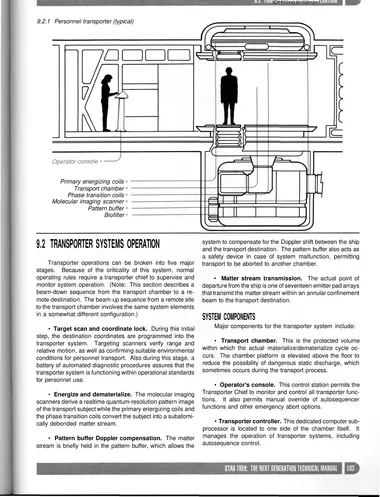
Transporter operations can be broken into five major stages. Because of the criticality of this system, normal operating rules require a transporter chief to supervise and monitor system operation. (Note: This section describes a beam-down sequence from the transport chamber to a remote destination. The beam-up sequence from a remote site to the transport chamber involves the same system elements in a somewhat different configuration.)
- Target scan and coordinate lock. During this initial step, the destination coordinates are programmed into the transporter system. Targeting scanners verify range and relative motion, as well as confirming suitable environmental conditions for personnel transport. Also during this stage, a battery of automated diagnostic procedures assures that the transporter system is functioning within operational standards for personnel use.
- Energize and dematerialize. The molecular imaging scanners derive a realtime quantum-resolution pattern image of the transport subject while the primary energizing coils and the phase transition coils convert the subject into a subatomically debonded matter stream.
- Pattern buffer Doppler compensation. The matter stream is briefly held in the pattern buffer, which allows the system to compensate for the Doppler shift between the ship and the transport destination. The pattern buffer also acts as a safety device in case of system malfunction, permitting transport to be aborted to another chamber.
- Matter stream transmission. The actual point of departure from the ship is one of seventeen emitter pad arrays that transmit the matter stream within an annular confinement beam to the transport destination.
System Components
Major components for the transporter system include:
- Transport chamber. This is the protected volume within which the actual materialize/dematerialize cycle occurs. The chamber platform is elevated above the floor to reduce the possibility of dangerous static discharge, which sometimes occurs during the transport process.
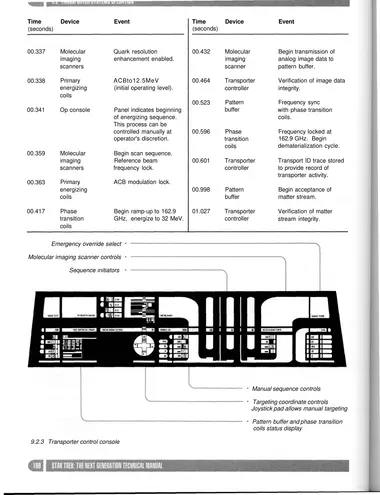
- Operator's console. This control station permits the Transporter Chief to monitor and control all transporter functions. It also permits manual override of autosequencer functions and other emergency abort options.
- Transporter controller. This dedicated computer subprocessor is located to one side of the chamber itself. It manages the operation of transporter systems, including autosequence control.
- Primary energizing coils. Located at the top of the transport chamber, these coils create the powerful Annular Confinement Beam (ACB), which creates a spatial matrix within which the materialize/dematerialize process occurs. A secondary field holds the transport subject within the ACB; this is a safety feature, as disruption of the ACB field during the early stages of dematerialization can result in a massive energy discharge.
- Phase transition coils. Located in the transport chamber platform. These wideband quark manipulation field devices accomplish the actual dematerialization/materialization process by partially decoupling the binding energy between subatomic particles. All personnel transporters are designed to operate at quantum resolution (necessary for successful transport of lifeforms). Cargo transporters are generally optimized at the more energy-efficient molecular resolution, but can also be set at quantum resolution if necessary.
- Molecular imaging scanners. Each upper pad incorporates four redundant sets of 0.0012µ molecular imaging scanners at 90° intervals around the primary pad axis. Error-checking routines permit any one scanner to be ignored if it disagrees with the other three. Failure of two or more scanners necessitates an automatic abort in the transport process. Each scanner is offset 3.5 arc seconds from the ACB axis, permitting realtime derivation of analog quantum state data using a series of dedicated Heisenberg compensators. Quantum state data are not used when transporters are operating in cargo (molecular resolution) mode.
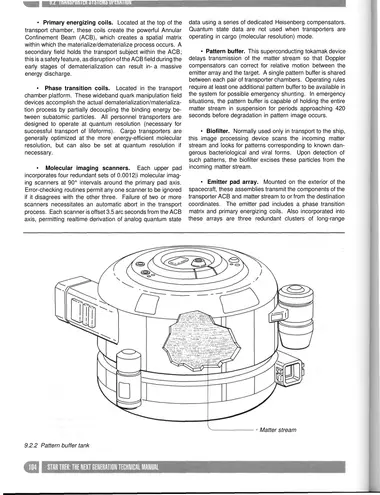
- Pattern buffer. This superconducting tokamak device delays transmission of the matter stream so that Doppler compensators can correct for relative motion between the emitter array and the target. A single pattern buffer is shared between each pair of transporter chambers. Operating rules require at least one additional pattern buffer to be available in the system for possible emergency shunting. In emergency situations, the pattern buffer is capable of holding the entire matter stream in suspension for periods approaching 420 seconds before degradation in pattern image occurs.
- Biofilter. Normally used only in transport to the ship, this image processing device scans the incoming matter stream and looks for patterns corresponding to known dangerous bacteriological and viral forms. Upon detection of such patterns, the biofilter excises these particles from the incoming matter stream.
- Emitter pad array. Mounted on the exterior of the spacecraft, these assemblies transmit the components of the transporter ACB and matter stream to or from the destination coordinates. The emitter pad includes a phase transition matrix and primary energizing coils. Also incorporated into these arrays are three redundant clusters of long-range virtual-focus molecular imaging scanners used during the beam-up process. Using phase inversion techniques, these emitters can also be used to transport subjects to and from coordinates within the habitable volume of the ship itself.
- Targeting scanners. A set of fifteen partially redundant sensor clusters located in the lateral, upper, and lower sensor arrays, these devices determine transporter coordinates, including bearing, range, and relative velocity to remote transport destinations. The targeting scanners also provide environmental information on the target site. Transport coordinates can also be determined using navigational, tactical, and communications scanners. For site-to-site intraship beaming, coordinates can be derived from interior sensors. Ship's personnel can be located for transport using communicators.
Transporter Operation Timeline
Transport operations require a large number of highly intricate procedures to be performed within milliseconds of one another, with extremely small margins for error. For this reason, much of the actual transport process is highly automated, although operating protocols generally require the supervision of a Transporter Chief. The operator will generally verify the coordinate lock and system readiness. The actual transport sequence is conducted by the autosequence programs of the transporter controller, under supervision of the operator.
Transporter autosequence major events for beamdown program (times are typical and vary with range and payload mass):