9.3 Instrumented Probes
Describes the inventory of instrumented probes carried aboard Deep Space 9, including class-1, class-4, and class-5 spacecraft and the stores to fabricate class-8 and class-9 probes, the periodic upgrades and secure delivery of probe systems, and detailed specifications of the class-1, combined class-5-type, and class-8 and class-9 warp probes, with comparisons drawn from a captured Cardassian probe.
The normal inventory of instrumented probes carried aboard Deep Space 9 includes class-1, class-4, and class-5 spacecraft. In addition, enough device stores and spares are maintained to fabricate class-8 and class-9 probes, which are based on the standard photon-torpedo casing (see 10.2). Experimental versions of class-8a and class-9a probes have undergone trials by Starfleet and have been declared provisionally operational. These are based on the quantum torpedo casing and take advantage of a higher delta-v sustainer engine rating (see 10.3).
All probe classes have received periodic upgrades by Starfleet's Defensive Weapons Development Laboratory. Systems allocations to Deep Space 9 have been delivered in either completed physical form or encrypted fabrication instruction form, for on-site manufacture at the station. Complete probes are off-loaded by starship or commercial freighter. Instructions for fabrication include onboard computer programming, numerical machining algorithms, and replicator formulae, and all data are transmitted over secure channels or delivered as protected isolinear memory blocks.
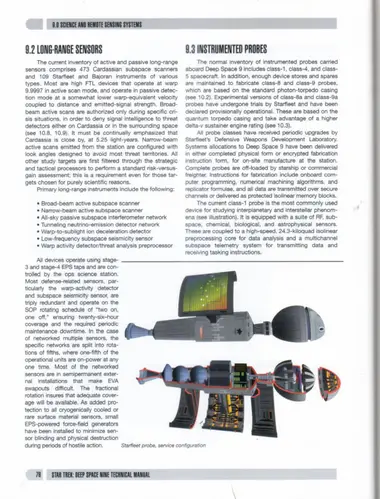
The current class-1 probe is the most commonly used device for studying interplanetary and interstellar phenomena (see illustration). It is equipped with a suite of RF, subspace, chemical, biological, and astrophysical sensors. These are coupled to a high-speed, 24.3-kiloquad isolinear preprocessing core for data analysis and a multichannel subspace telemetry system for transmitting data and receiving tasking instructions.
Propulsion is provided by a vectored deuterium microfusion thruster and is able to run on cryogenic fuels stored at the station or aboard attached Starfleet vessels. Attitude and translational control are accomplished through the thruster nozzle, which can be exhausted in 360 degrees in the X-Y plane, 180 degrees in the Y-Z plane (-Z), and 180 degrees in the X-Z plane (-Z). This essentially allows for all +Z thrusting with total radial thrust control. Reaction control at the +Z end of the probe is handled by four cold-gas nitrogen thrusters near the sensor head connector.
The effective range of the class-1 is 3.2 x 10⁷ kilometers, and the total delta-v is 0.6c. The operational philosophy is to get the device on-site as quickly as possible, take full readings, and transmit telemetry. The effective transceiver power is rated at 15.7 megawatts over 18,650 channels. Full control is available for deployment programming, including data storage and probe return for later downloading, in situations where subspace silence is required. The class-1 casing is available with low-observability coatings and hull materials, though the standard model is a duranium and tritanium composite.
The class-4 and class-5 upgrades have been combined into a single new class-5-type hull casing. The previous primary mission for the class-4 involved close stellar contact at medium impulse velocities only. This has been altered to high-impulse study of subspace anomalies and other phenomena not usually encountered in normal space. Effective range is 7.23 x 10⁷ and total delta-v is 0.98c. The power plant remains a vectored microfusion engine with a near-warp sustainer coil. Sensors include full subspace EM and seismicity detectors, zero-point vacuum energy detector, and protected temporal distortion sensors. Onboard data preprocessing is handled by a 15.9-kiloquad isolinear computer, and telemetry is transmitted over a ruggedized STA radiating 20.6 megawatts over 14,776 channels.
The class-5 probe retains its warp sustainer and its role as a stealthy reconnaissance spacecraft. Effective range is 8.42 x 10¹⁰ and total delta-v is warp 2.6. The dual-mode matter-antimatter (M/A) power plant has been replaced by a direct M/A coil reactor, bypassing the need for an intermediate EPS power transfer conduit (PTC). Sensors include full passive signal intelligence pallet, autonomous deep-sky astrophysical detectors, and subspace wave analysis suite. Data-gathering and recording capabilities are handled by a 54.7-kiloquad isolinear computer. Anticapture and EM-tamper detector subroutines will cause immediate detonation of onboard M/A fuel supplies. Encrypted telemetry is triggered only within secured territory, at 3.4 megawatts over 5,482 channels.
The class-8 and -9 warp probes and their quantum torpedo casing variants continue within their existing mission capabilities as regards range and total velocities in the one hundred to nine hundred light-year and warp 9+ flight regime. All four types can be assembled from existing components within a fifteen-minute window, and all are multimission-capable. Standard torpedo launchers are utilized for all probes, with minor variations in initial accelerations, depending on payload type.
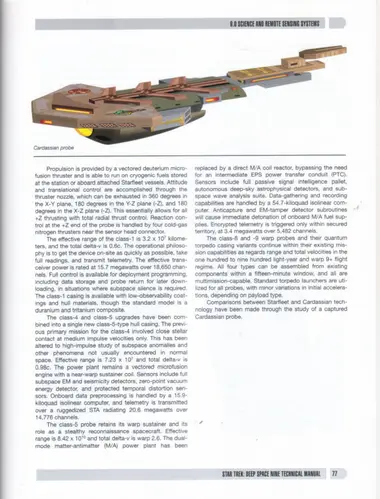
Comparisons between Starfleet and Cardassian technology have been made through the study of a captured Cardassian probe.