3.1 Operations Center
Describes the Operations Center (ops) on Level 1, its history as the Cardassian Command Center, the sunken computer-core pit, the overhead gas-suspension display, the environmental and access systems, and the refurbished work stations that comprise ops.
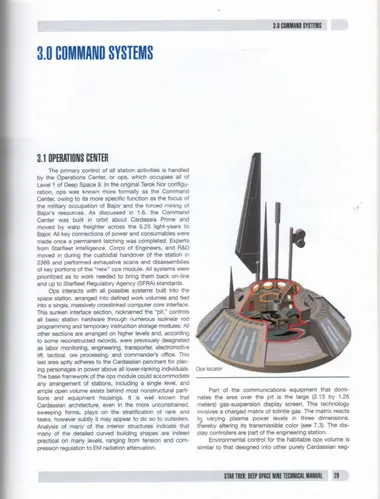
The primary control of all station activities is handled by the Operations Center, or ops, which occupies all of Level 1 of Deep Space 9. In the original Terok Nor configuration, ops was known more formally as the Command Center, owing to its more specific function as the focus of the military occupation of Bajor and the forced mining of Bajor’s resources. As discussed in 1.6, the Command Center was built in orbit about Cardassia Prime and moved by warp freighter across the 5.25 light-years to Bajor. All key connections of power and consumables were made once a permanent latching was completed. Experts from Starfleet Intelligence, Corps of Engineers, and R&D moved in during the custodial handover of the station in 2369 and performed exhaustive scans and disassemblies of key portions of the “new” ops module. All systems were prioritized as to work needed to bring them back on-line and up to Starfleet Regulatory Agency (SFRA) standards.
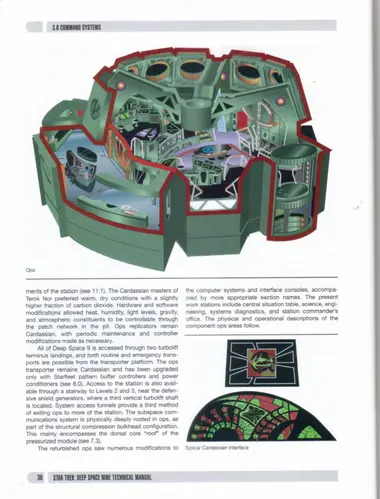
Ops interacts with all possible systems built into the space station, arranged into defined work volumes and tied into a single, massively crosslinked computer core interface. This sunken interface section, nicknamed the “pit,” controls all basic station hardware through numerous isolinear rod programming and temporary instruction storage modules. All other sections are arranged on higher levels and, according to some reconstructed records, were previously designated as labor monitoring, engineering, transporter, electromotive lift, tactical, ore processing, and commander’s office. This last area aptly adheres to the Cardassian penchant for placing personages in power above all lower-ranking individuals.
The base framework of the ops module could accommodate any arrangement of stations, including a single level, and ample open volume exists behind most nonstructural partitions and equipment housings. It is well known that Cardassian architecture, even in the more unconstrained, sweeping forms, plays on the stratification of rank and tasks, however subtly it may appear to do so to outsiders. Analysis of many of the interior structures indicate that many of the detailed curved building shapes are indeed practical on many levels, ranging from tension and compression regulation to EM radiation attenuation.
Part of the communications equipment that dominates the area over the pit is the large (2.13 by 1.25 meters) gas-suspension display screen. This technology involves a charged matrix of tolinite gas. The matrix reacts to varying plasma power levels in three dimensions, thereby altering its transmissible color (see 7.3). The display controllers are part of the engineering station.
Environmental control for the habitable ops volume is similar to that designed into other purely Cardassian segments of the station (see 11.1). The Cardassian masters of Terok Nor preferred warm, dry conditions with a slightly higher fraction of carbon dioxide. Hardware and software modifications allowed heat, humidity, light levels, gravity, and atmospheric constituents to be controllable through the patch network in the pit. Ops replicators remain Cardassian, with periodic maintenance and controller modifications made as necessary.
All of Deep Space 9 is accessed through two turbolift terminus landings, and both routine and emergency transports are possible from the transporter platform. The ops transporter remains Cardassian and has been upgraded only with Starfleet pattern buffer controllers and power conditioners (see 8.0). Access to the station is also available through a stairway to Levels 2 and 3, near the defensive shield generators, where a third vertical turbolift shaft is located. System access tunnels provide a third method of exiting ops to more of the station. The subspace communications system is physically deeply rooted in ops, as part of the structural compression bulkhead configuration. This mainly encompasses the dorsal core “roof” of the pressurized module (see 7.3).
The refurbished ops saw numerous modifications to the computer systems and interface consoles, accompanied by more appropriate section names. The present work stations include central situation table, science, engineering, systems diagnostics, and station commander’s office. The physical and operational descriptions of the component ops areas follow.