3.1 Main Bridge
Describes the Main Bridge on Deck 1, its layout, command and aft stations, main viewer, computer subprocessors, structural module construction, and emergency life support.
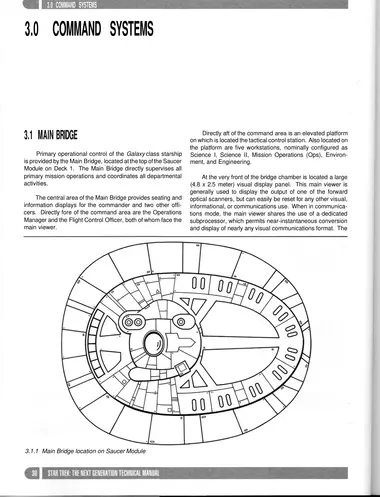
Primary operational control of the Galaxy class starship is provided by the Main Bridge, located at the top of the Saucer Module on Deck 1. The Main Bridge directly supervises all primary mission operations and coordinates all departmental activities.
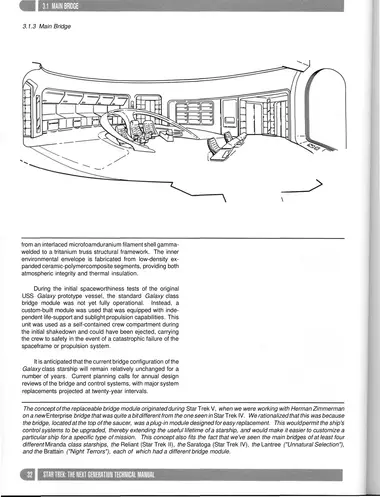
The central area of the Main Bridge provides seating and information displays for the commander and two other officers. Directly fore of the command area are the Operations Manager and the Flight Control Officer, both of whom face the main viewer.
Directly aft of the command area is an elevated platform on which is located the tactical control station. Also located on the platform are five workstations, nominally configured as Science I, Science II, Mission Operations (Ops), Environment, and Engineering.
At the very front of the bridge chamber is located a large (4.8 x 2.5 meter) visual display panel. This main viewer is generally used to display the output of one of the forward optical scanners, but can easily be reset for any other visual, informational, or communications use. When in communications mode, the main viewer shares the use of a dedicated subprocessor, which permits near-instantaneous conversion and display of nearly any visual communications format. The main viewer display matrix includes omni-holographic display elements and is thus capable of displaying three-dimensional information.
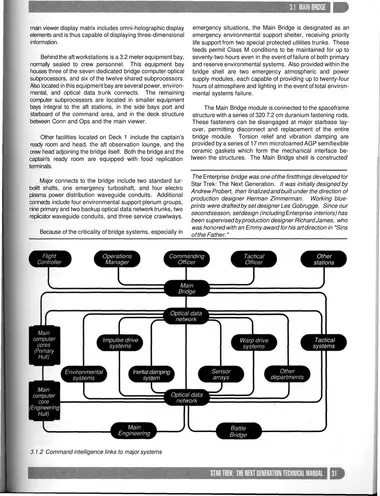
Behind the aft workstations is a 3.2 meter equipment bay, normally sealed to crew personnel. This equipment bay houses three of the seven dedicated bridge computer optical subprocessors, and six of the twelve shared subprocessors. Also located in this equipment bay are several power, environmental, and optical data trunk connects. The remaining computer subprocessors are located in smaller equipment bays integral to the aft stations, in the side bays port and starboard of the command area, and in the deck structure between Conn and Ops and the main viewer.
Other facilities located on Deck 1 include the captain's ready room and head, the aft observation lounge, and the crew head adjoining the bridge itself. Both the bridge and the captain's ready room are equipped with food replication terminals.
Major connects to the bridge include two standard turbolift shafts, one emergency turboshaft, and four electro plasma power distribution waveguide conduits. Additional connects include four environmental support plenum groups, nine primary and two backup optical data network trunks, two replicator waveguide conduits, and three service crawlways.
Because of the criticality of bridge systems, especially in emergency situations, the Main Bridge is designated as an emergency environmental support shelter, receiving priority life support from two special protected utilities trunks. These feeds permit Class M conditions to be maintained for up to seventy-two hours even in the event of failure of both primary and reserve environmental systems. Also provided within the bridge shell are two emergency atmospheric and power supply modules, each capable of providing up to twenty-four hours of atmosphere and lighting in the event of total environmental systems failure.
The Main Bridge module is connected to the spaceframe structure with a series of 320 7.2 cm duranium fastening rods. These fasteners can be disengaged at major starbase layover, permitting disconnect and replacement of the entire bridge module. Torsion relief and vibration damping are provided by a series of 17 mm microfoamed AGP semiflexible ceramic gaskets which form the mechanical interface between the structures. The Main Bridge shell is constructed from an interlaced microfoam duranium filament shell gammawelded to a tritanium truss structural framework. The inner environmental envelope is fabricated from low-density expanded ceramic-polymer composite segments, providing both atmospheric integrity and thermal insulation.
During the initial spaceworthiness tests of the original USS Galaxy prototype vessel, the standard Galaxy class bridge module was not yet fully operational. Instead, a custom-built module was used that was equipped with independent life-support and sublight propulsion capabilities. This unit was used as a self-contained crew compartment during the initial shakedown and could have been ejected, carrying the crew to safety in the event of a catastrophic failure of the spaceframe or propulsion system.
It is anticipated that the current bridge configuration of the Galaxy class starship will remain relatively unchanged for a number of years. Current planning calls for annual design reviews of the bridge and control systems, with major system replacements projected at twenty-year intervals.