8.2 Galaxy Class Systems
A description of the ship's transporter, engineering, and propulsion systems, including the personnel and cargo transporters, Main Engineering and the intermix unit, the field-configuration warp drive and warp 9.9 maximum speed, phaser and photon torpedo armament, and an introduction to the Galaxy Class Medical Unit.
two in the Engineering section on Deck 14. In addition, eight cargo transporters and six emergency personnel transporters are installed in various locations throughout the ship. These facilities operate largely as Federation transporter systems always have, with only slightly greater range than on previous models. Major improvements have taken place, in the areas of signal purity, dense matter penetration capability, and biohazard limitation.
Each personnel transporter room features the familiar, circular transport platform and free-standing control pedestal. To one side, an access corridor wall is dominated by a transporter controller subprocessor, which oversees all transport functions and houses the system's primary isolinear optical chip array.
Main Engineering is the domain of the ship's Chief Engineering Officer, and all vessel propulsion and power distribution systems are controlled from this point. Located on Deck 36, the room's main feature is the ship's primary intermix unit/dilithium crystal housing, contained within the massive matter/anti-matter reaction chamber at the facility's aft end. It is here that the incredible propulsive energies of the vessel are produced and directed, creating the subspace wave bubble through which the ship is able to attain faster than lightspeed.
The Chief Engineer's office, located to one side of the main intermix area, offers continuous and immediate visual data pertaining to the functioning of all engine and power systems. The free-standing master systems display, located in the center of the main entry corridor, gives engineering personnel an immediate picture of the overall condition of the vessel's many power-feed complexes and can be reconfigured, when necessary, to provide emergency control of the ship's flight and power distribution networks.
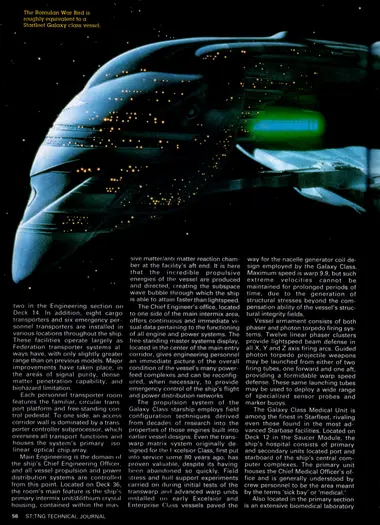
The propulsion system of the Galaxy Class starship employs field configuration techniques derived from decades of research into the properties of those engines built into earlier vessel designs. Even the transwarp matrix system originally designed for the Excelsior Class, first put into service some 80 years ago, has proven valuable, despite its having been abandoned so quickly. Field stress and hull support experiments carried on during initial tests of the transwarp and advanced warp units installed on early Excelsior and Enterprise Class vessels paved the way for the nacelle generator coil design employed by the Galaxy Class. Maximum speed is warp 9.9, but such extreme velocities cannot be maintained for prolonged periods of time, due to the generation of structural stresses beyond the compensation ability of the vessel's structural integrity fields.
Vessel armament consists of both phaser and photon torpedo firing systems. Twelve linear phaser clusters provide lightspeed beam defense in all X, Y and Z axis firing arcs. Guided photon torpedo projectile weapons may be launched from either of two firing tubes, one forward and one aft, providing a formidable warp speed defense. These same launching tubes may be used to deploy a wide range of specialized sensor probes and marker buoys.
The Galaxy Class Medical Unit is among the finest in Starfleet, rivaling even those found in the most advanced Starbase facilities. Located on Deck 12 in the Saucer Module, the ship's hospital consists of primary and secondary units located port and starboard of the ship's central computer complexes. The primary unit houses the Chief Medical Officer's office and is generally understood by crew personnel to be the area meant by the terms ‘sick bay’ or ‘medical.’ Also located in the primary section is an extensive biomedical laboratory