13.6 Turbolift Personnel Transport System
Describes the turboelevator network of induction-powered transport tubes, turbolift car construction, voice command, routing, and operation during alerts and starbase docking.
Intraship personnel transport is provided by the turboelevator system. This network of inductively powered transport tubes allows high-speed personnel movement throughout the habitable volume of the ship.
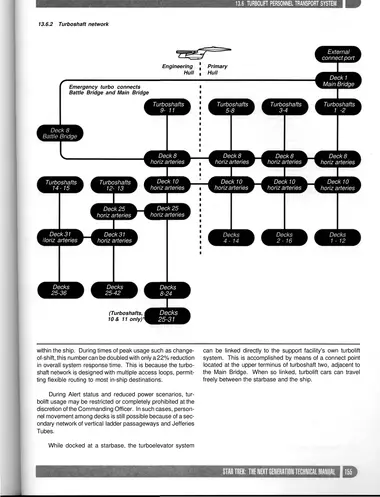
The turboshaft network consists of two parallel main vertical arteries, which provide service to hubs in horizontal networks located on each deck. Redundant horizontal links on Decks 8, 10, 25, and 31 connect the discontinuous vertical segments. The network is designed to provide alternate access routes to all decks, permitting alternate routing during times of heavy system usage. This design philosophy also minimizes the effect of any given single malfunction on overall system performance. Additionally, there is a single dedicated emergency turboshaft connecting the Main Bridge on Deck 1 to the Battle Bridge on Deck 8.
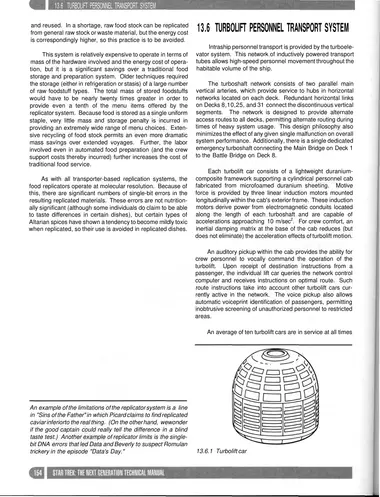
Each turbolift car consists of a lightweight duranium-composite framework supporting a cylindrical personnel cab fabricated from microfoamed duranium sheeting. Motive force is provided by three linear induction motors mounted longitudinally within the cab's exterior frame. These induction motors derive power from electromagnetic conduits located along the length of each turboshaft and are capable of accelerations approaching 10 m/sec2. For crew comfort, an inertial damping matrix at the base of the cab reduces (but does not eliminate) the acceleration effects of turbolift motion.
An auditory pickup within the cab provides the ability for crew personnel to vocally command the operation of the turbolift. Upon receipt of destination instructions from a passenger, the individual lift car queries the network control computer and receives instructions on optimal route. Such route instructions take into account other turbolift cars currently active in the network. The voice pickup also allows automatic voiceprint identification of passengers, permitting inobtrusive screening of unauthorized personnel to restricted areas.
An average of ten turbolift cars are in service at all times within the ship. During times of peak usage such as change-of-shift, this number can be doubled with only a 22% reduction in overall system response time. This is because the turboshaft network is designed with multiple access loops, permitting flexible routing to most in-ship destinations.
During Alert status and reduced power scenarios, turbolift usage may be restricted or completely prohibited at the discretion of the Commanding Officer. In such cases, personnel movement among decks is still possible because of a secondary network of vertical ladder passageways and Jefferies Tubes.
While docked at a starbase, the turboelevator system can be linked directly to the support facility's own turbolift system. This is accomplished by means of a connect point located at the upper terminus of turboshaft two, adjacent to the Main Bridge. When so linked, turbolift cars can travel freely between the starbase and the ship.