12.2 Atmospheric System
Describes the primary, reserve, and emergency atmospheric processing systems that maintain a Class M oxygen-nitrogen environment throughout the ship.
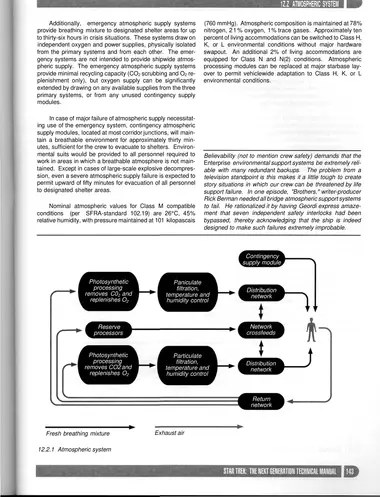
The USS Enterprise environmental system maintains a Class M compatible oxygen-nitrogen atmosphere throughout the habitable volume of the spacecraft. Two independent primary atmospheric plenum systems deliver temperature and humidity controlled environmental gases throughout the vehicle. Additionally, a separate reserve system and emergency systems provide additional redundancy.
Atmospheric processing units for the primary system are located throughout the spacecraft at the rate of approximately two redundant primary units for every 50 m3 of habitable ship's volume. These devices maintain a comfortable, breathable mixture by removing CO2 and other waste gases and particulates, then replenishing the O2 partial pressure. This is principally accomplished through the use of photosynthetic bioprocessing. The atmospheric processors also maintain temperature and humidity within prescribed limits. Once so processed, the breathing mixture is recirculated through the plenum network.
Cruise Mode operational rules specify a ninety-six-hour duty cycle for processing modules, although normal time between scheduled maintenance is approximately two thousand operating hours. At the end of each ninety-six-hour duty cycle, it is normal for the entire atmospheric processing load to be automatically switched to the alternate primary system.
It is, however, possible to individually switch specific system elements as needed. Atmospheric plenum flow can be remotely switched at utilities junction nodes, so that breathing atmosphere can be rerouted to processors at other locations, offering an additional measure of redundancy.
The reserve system is a third redundant set of atmospheric processors, providing up to 50% of nominal system capacity for periods up to twenty-four hours, depending on system load. These are intended for use in the event of incapacity of major elements of the two primary atmospheric systems. The reserve system shares the plenum network of the two primary systems, and operates by computerized system analysis, which allows any damaged plenum sections or processors to be isolated and removed from service.
Additionally, emergency atmospheric supply systems provide breathing mixture to designated shelter areas for up to thirty-six hours in crisis situations. These systems draw on independent oxygen and power supplies, physically isolated from the primary systems and from each other. The emergency systems are not intended to provide shipwide atmospheric supply. The emergency atmospheric supply systems provide minimal recycling capacity (CO2 scrubbing and O2 replenishment only), but oxygen supply can be significantly extended by drawing on any available supplies from the three primary systems, or from any unused contingency supply modules.
In case of major failure of atmospheric supply necessitating use of the emergency system, contingency atmospheric supply modules, located at most corridor junctions, will maintain a breathable environment for approximately thirty minutes, sufficient for the crew to evacuate to shelters. Environmental suits would be provided to all personnel required to work in areas in which a breathable atmosphere is not maintained. Except in cases of large-scale explosive decompression, even a severe atmospheric supply failure is expected to permit upward of fifty minutes for evacuation of all personnel to designated shelter areas.
Nominal atmospheric values for Class M compatible conditions (per SFRA-standard 102.19) are 26°C, 45% relative humidity, with pressure maintained at 101 kilopascals (760 mmHg). Atmospheric composition is maintained at 78% nitrogen, 21% oxygen, 1% trace gases. Approximately ten percent of living accommodations can be switched to Class H, K, or L environmental conditions without major hardware swapout. An additional 2% of living accommodations are equipped for Class N and N(2) conditions. Atmospheric processing modules can be replaced at major starbase layover to permit vehiclewide adaptation to Class H, K, or L environmental conditions.
Believability (not to mention crew safety) demands that the Enterprise environmental support systems be extremely reliable with many redundant backups. The problem from a television standpoint is this makes it a little tough to create story situations in which our crew can be threatened by life support failure. In one episode, "Brothers," writer-producer Rick Berman needed all bridge atmospheric support systems to fail. He rationalized it by having Geordi express amazement that seven independent safety interlocks had been bypassed, thereby acknowledging that the ship is indeed designed to make such failures extremely improbable.