11.3 Photon Torpedoes
Development and design of the photon torpedo as a warp-capable matter/antimatter weapon, covering its history, casing configuration, sustainer engine, and launcher operations.
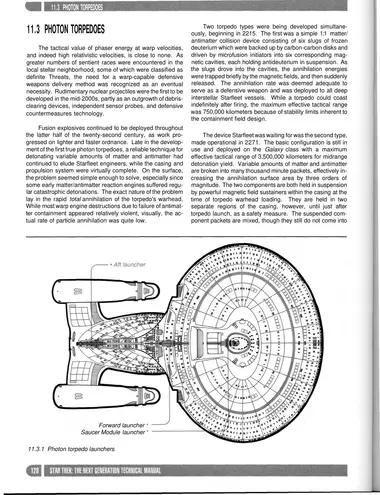
The tactical value of phaser energy at warp velocities, and indeed high relativistic velocities, is close to none. As greater numbers of sentient races were encountered in the local stellar neighborhood, some of which were classified as definite Threats, the need for a warp-capable defensive weapons delivery method was recognized as an eventual necessity. Rudimentary nuclear projectiles were the first to be developed in the mid-2000s, partly as an outgrowth of debris-clearing devices, independent sensor probes, and defensive countermeasures technology.
Fusion explosives continued to be deployed throughout the latter half of the twenty-second century, as work progressed on lighter and faster ordnance. Late in the development of the first true photon torpedoes, a reliable technique for detonating variable amounts of matter and antimatter had continued to elude Starfleet engineers, while the casing and propulsion system were virtually complete. On the surface, the problem seemed simple enough to solve, especially since some early matter/antimatter reaction engines suffered regular catastrophic detonations. The exact nature of the problem lay in the rapid total annihilation of the torpedo's warhead. While most warp engine destructions due to failure of antimatter containment appeared relatively violent, visually, the actual rate of particle annihilation was quite low.
Two torpedo types were being developed simultaneously, beginning in 2215. The first was a simple 1:1 matter/antimatter collision device consisting of six slugs of frozen deuterium which were backed up by carbon-carbon disks and driven by microfusion initiators into six corresponding magnetic cavities, each holding antideuterium in suspension. As the slugs drove into the cavities, the annihilation energies were trapped briefly by the magnetic fields, and then suddenly released. The annihilation rate was deemed adequate to serve as a defensive weapon and was deployed to all deep interstellar Starfleet vessels. While a torpedo could coast indefinitely after firing, the maximum effective tactical range was 750,000 kilometers because of stability limits inherent to the containment field design.
The device Starfleet was waiting for was the second type, made operational in 2271. The basic configuration is still in use and deployed on the Galaxy class with a maximum effective tactical range of 3,500,000 kilometers for midrange detonation yield. Variable amounts of matter and antimatter are broken into many thousand minute packets, effectively increasing the annihilation surface area by three orders of magnitude. The two components are both held in suspension by powerful magnetic field sustainers within the casing at the time of torpedo warhead loading. They are held in two separate regions of the casing, however, until just after torpedo launch, as a safety measure. The suspended component packets are mixed, though they still do not come into direct contact with one another because of the fields surrounding each packet. At a signal from the onboard detonation circuitry, the fields collapse and drive the materials together, resulting in the characteristic release of energy. While the maximum payload of antimatter in a standard photon torpedo is only about 1.5 kilograms, the released energy per unit time is actually greater than that calculated for a Galaxy class antimatter pod rupture.
Torpedo Configuration
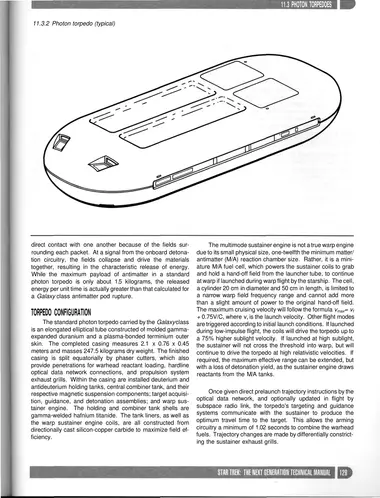
The standard photon torpedo carried by the Galaxy class is an elongated elliptical tube constructed of molded gamma-expanded duranium and a plasma-bonded terminium outer skin. The completed casing measures 2.1 x 0.76 x 0.45 meters and masses 247.5 kilograms dry weight. The finished casing is split equatorially by phaser cutters, which also provide penetrations for warhead reactant loading, hardline optical data network connections, and propulsion system exhaust grills. Within the casing are installed deuterium and antideuterium holding tanks, central combiner tank, and their respective magnetic suspension components; target acquisition, guidance, and detonation assemblies; and warp sustainer engine. The holding and combiner tank shells are gamma-welded hafnium titanide. The tank liners, as well as the warp sustainer engine coils, are all constructed from directionally cast silicon-copper carbide to maximize field efficiency.
The multimode sustainer engine is not a true warp engine due to its small physical size, one-twelfth the minimum matter/antimatter (M/A) reaction chamber size. Rather, it is a miniature M/A fuel cell, which powers the sustainer coils to grab and hold a hand-off field from the launcher tube, to continue at warp if launched during warp flight by the starship. The cell, a cylinder 20 cm in diameter and 50 cm in length, is limited to a narrow warp field frequency range and cannot add more than a slight amount of power to the original hand-off field. The maximum cruising velocity will follow the formula vmax= vf + 0.75V/C, where v, is the launch velocity. Other flight modes are triggered according to initial launch conditions. If launched during low-impulse flight, the coils will drive the torpedo up to a 75% higher sublight velocity. If launched at high sublight, the sustainer will not cross the threshold into warp, but will continue to drive the torpedo at high relativistic velocities. If required, the maximum effective range can be extended, but with a loss of detonation yield, as the sustainer engine draws reactants from the M/A tanks.
Once given direct prelaunch trajectory instructions by the optical data network, and optionally updated in flight by subspace radio link, the torpedo's targeting and guidance systems communicate with the sustainer to produce the optimum travel time to the target. This allows the arming circuitry a minimum of 1.02 seconds to combine the warhead fuels. Trajectory changes are made by differentially constricting the sustainer exhaust grills.
The actual firing operation occurs in the two launcher tubes, one forward within the connecting dorsal on Deck 25, and one aft above the support pylon wing on Deck 35. The launcher is downstream from four loader stages, where the M/A fuels are injected into four torpedoes at one time. Each loader can place a torpedo into the launcher for volley firing. In each position, the launcher tube, 30 meters in length, is constructed from machined tritanium and sarium farnide. It is strung with sequential field induction coils and launch assist gas generators to provide initial power to the sustainer and propel the casing away from the starship. Once fired, the launcher tube is purged of surface residues by flash sterilizers, the coil charges are neutralized, and the firing sequencer is reset to await a new load of torpedoes. In the event a set of casings is loaded, and the ship then stands down from Red Alert, the warhead fuels are off-loaded and returned to storage, and the launcher system is powered down.
Both launchers can be loaded with as many as ten torpedoes at one time for simultaneous launch. In such cases, all torpedo devices are ejected from the tube in a single impulse and remain together for approximately 150 meters. At this point, individual control programs assume flight and targeting control for each torpedo. This is an effective means for simultaneous delivery of torpedoes to multiple targets.
The same technologies that produced high-velocity defensive weapons have also produced advanced warp-capable remote sensor probes. One quarter of the 275 basic casings normally stored aboard the ship can be packed with sensor arrays, signal processors, and telemetry systems for launch toward nearby targets. Applications will typically include stellar and planetary studies, as well as strategic reconnaissance.