3.6 Phasers - Once and For All
This memo clarifies the two main phaser types and details the effects of each power setting, from basic stun through the kill settings to total vaporization, and describes the larger rifle and ship-mounted phaser variants.
Phasers — Once and for all
Okay. There's been some honest confusion over what phasers do and what our new and improved phasers' capabilities are. This memo is specially formulated to eliminate that confusion, and get your 24th Century life in order. Once you have tried the best that Starfleet R&D has to offer, you won't want to go back to some run-of-the-mill black market molecular disruption weapon.
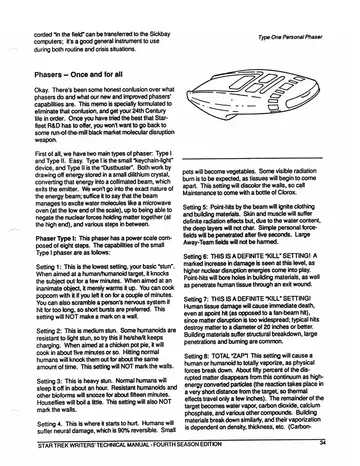
First of all, we have two main types of phaser: Type I and Type II. Easy. Type I is the small “keychain-light” device, and Type II is the “Dustbuster”. Both work by drawing off energy stored in a small dilithium crystal, converting that energy into a collimated beam, which exits the emitter. We won't go into the exact nature of the energy beam; suffice it to say that the beam manages to excite water molecules like a microwave oven (at the low end of the scale), up to being able to negate the nuclear forces holding matter together (at the high end), and various steps in between.
Phaser Type I: This phaser has a power scale composed of eight steps. The capabilities of the small Type I phaser are as follows:
Setting 1: This is the lowest setting, your basic “stun”. When aimed at a human/humanoid target, it knocks the subject out for a few minutes. When aimed at an inanimate object, it merely warms it up. You can cook a TV dinner with it if you left it on for a couple of minutes. This setting will NOT make its mark on the walls.
Setting 2: This is medium stun. Some humanoids are resistant to light stun, so try this if he/she/it keeps charging. When aimed at a chicken pot pie, it will cook in about five minutes or so. Hitting normal humans will knock them out for the same amount of time. This setting will NOT mark the walls.
Setting 3: This is heavy stun. Normal humans will sleep it off in about an hour. Resistant humanoids and other bioforms will snooze for about fifteen minutes. Houseflies will boil a little. This setting will also NOT mark the walls.
Setting 4: This is where it starts to hurt. Humans will suffer neural damage, which is 90% reversible. Small pets will become vegetables. Some visible radiation burn is to be expected, as tissues will begin to come apart. This setting will discolor the walls, so call Maintenance to come with a bottle of Clorox.
Setting 5: Point-hits by the beam will ignite clothing and building materials. Skin and muscle will suffer definite radiation effects but, due to the water content, the deep layers will not char. Simple personal forcefields will be penetrated after five seconds. Large Away-Team fields will not be harmed.
Setting 6: THIS IS A DEFINITE “KILL” SETTING! A marked increase in damage is seen at this level, as higher nuclear disruption energies come into play. Point-hits will bore holes in building materials, as well as penetrate human tissue through an exit wound.
Setting 7: THIS IS A DEFINITE “KILL” SETTING! Human tissue damage will be complete and lethal, even at a point hit (as opposed to a fan-beam hit), since matter disruption is too widespread; typical hits destroy matter to a diameter of 20 inches or better. Building materials suffer structural breakdown, large penetrations and burning are common.
Setting 8: TOTAL “ZAP”! This setting will cause a human or humanoid to totally vaporize, as physical forces break down. Fifty percent of the disrupted matter disappears from this continuum as high energy converted particles (the reaction takes place in a very short distance from the target, so thermal effects travel only a few inches). The remainder of the target becomes water vapor, carbon dioxide, calcium phosphate, and various other compounds. Building materials break down similarly, and their vaporization is dependent on density, thickness, etc. (Carbon-epoxy composite panels instantly fly to gas, while rock walls eat away slowly).
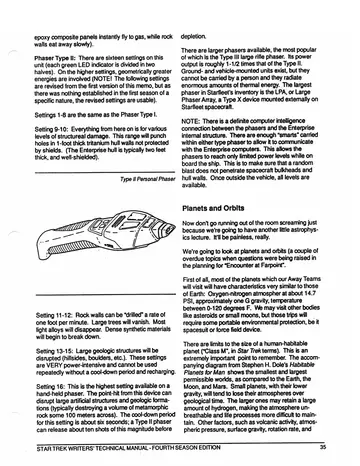
Phaser Type II: There are sixteen settings on this unit (each green LED indicator is divided in two halves). On the higher settings, geometrically greater energies are involved (NOTE! The following settings are revised from the first version of this memo, but as there was nothing established in the first season of a specific nature, the revised settings are usable).
Settings 1-8 are the same as the Phaser Type I.
Setting 9-10: Everything from here on is for various levels of structural damage. This range will punch holes in 1-foot thick tritanium hull walls not protected by shields. (The Enterprise hull is typically two feet thick, and well-shielded).
Setting 11-12: Rock walls can be “drilled” at a rate of one foot per minute. Large trees will vanish. Most light alloys will disappear. Dense synthetic materials will begin to break down.
Setting 13-15: Large geologic structures will be disrupted (hillsides, boulders, etc.). These settings are VERY power-intensive and cannot be used repeatedly without a cool-down period and recharging.
Setting 16: This is the highest setting available on a hand-held phaser. The point-hit from this device can disrupt large artificial structures and geologic formations (typically destroying a volume of metamorphic rock some 100 meters across). The cool-down period for this setting is about six seconds; a Type II phaser can release about ten shots of this magnitude before depletion.
There are larger phasers available, the most popular of which is the Type III large rifle phaser. Its power output is roughly 1-1/2 times that of the Type II. Ground- and vehicle-mounted units exist, but they cannot be carried by a person and they radiate enormous amounts of thermal energy. The largest phaser in Starfleet's inventory is the LPA, or Large Phaser Array, a Type X device mounted externally on Starfleet spacecraft.
NOTE: There is a definite computer intelligence connection between the phasers and the Enterprise internal structure. There are enough “smarts” carried within either type phaser to allow it to communicate with the Enterprise computers. This allows the phasers to reach only limited power levels while on board the ship. This is to make sure that a random blast does not penetrate spacecraft bulkheads and hull walls. Once outside the vehicle, all levels are available.