3.2 Ships: UNSS Lewis and Clark, UNSS Wheeler, Space Ferry II, U Thant
An illustrated ships chronology of the period, presenting an annotated year-by-year timeline of the principal spacecraft, probes and events from 2001 to 2025 alongside detailed specification panels for the major ships of the era.
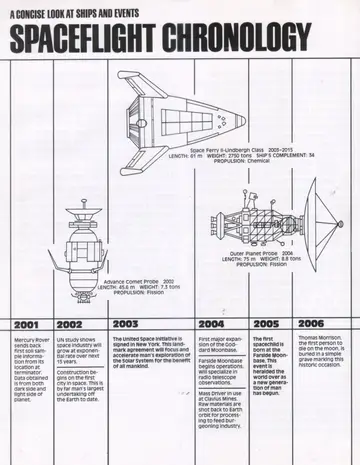
A Concise Look at Ships and Events: Spaceflight Chronology
2001—Mercury Rover sends back first soil sample information from its location at terminator. Data obtained is from both dark side and light side of planet.
2002—UN study shows space industry will grow at exponential rate over next 15 years. Construction begins on the first city in space. This is by far man's largest undertaking off the Earth to date.
2003—The United Space Initiative is signed in New York. This landmark agreement will focus and accelerate man's exploration of the Solar System for the benefit of all mankind.
2004—First major expansion of the Goddard Moonbase. Farside Moonbase begins operations. Will specialize in radio telescope observations. Mass Driver in use at Clavius Mines. Raw materials are shot back to Earth orbit for processing to feed burgeoning industry.
2005—The first spacechild is born at the Farside Moonbase. This event is heralded the world over as a new generation of man has begun.
2006—Thomas Morrison, the first person to die on the moon, is buried in a simple grave marking this historic occasion.
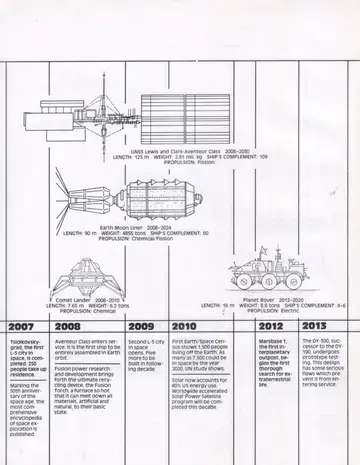
2007—Tsiolkovskygrad, the first L-5 city in space, is completed. 250 people take up residence. Marking the 50th anniversary of the space age, the most comprehensive encyclopedia of space exploration is published.
2008—Aventeur Class enters service. It is the first ship to be entirely assembled in Earth orbit. Fusion power research and development brings forth the ultimate recycling device, the Fusion Torch, a furnace so hot that it can melt down all materials, artificial and natural, to their basic state.
2009—Second L-5 city in space opens. Five more to be built in following decade.
2010—First Earth/Space Census shows 1,500 people living off the Earth. As many as 7,500 could be in space by the year 2020, UN study shows. Solar now accounts for 40% US energy use. Worldwide accelerated Solar Power Satellite program will be completed this decade.
2012—Marsbase 1, the first interplanetary outpost, begins the first thorough search for extraterrestrial life.
2013—The DY-300, successor to the DY-100, undergoes prototype testing. This design has some serious flaws which prevent it from entering service.
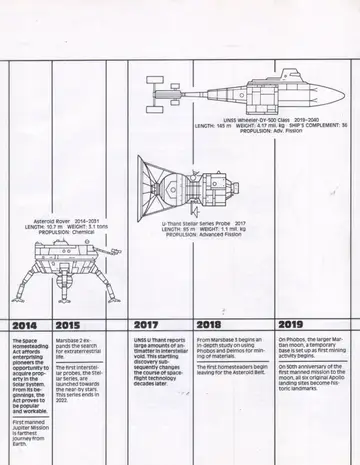
2014—The Space Homesteading Act affords enterprising pioneers the opportunity to acquire property in the Solar System. From its beginnings, the Act proves to be popular and workable. First manned Jupiter Mission is farthest journey from Earth.
2015—Marsbase 2 expands the search for extraterrestrial life. The first interstellar probes, the Stellar Series, are launched towards the near-by stars. This series ends in 2022.
2017—UNSS U Thant reports large amounts of antimatter in interstellar void. This startling discovery subsequently changes the course of spaceflight technology decades later.
2018—From Marsbase 3 begins an in-depth study on using Phobos and Deimos for mining of materials. The first homesteaders begin leaving for the Asteroid Belt.
2019—On Phobos, the larger Martian moon, a temporary base is set up as first mining activity begins. On 50th anniversary of the first manned mission to the moon, all six original Apollo landing sites become historic landmarks.
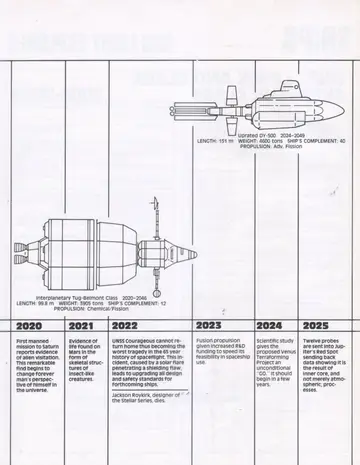
2020—First manned mission to Saturn reports evidence of alien visitation. This remarkable find begins to change forever man's perspective of himself in the universe.
2021—Evidence of life found on Mars in the form of skeletal structures of insect-like creatures.
2022—UNSS Courageous cannot return home thus becoming the worst tragedy in the 65 year history of spaceflight. This incident, caused by a solar flare penetrating a shielding flaw, leads to upgrading all design and safety standards for forthcoming ships. Jackson Roykirk, designer of the Stellar Series, dies.
2023—Fusion propulsion given increased R&D funding to speed its feasibility in spaceship use.
2024—Scientific study gives the proposed Venus Terraforming Project an unconditional "GO." It should begin in a few years.
2025—Twelve probes are sent into Jupiter's Red Spot sending back data showing it is the result of inner core, and not merely atmospheric, processes.
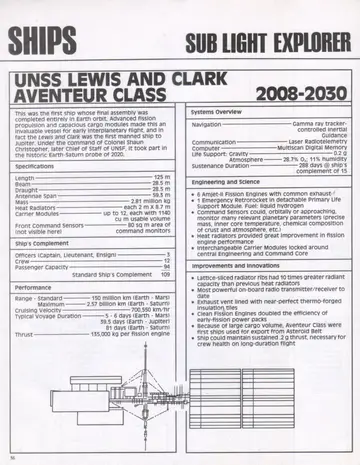
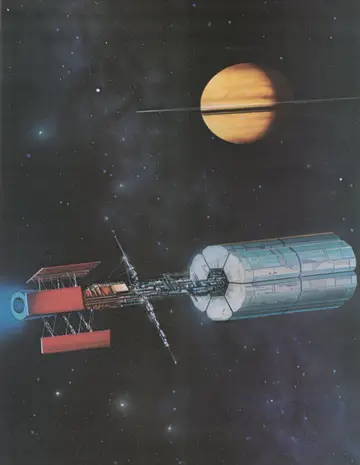
UNSS Lewis and Clark, Aventeur Class
Sub Light Explorer, 2008-2030.
This was the first ship whose final assembly was completed entirely in Earth orbit. Advanced fission propulsion and capacious cargo modules made this an invaluable vessel for early interplanetary flight, and in fact the Lewis and Clark was the first manned ship to Jupiter. Under the command of Colonel Shaun Christopher, later Chief of Staff of UNSF, it took part in the historic Earth-Saturn probe of 2020.
Command Sensors
Command Sensors could, orbitally or approaching, monitor many relevant planetary parameters (precise mass, inner core temperature, chemical composition of crust and atmosphere, etc.). Heat radiators provided great improvement in fission engine performance. Interchangeable Carrier Modules locked around central Engineering and Command Core.
Improvements and Innovations
- Lattice-sliced radiator ribs had 10 times greater radiant capacity than previous heat radiators
- Most powerful on-board radio transmitter/receiver to date
- Exhaust vent lined with near-perfect thermo-forged insulation tiles
- Clean Fission Engines doubled the efficiency of early-fission power packs
- Because of large cargo volume, Aventeur Class were first ships used for export from Asteroid Belt
- Ship could maintain sustained .2 g thrust, necessary for crew health on long-duration flight
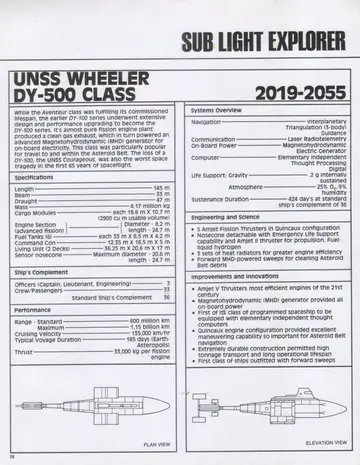
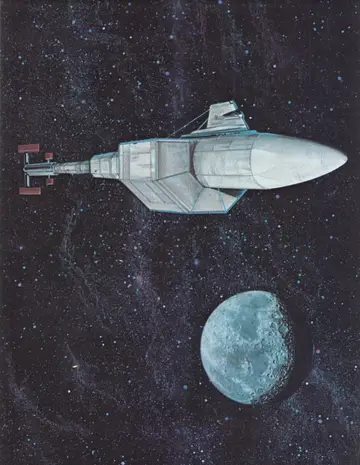
UNSS Wheeler, DY-500 Class
Sub Light Explorer, 2019-2055.
While the Aventeur class was fulfilling its commissioned lifespan, the earlier DY-100 series underwent extensive design and performance upgrading to become the DY-500 series. Its almost pure fission engine plant produced a clean gas exhaust, which in turn powered an advanced Magnetohydrodynamic (MHD) generator for on-board electricity. This class was particularly popular for travel to and within the Asteroid Belt. The loss of a DY-500, the UNSS Courageous, was also the worst space tragedy in the first 65 years of spaceflight.
Improvements and Innovations
- Amjet V Thrusters most efficient engines of the 21st century
- Magnetohydrodynamic (MHD) generator provided all on-board power
- First of its class of programmed spaceship to be equipped with elementary independent thought computers
- Quincaux engine configuration provided excellent maneuvering capability so important for Asteroid Belt navigation
- Extremely durable construction permitted high tonnage transport and long operational lifespan
- First class of ships outfitted with forward sweeps
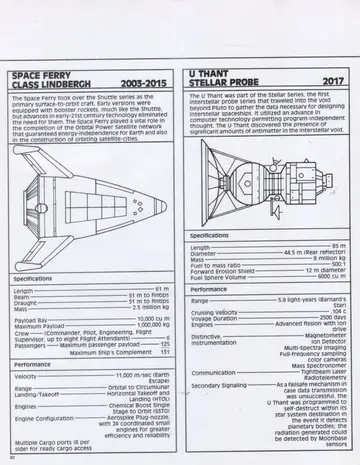
Space Ferry, Class Lindbergh
2003-2015.
The Space Ferry took over the Shuttle series as the primary surface-to-orbit craft. Early versions were equipped with booster rockets, much like the Shuttle, but advances in early-21st century technology eliminated the need for them. The Space Ferry played a vital role in the completion of the Orbital Power Satellite network that guaranteed energy-independence for Earth and also in the construction of orbiting satellite-cities.
U Thant, Stellar Probe
2017.
The U Thant was part of the Stellar Series, the first interstellar probe series that traveled into the void beyond Pluto to gather the data necessary for designing interstellar spaceships. It utilized an advance in computer technology permitting program-independent thought. The U Thant discovered the presence of significant amounts of antimatter in the interstellar void.