6.2 Stellar Explorations: Rigel
A profile of Rigel, one of the most populated systems in the galaxy and a founding member of the UFP, whose trading planet Rigel IV is the commercial center of the known galaxy, accompanied by a planetary data table, an orbital diagram and a map showing how the Horizon Class ships extended Federation trade routes even as space pirates began attacking them.
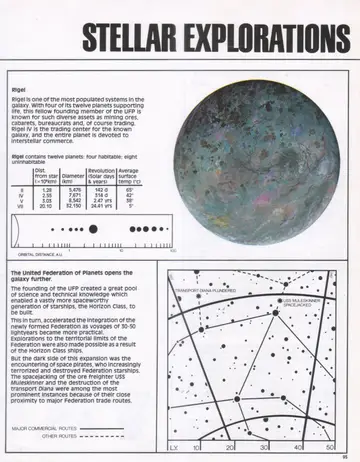
Rigel
Rigel is one of the most populated systems in the galaxy. With four of its twelve planets supporting life, this fellow founding member of the UFP is known for such diverse assets as mining ores, cabarets, bureaucrats and, of course trading. Rigel IV is the trading center for the known galaxy, and the entire planet is devoted to interstellar commerce.
Rigel contains twelve planets: four habitable; eight uninhabitable.
- Planet II: distance from star 1.28 (x10&sup6; km); diameter 5,476 km; revolution 142 d; average surface temp 65°C.
- Planet IV: distance from star 2.55 (x10&sup6; km); diameter 7,671 km; revolution 314 d; average surface temp 42°C.
- Planet V: distance from star 3.03 (x10&sup6; km); diameter 8,542 km; revolution 2.47 yrs; average surface temp 38°C.
- Planet VII: distance from star 20.10 (x10&sup6; km); diameter 32,150 km; revolution 24.41 yrs; average surface temp 5°C.
The United Federation of Planets Opens the Galaxy Further
The founding of the UFP created a great pool of science and technical knowledge which enabled a vastly more spaceworthy generation of starships, the Horizon Class, to be built.
This in turn, accelerated the integration of the newly formed Federation as voyages of 30-50 lightyears became more practical.
Explorations to the territorial limits of the Federation were also made possible as a result of the Horizon Class ships.
But the dark side of this expansion was the encountering of space pirates, who increasingly terrorized and destroyed Federation starships. The spacejacking of the ore freighter USS Muleskinner and the destruction of the transport Diana were among the most prominent instances because of their close proximity to major Federation trade routes.