9.1 Ships: USS Endurance, USS Moscow, Flying Fortress, USS Muletrain
An illustrated ships chronology of 2151-2175 presenting a year-by-year timeline of events alongside a gallery of period spacecraft, followed by detailed specification sheets for the warp 4.5 USS Endurance (Mann Class), the warp 4.8 USS Moscow (Baton Rouge Class), the armored Flying Fortress (Rickenbacker Class), and the superconvoy lead ship USS Muletrain (Provider Class).
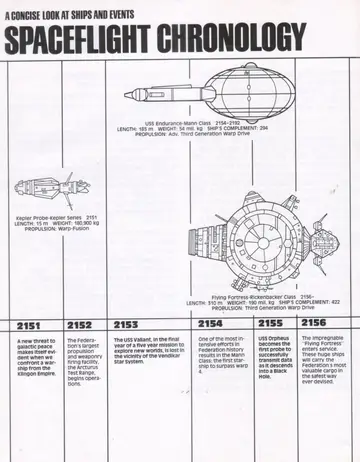
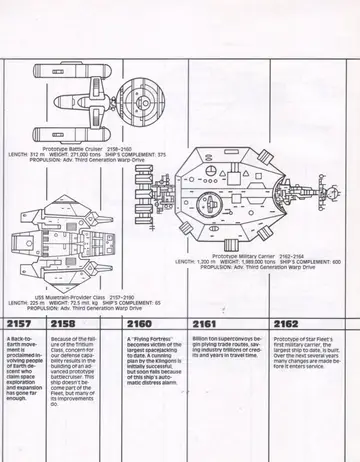
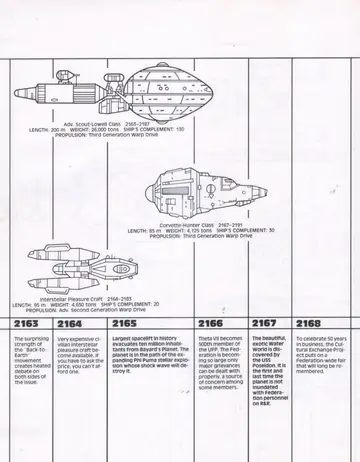
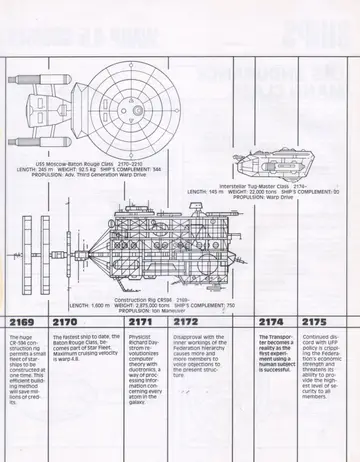
A Concise Look at Ships and Events: Spaceflight Chronology
2151—A new threat to galactic peace makes itself evident when we confront a warship from the Klingon Empire.
2152—The Federation's largest propulsion and weaponry firing facility, the Arcturus Test Range, begins operations.
2153—The USS Valiant, in the final year of a five year mission to explore new worlds, is lost in the vicinity of the Vendikar Star System.
2154—One of the most intensive efforts in Federation history results in the Mann Class: the first starship to surpass warp 4.
2155—USS Orpheus becomes the first probe to successfully transmit data as it descends into a Black Hole.
2156—The impregnable “Flying Fortress” enters service. These huge ships will carry the Federation's most valuable cargo in the safest way ever devised.
2157—A Back-to-Earth movement is proclaimed involving people of Earth descent who claim space exploration and expansion has gone far enough.
2158—Because of the failure of the Tritium Class, concern for our defense capability results in the building of an advanced prototype battlecruiser. This ship doesn't become part of the Fleet, but many of its improvements do.
2160—A “Flying Fortress” becomes victim of the largest spacejacking to date. A cunning plan by the Klingons is initially successful, but soon fails because of this ship's automatic distress alarm.
2161—Billion ton superconvoys begin plying trade routes, saving industry trillions of credits and years in travel time.
2162—Prototype of Star Fleet's first military carrier, the largest ship to date, is built. Over the next several years many changes are made before it enters service.
2163—The surprising strength of the “Back-to-Earth” movement creates heated debate on both sides of the issue.
2164—Very expensive civilian interstellar pleasure craft become available. If you have to ask the price, you can't afford one.
2165—Largest spacelift in history evacuates ten million inhabitants from Bayard's Planet. The planet is in the path of the expanding Phi Puma stellar explosion whose shock wave will destroy it.
2166—Theta VII becomes 500th member of the UFP. The Federation is becoming so large only major grievances can be dealt with properly, a source of concern among some members.
2167—The beautiful, exotic Water World is discovered by the USS Poseidon. It is the first and last time the planet is not inundated with Federation personnel on R&R.
2168—To celebrate 50 years in business, the Cultural Exchange Project puts on a Federation-wide fair that will long be remembered.
2169—The huge CR-594 construction rig permits a small fleet of starships to be constructed at one time. This efficient building method will save millions of credits.
2170—The fastest ship to date, the Baton Rouge Class, becomes part of Star Fleet. Maximum cruising velocity is warp 4.8.
2171—Physicist Richard Daystrom revolutionizes computer theory with duotronics, a way of processing information concerning every atom in the galaxy.
2172—Disapproval with the inner workings of the Federation hierarchy causes more and more members to voice objections to the present structure.
2174—The Transporter becomes a reality as the first experiment using a human subject is successful.
2175—Continued discord with UFP policy is crippling the Federation's economic strength and threatens its ability to provide the highest level of security to all members.
Ship Gallery
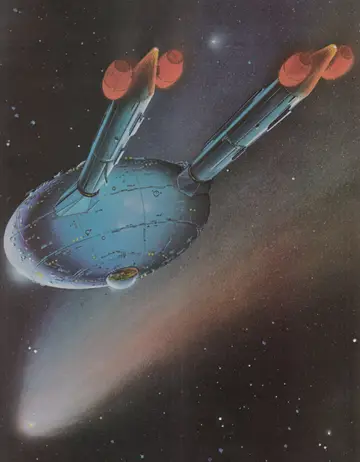
- USS Endurance—Mann Class (2154-2192). Length: 185 m. Weight: 54 mil. kg. Ship's Complement: 294. Propulsion: Adv. Third Generation Warp Drive.
- Kepler Probe—Kepler Series (2151). Length: 15 m. Weight: 180,900 kg. Propulsion: Warp-Fusion.
- Flying Fortress—Rickenbacker Class (2156- ). Length: 310 m. Weight: 190 mil. kg. Ship's Complement: 422. Propulsion: Third Generation Warp Drive.
- Prototype Battle Cruiser (2158-2160). Length: 312 m. Weight: 271,000 tons. Ship's Complement: 375. Propulsion: Adv. Third Generation Warp-Drive.
- Prototype Military Carrier (2162-2164). Length: 1,200 m. Weight: 1,989,000 tons. Ship's Complement: 600. Propulsion: Adv. Third Generation Warp Drive.
- USS Muletrain—Provider Class (2157-2190). Length: 225 m. Weight: 72.5 mil. kg. Ship's Complement: 65. Propulsion: Adv. Third Generation Warp Drive.
- Adv. Scout—Lowell Class (2163-2187). Length: 200 m. Weight: 26,000 tons. Ship's Complement: 130. Propulsion: Third Generation Warp Drive.
- Corvette—Hunter Class (2167-2191). Length: 85 m. Weight: 4,125 tons. Ship's Complement: 30. Propulsion: Third Generation Warp Drive.
- Interstellar Pleasure Craft (2164-2183). Length: 95 m. Weight: 4,650 tons. Ship's Complement: 20. Propulsion: Adv. Second Generation Warp Drive.
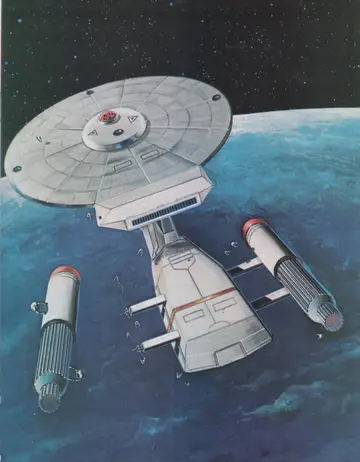
- USS Moscow—Baton Rouge Class (2170-2210). Length: 245 m. Weight: 92.5 kg. Ship's Complement: 344. Propulsion: Adv. Third Generation Warp Drive.
- Interstellar Tug—Master Class (2174- ). Length: 145 m. Weight: 22,000 tons. Ship's Complement: 20. Propulsion: Warp Drive.
- Construction Rig CR594 (2169- ). Length: 1,600 m. Weight: 2,875,000 tons. Ship's Complement: 750. Propulsion: Ion Maneuver.
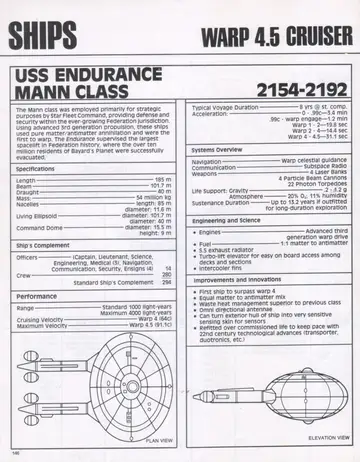
USS Endurance: Mann Class (2154-2192)
The Mann class was employed primarily for strategic purposes by Star Fleet Command, providing defense and security within the ever-growing Federation jurisdiction. Using advanced 3rd generation propulsion, these ships used pure matter/antimatter annihilation and were the first to warp. The Endurance supervised the largest spacelift in Federation history, where the over ten million residents of Bayard's Planet were successfully evacuated.
Specifications
- Length: 185 m
- Beam: 101.7 m
- Draught: 40 m
- Mass: 54 million kg
- Nacelles: length 85 m; diameter 11.6 m
- Living Ellipsoid: diameter 101.7 m; diameter 40 m
- Command Dome: diameter 15.5 m; height 9 m
Ship's Complement
- Officers (Captain, Lieutenant, Science, Engineering, Medical (3), Navigation, Communication, Security, Ensigns (4)): 14
- Crew: 280
- Standard Ship's Complement: 294
Performance
- Range: Standard 1000 light-years; Maximum 4000 light-years
- Cruising Velocity: Warp 4 (64c)
- Maximum Velocity: Warp 4.5 (91.1c)
- Typical Voyage Duration: 8 yrs @ st. comp.
- Acceleration: 0 - .99c: 3.4 min; .99c - warp engage: 1.2 min; Warp 1 - 2: 19.8 sec; Warp 2 - 4: 14.4 sec; Warp 4 - 4.5: 31.1 sec
Systems Overview
- Navigation: Warp celestial guidance
- Communication: Subspace Radio
- Weapons: 4 Laser Banks; 4 Particle Beam Cannons; 22 Photon Torpedoes
- Life Support: Gravity 2 - 1.2 g; Atmosphere 20% O2, 11% humidity
- Sustenance Duration: Up to 13.2 years if outfitted for long-duration exploration
Engineering and Science
- Engines: Advanced third generation warp drive
- Fuel: 1:1 matter to antimatter
- 5.5 exhaust radiator
- Turbo-lift elevator for easy on board access among decks and sections
- Intercooler fins
Improvements and Innovations
- First ship to surpass warp 4
- Equal matter to antimatter mix
- Waste heat management superior to previous class
- Omni directional antennae
- Can turn exterior hull of ship into very sensitive sensing skin for sensors
- Refitted over commissioned life to keep pace with 22nd century technological advances (transporter, duotronics, etc.)
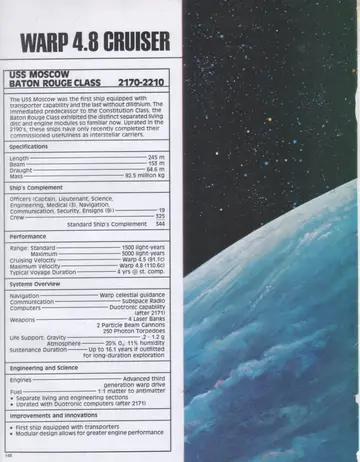
USS Moscow: Baton Rouge Class (2170-2210)
The USS Moscow was the first ship equipped with transporter capability and the last without dilithium. The immediate predecessor to the Constitution Class, the Baton Rouge Class exhibited the distinct separated living disc and engine modules so familiar now. Uprated in the 2190's, these ships have only recently completed their commissioned usefulness as interstellar carriers.
Specifications
- Length: 245 m
- Beam: 153 m
- Draught: 64.6 m
- Mass: 92.5 million kg
Ship's Complement
- Officers (Captain, Lieutenant, Science, Engineering, Medical (3), Navigation, Communication, Security, Ensigns (9)): 19
- Crew: 325
- Standard Ship's Complement: 344
Performance
- Range: Standard 1500 light-years; Maximum 5000 light-years
- Cruising Velocity: Warp 4.5 (91.1c)
- Maximum Velocity: Warp 4.8 (110.6c)
- Typical Voyage Duration: 4 yrs @ st. comp.
Systems Overview
- Navigation: Warp celestial guidance
- Communication: Subspace Radio
- Computers: Duotronic capability (after 2171)
- Weapons: 4 Laser Banks; 2 Particle Beam Cannons; 250 Photon Torpedoes
- Life Support: Gravity 2 - 1.2 g; Atmosphere 20% O2, 11% humidity
- Sustenance Duration: Up to 16.1 years if outfitted for long-duration exploration
Engineering and Science
- Engines: Advanced third generation warp drive
- Fuel: 1:1 matter to antimatter
- Separate living and engineering sections
- Uprated with Duotronic computers (after 2171)
Improvements and Innovations
- First ship equipped with transporters
- Modular design allows for greater engine performance
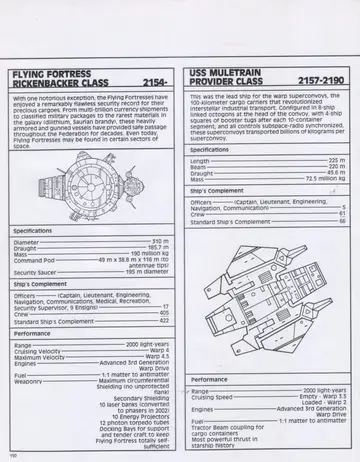
Flying Fortress: Rickenbacker Class (2154- )
With one notorious exception, the Flying Fortresses have enjoyed a remarkably flawless security record for their precious cargoes. From multi-trillion currency shipments to classified military packages to the rarest materials in the galaxy (dilithium, Saurian brandy), these heavily armored and gunned vessels have provided safe passage throughout the Federation for decades. Even today, these Flying Fortresses may be found in certain sectors of space.
Specifications
- Diameter: 310 m
- Draught: 185.7 m
- Mass: 190 million kg
- Command Pod: 49 m x 38.8 m x 116 m (to antennae tips)
- Security Saucer: 195 m diameter
Ship's Complement
- Officers (Captain, Lieutenant, Engineering, Navigation, Communications, Medical, Recreation, Security Supervisor, 9 Ensigns): 17
- Crew: 405
- Standard Ship's Complement: 422
Performance
- Range: 2000 light-years
- Cruising Velocity: Warp 4
- Maximum Velocity: Warp 4.5
- Engines: Advanced 3rd Generation Warp Drive
- Fuel: 1:1 matter to antimatter
- Weaponry: Maximum circumferential shielding (no unprotected flank); Secondary Shielding; 10 laser banks (converted to phasers in 2002); 10 Energy Projectors; 12 photon torpedo tubes; Docking Bays for support and tender craft to keep Flying Fortress totally self-sufficient; Tractor Beam coupling for cargo containers; Most powerful thrust in starship history
USS Muletrain: Provider Class (2157-2190)
This was the lead ship for the warp superconvoys, the 100-kilometer cargo carriers that revolutionized interstellar industrial transport. Configured in 8-ship linked octogons at the head of the convoy, with 4-ship squares of booster tugs after each 10-container segment, and all controls subspace-radio synchronized, these superconvoys transported billions of kilograms per superconvoy.
Specifications
- Length: 225 m
- Beam: 220 m
- Draught: 45.6 m
- Mass: 72.5 million kg
Ship's Complement
- Officers (Captain, Lieutenant, Engineering, Navigation, Communication): 5
- Crew: 61
- Standard Ship's Complement: 66
Performance
- Range: 2000 light-years
- Cruising Speed: Empty - Warp 3.5; Loaded - Warp 2
- Engines: Advanced 3rd Generation Warp Drive
- Fuel: 1:1 matter to antimatter
- Tractor Beam coupling for cargo containers
- Most powerful thrust in starship history