8.1 Ships: USS King Charles, USS Tritium, USS Dewey, Starliner Shuttleplane
An illustrated ships chronology of 2126-2150 presenting a year-by-year timeline of events alongside a gallery of period spacecraft, followed by detailed specification sheets for the luxurious USS King Charles (Stellarford Class) starliner and the disastrous USS Tritium (Tritium Class) three-nacelle cruiser.
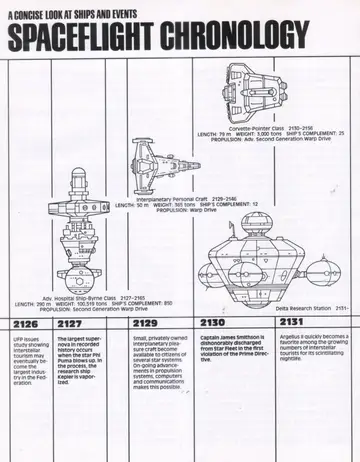
A Concise Look at Ships and Events: Spaceflight Chronology
2126—UFP issues study showing interstellar tourism may eventually become the largest industry in the Federation.
2127—The largest supernova in recorded history occurs when the star Phi Puma blows up. In the process, the research ship Kepler is vaporized.
2129—Small, privately owned interplanetary pleasure craft become available to citizens of several star systems. On-going advancements in propulsion systems, computers and communications makes this possible.
2130—Captain James Smithson is dishonorably discharged from Star Fleet in the first violation of the Prime Directive.
2131—Argelius II quickly becomes a favorite among the growing numbers of interstellar tourists for its scintillating nightlife.
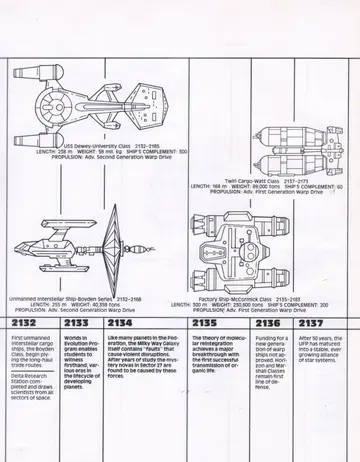
2132—First unmanned interstellar cargo ships, the Boyden Class, begin plying the long-haul trade routes. Delta Research Station completed and draws scientists from all sectors of space.
2133—Worlds in Evolution Program enables students to witness firsthand, various eras in the lifecycle of developing planets.
2134—Like many planets in the Federation, the Milky Way Galaxy itself contains “faults” that cause violent disruptions. After years of study the mystery novas in Sector 27 are found to be caused by these forces.
2135—The theory of molecular reintegration achieves a major breakthrough with the first successful transmission of organic life.
2136—Funding for a new generation of warp ships not approved. Horizon and Marshall Classes remain first line of defense.
2137—After 50 years, the UFP has matured into a stable, ever growing alliance of star systems.
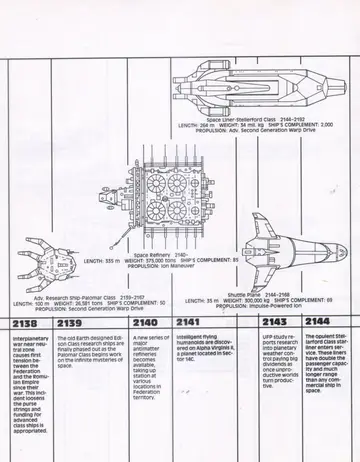
2138—Interplanetary war near neutral zone causes first tension between the Federation and the Romulan Empire since their war. This incident loosens the purse strings and funding for advanced class ships is appropriated.
2139—The old Earth designed Edison Class research ships are finally phased out as the Palomar Class begins work on the infinite mysteries of space.
2140—A new series of major antimatter refineries becomes available, taking up station at various locations in Federation territory.
2141—Intelligent flying humanoids are discovered on Alpha Virginis II, a planet located in Sector 14C.
2143—UFP study reports research into planetary weather control paying big dividends as once unproductive worlds turn productive.
2144—The opulent Stellarford Class starliner enters service. These liners have double the passenger capacity and much longer range than any commercial ship in space.
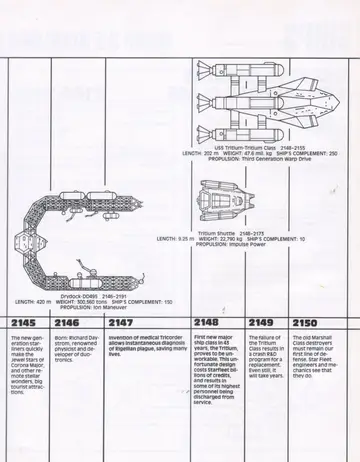
2145—The new generation starliners quickly make the Jewel Stars of Corona Major, and other remote stellar wonders, big tourist attractions.
2146—Born: Richard Daystrom, renowned physicist and developer of duotronics.
2147—Invention of medical Tricorder allows instantaneous diagnosis of Rigellian plague, saving many lives.
2148—First new major ship class in 43 years, the Tritium, proves to be unworkable. This unfortunate design costs Starfleet billions of credits, and results in some of its highest personnel being discharged from service.
2149—The failure of the Tritium Class results in a crash R&D program for a replacement. Even still, it will take years.
2150—The old Marshall Class destroyers must remain our first line of defense. Star Fleet engineers and mechanics see that they do.
Ship Gallery
- Corvette—Pointer Class (2130-2156). Length: 79 m. Weight: 3,000 tons. Ship's Complement: 25. Propulsion: Adv. Second Generation Warp Drive.
- Interplanetary Personal Craft (2129-2146). Length: 50 m. Weight: 365 tons. Ship's Complement: 12. Propulsion: Warp Drive.
- Adv. Hospital Ship—Byrne Class (2127-2165). Length: 290 m. Weight: 100,519 tons. Ship's Complement: 850. Propulsion: Second Generation Warp Drive.
- Delta Research Station (2131- ).
- USS Dewey—University Class (2132-2185). Length: 238 m. Weight: 58 mil. kg. Ship's Complement: 300. Propulsion: Adv. Second Generation Warp Drive.
- Twin Cargo—Watt Class (2137-2173). Length: 164 m. Weight: 89,000 tons. Ship's Complement: 60. Propulsion: Adv. First Generation Warp Drive.
- Unmanned Interstellar Ship—Boyden Series (2132-2168). Length: 255 m. Weight: 40,358 tons. Propulsion: Adv. Second Generation Warp Drive.
- Factory Ship—McCormick Class (2135-2183). Length: 300 m. Weight: 230,600 tons. Ship's Complement: 200. Propulsion: Adv. First Generation Warp Drive.
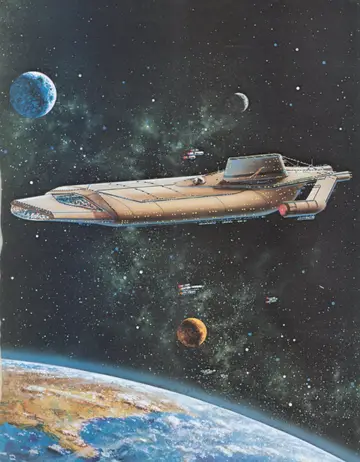
- Space Liner—Stellarford Class (2144-2192). Length: 264 m. Weight: 34 mil. kg. Ship's Complement: 2,000. Propulsion: Adv. Second Generation Warp Drive.
- Space Refinery (2140- ). Length: 335 m. Weight: 375,000 tons. Ship's Complement: 85. Propulsion: Ion Maneuver.
- Adv. Research Ship—Palomar Class (2139-2167). Length: 100 m. Weight: 26,581 tons. Ship's Complement: 50. Propulsion: Second Generation Warp Drive.
- Shuttle Plane (2144-2168). Length: 35 m. Weight: 300,000 kg. Ship's Complement: 69. Propulsion: Impulse-Powered Ion.
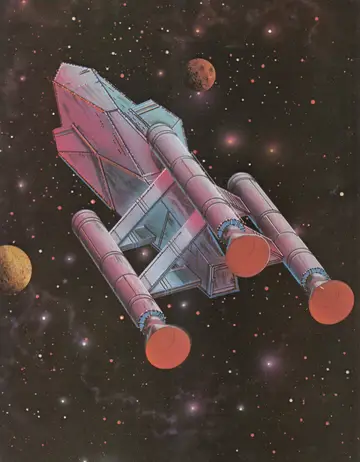
- USS Tritium—Tritium Class (2148-2155). Length: 202 m. Weight: 47.6 mil. kg. Ship's Complement: 250. Propulsion: Third Generation Warp Drive.
- Tritium Shuttle (2148-2173). Length: 9.25 m. Weight: 22,790 kg. Ship's Complement: 10. Propulsion: Impulse Power.
- Drydock—DD495 (2146-2191). Length: 420 m. Weight: 300,560 tons. Ship's Complement: 150. Propulsion: Ion Maneuver.
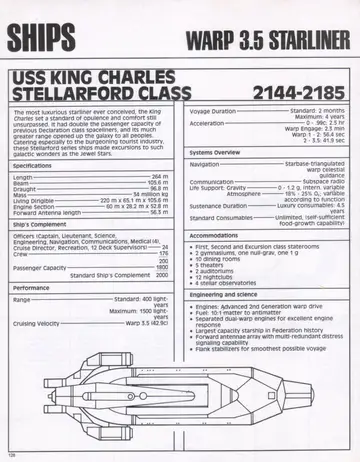
USS King Charles: Stellarford Class (2144-2185)
The most luxurious starliner ever conceived, the King Charles set a standard of opulence and comfort still unsurpassed. It had double the passenger capacity of previous Declaration class spaceliners, and its much greater range opened up the galaxy to all peoples. Catering especially to the burgeoning tourist industry, these Stellarford series ships made excursions to such galactic wonders as the Jewel Stars.
Specifications
- Length: 264 m
- Beam: 105.6 m
- Draught: 96.8 m
- Mass: 34 million kg
- Living Dirigible: 220 m x 65.1 m x 105.6 m
- Engine Section: 60 m x 28.2 m x 52.8 m
- Forward Antenna length: 56.3 m
Voyage
- Voyage Duration: standard 2 months; maximum 4 years
- Acceleration: 0 - .99c: 2.5 hr; Warp Engage: 2.3 min; Warp 1 - 2: 56.4 sec; Warp 2 - 3.5: 41.9 sec
- Range: standard 400 light-years; maximum 1500 light-years
- Cruising Velocity: Warp 3.5 (42.9c)
Systems Overview
- Navigation: Starbase-triangulated warp celestial guidance
- Communication: subspace radio
- Life Support: Gravity 0 - 1.2 g, internally variable; Atmosphere 18% - 25% O2, variable according to function
- Sustenance Duration: Luxury consumables 4.5 years; Consumables unlimited (self-sufficient food-growth capability)
Ship's Complement
- Officers (Captain, Lieutenant, Science, Engineering, Navigation, Communications, Medical (4), Cruise Director, Recreation, 12 Deck Supervisors): 24
- Crew: 176
- Passenger Capacity: 1800
- Standard Ship's Complement: 2000
Accommodations
- First, Second and Excursion class staterooms
- 2 gymnasiums, one null-grav, one 1 g
- 10 dining rooms
- 5 theaters
- 12 nightclubs
- 4 stellar observatories
Engineering and Science
- Engines: Advanced 2nd Generation warp drive
- Fuel: 10:1 matter to antimatter
- Separated dual-warp engines for excellent engine response
- Largest capacity starship in Federation history
- Forward antennae array with multi-redundant distress signaling capability
- Flank stabilizers for smoothest possible voyage
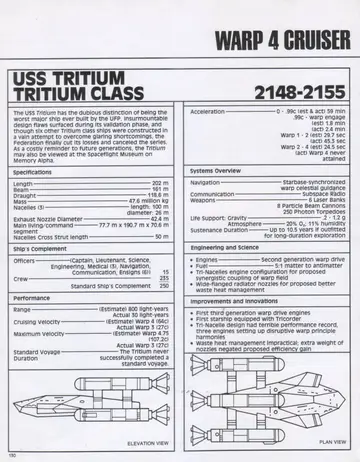
USS Tritium: Tritium Class (2148-2155)
The USS Tritium has the dubious distinction of being the worst major ship ever built by the UFP. Insurmountable design flaws surfaced during its validation phase, and though six other Tritium class ships were constructed in a vain attempt to overcome glaring shortcomings, the Federation finally cut its losses and canceled the series. As a costly reminder to future generations, the Tritium may also be viewed at the Spaceflight Museum on Memory Alpha.
Specifications
- Length: 202 m
- Beam: 161 m
- Draught: 118.6 m
- Mass: 47.6 million kg
- Nacelles (3): length 100 m; diameter 26 m
- Exhaust Nozzle Diameter: 42.4 m
- Main living/command segment: 77.7 m x 190.7 m x 70.6 m
- Nacelles Cross Strut length: 50 m
Performance
- Acceleration: 0 - .99c (est & act) 59 min; .99c - warp engage (est) 1.8 min, (act) 2.4 min; Warp 1 - 2 (est) 29.7 sec, (act) 45.3 sec; Warp 2 - 4 (est) 24.5 sec, (act) warp 4 never attained
- Range: (Estimate) 800 light-years; (Actual) 30 light-years
- Maximum Velocity: (Estimate) Warp 4.75 (107.2c); (Actual) Warp 3 (27c)
- Standard Voyage Duration: The Tritium never successfully completed a standard voyage.
Systems Overview
- Navigation: Starbase-synchronized warp celestial guidance
- Communication: Subspace Radio
- Weapons: 6 Laser Banks; 8 Particle Beam Cannons; 250 Photon Torpedoes
- Life Support: Gravity 2 - 1.2 g; Atmosphere 20% O2, 11% humidity
- Sustenance Duration: Up to 10.5 years if outfitted for long-duration exploration
Ship's Complement
- Officers (Captain, Lieutenant, Science, Engineering, Medical (3), Navigation, Communication, Ensigns (6)): 15
- Crew: 235
- Standard Ship's Complement: 250
Engineering and Science
- Engines: Second generation warp drive
- Fuel: 5:1 matter to antimatter
- Tri-Nacelles engine configuration for proposed synergistic coupling of warp field
- Wide-flanged radiator nozzles for proposed better waste heat management
Improvements and Innovations
- First third generation warp drive engines
- First starship equipped with Tricorder
- Tri-Nacelle design had terrible performance record, setting up disruptive warp principle
- Waste heat management impractical; extra weight of nozzles negated proposed efficiency gain