2.4 Official Logs
Reconstructed twentieth-century news reports and a preface chronicle the major early spaceflight events, from Sputnik 1 and the first manned flights through Apollo 11, the Outer Space Treaty, Skylab, the Apollo-Soyuz link-up, the end of the Space Shuttle series, the mystery ship leaving the Solar System and the opening of the Goddard Moonbase.
Launching of First Earth Satellite
Based on TASS news release, 1957
In the exploratory spirit of this International Geophysical Year, the first artificial satellite of the Earth was successfully launched today, October 4, by the Union of Soviet Socialist Republics. This successful launching of Sputnik 1 represents the culmination of years of tireless research by the worker-scientists of the Republic and proves that the free and conscious labor of the people can turn even the most daring of man's dreams into reality.
According to first reports, the propulsion rocket performed flawlessly in achieving the required orbital velocity of 8000 m/sec. The satellite is presently describing an elliptical trajectory around the Earth which will enable it to pass over the capital city of Moscow twice tomorrow, at 1:46 A.M. and 6:42 A.M.
Sputnik 1 is of spherical design, fifty-eight centimeters in diameter, and weighing 83.6 kilograms. It will travel at altitudes of up to 900 kilometers and calculations indicate it should remain in orbit three months, after which it will burn up like a meteor as it reenters the denser layers of the atmosphere.
The possibility of cosmic flight with rockets was first theoretically substantiated in Russia by the aeronautical visionary Konstantin Tsiolkovsky. Today, the work this great man of the nineteenth century inaugurated has become a reality through the efforts of great men of the twentieth century.
United States Enters Space Race
America launches Explorer 1. Based on New York Times report of Jan. 31, 1958
President Eisenhower announced today the United States Army has successfully placed a scientific satellite into orbit around the Earth. "This launching is part of our country's participation in the International Geophysical Year," the President stated, further promising, "All information received from this satellite will promptly be made available to the scientific community of the world."
The Soviet Union, first to orbit a scientific satellite, has come under criticism for the secrecy surrounding its space program. With America's entry into what some are already calling a space race, the president hoped the flow of scientific knowledge could proceed unimpeded by political considerations. Following up on that, the vice-president hailed the Explorer 1 launching as a victory for the United States' peace policy.
The thirty-one pound satellite was put into orbit by a modified seventy-foot-tall Jupiter-C rocket. The rocket, developed jointly by the Army Ballistic Missile Agency (ABMA) in Huntsville, Alabama, and the Jet Propulsion Laboratory of California, was in three stages, the first using liquid propellant with the upper stages solid propellant.
As firing time neared at Cape Canaveral, an anxious silence fell over the crowd gathered there to witness the historic event. Just a few weeks ago, America's first attempt to launch a satellite failed as the rocket blew up on ignition. This time, blast-off was heralded by a billowing orange cloud of fire that thrust from the base of the rocket in all directions. As the spectators held their collective breath, the Jupiter-C, which rose painfully slowly at first as it cleared its launch pad, quickly picked up speed and shot into the nighttime sky. The people spontaneously cheered as America entered the race for space, and mankind began a new dawn of exploration.
First Man in Space
Soviet Cosmonaut orbits Earth. Based on official Soviet radio announcement of April 12, 1961
...We interrupt our regularly scheduled programming for a momentous message to the peoples of the Republic...
The Union of Soviet Socialist Republics announced this morning it has successfully put the first man into orbit around the Earth. The name of this Cosmonaut is Major Yuri Gagarin. He was launched in a sputnik named Vostok 1. His sputnik revolved once around the Earth at a minimum altitude of 176 kilometers and a maximum of 302 kilometers. The weight of the space capsule was 4734 kilograms and the flight lasted 108 minutes.
Major Gagarin proclaimed upon returning, "Please report to the Party and the People that the landing was normal. I feel well and have no injuries or bruises."
Major Gagarin, who is twenty-seven years old and married, is an industrial technician. He received extensive pre-flight training in preparation for this historic flight, training that he himself will now give to future cosmonauts.
Premier Khrushchev has hailed this great feat as another first for the Soviet Union and invites all Soviet citizens to take Communist pride in this achievement. The space race, he declared, is yet another example of the historic Marxist-Leninist dialectic which will see the honest workers triumphant over the capitalist oppressors...
...That concludes our special report. We now return to regular programming.
Preface
The first decades of man's spaceflight were yet disorganized times, marked by rapid breakthroughs and heady competition among participating nation-states. However, unlike the Logs, which have been faithfully kept since the inauguration of the United Space Initiative, no comprehensive information retrieval system existed back then. Announcements of space events were apt to appear in any number of media: radio, video, daily newspapers, and periodic journals of popular or scientific appeal. In addition, reporting was often tinged with propaganda for the particular nation-state responsible for the event.
To give the flavor of those rawboned, vibrant first years of space exploration, the Editors have reconstructed announcements of the major events as they might have appeared in the twentieth century media. The remainder of this history, from 2003 to the present era, will employ the standardized Log format that is the norm for Federation Spaceflight Chronology.
First International Outer Space Treaty Signed
From the United Nations Bulletin, 1967
The General Assembly of the United Nations has, after two years of consideration, signed the Treaty of Principles Governing the Activities of States in the Exploration and Use of Outer Space; also known as the Outer Space Treaty.
This document is the first to address the global implications of spaceflight by stressing both the peaceful exploration and use of outer space, including the moon and other celestial bodies, shall be carried out for the benefit, and in the interest of all mankind.
The Outer Space Treaty limits countries exclusively to peaceful activities in space and specifically prohibits the use of nuclear or other arms. To guarantee this, an "oversight provision" allows any country access to another's installations to assure concordance with the military ban.
Of the many legal aspects covered in the Treaty, liability for damages resulting from space accidents and the need to avoid harmful contamination, or other adverse changes, to the terrestrial environment could prove to be two of the most important.
Finally, to imbue the spirit of international cooperation such humane considerations as, "Astronauts of one nation shall render all possible assistance to astronauts of another nation," are liberally found throughout the document.
Diplomatic sources agree the 1967 Outer Space Treaty represents the first important international step in the exploration of space and will, in years to come, be a model for all future international agreements.
First Man on the Moon
Based on New York Times report of July 21, 1969
Today, two American astronauts of Apollo 11 navigated their gawky lunar module onto the powdery surface of the Sea of Tranquility, fulfilling a decade-long national goal and a timeless dream of mankind. Man had made it to the moon.
The following transcript between the Lunar lander Eagle and NASA officials at the Houston, Texas ground control records the historic moment:
Eagle: Houston, Tranquility Base here. The Eagle has landed.
Houston: Roger, Tranquility, we copy you on the ground. You've got a bunch of guys about to turn blue. We're breathing again. Thanks a lot.
Tranquility Base: Thank you.
Houston: You're looking good here.
Tranquility Base: A very smooth touchdown.
Columbia (the Command Module orbiting moon): How do you read me?
Houston: Columbia, he has landed Tranquility Base. Eagle is at Tranquility.
Columbia: Yeah, I heard the whole thing.
Houston: Well, it's a good show.
Columbia: Fantastic.
Tranquility Base: I'll second that.
Six and a half hours later, with his landing companion, Edwin "Buzz" Aldrin looking on, the Apollo Commander, Neil A. Armstrong, left the fragile security of Tranquility Base and became the first man to step foot on Earth's celestial partner.
"That's one small step for a man, one giant leap for mankind," declared Mr. Armstrong, in words that will probably be remembered for centuries.
The President of the United States called the astronauts at Tranquility Base to convey his country's profound gratitude for their courageous feat. "Because of what you have done, the heavens have become a part of man's world," he said. "For one priceless moment, the whole history of man, all the people of this Earth are truly one."
The two astronauts will conduct experiments and take samples of the moon crust back with them, which should provide invaluable insights into our celestial neighbor.
U.S. Puts Space Station Into Orbit
Skylab will be the astronauts home away from home. Based on Newsweek magazine report, 1973
Another era in space exploration began this week when Skylab was launched from Cape Kennedy, Florida. This orbiting research station will provide a semi-permanent home for astronauts studying outer space, themselves and our world.
By previous standards, Skylab has an almost opulent amount of accommodation for the three astronauts to live and work in. Made from a converted Saturn booster shell, the main workshop area is forty-eight feet long and 21.5 feet in diameter. It is divided into two decks, one serving as a laboratory for experimentation and the other as the crew's living quarters. In addition, there's an airlock module for space walks and a multiple docking adaptor to link the station with the Command Module for transportation to and from Earth. Three man crews will be rotated on a continuing basis, the length of residence increasing with each stay.
Skylab will serve several purposes. It will provide the first suitable environment to study the effects of long-term weightlessness on man, information which is vitally important for further space exploration. Its sophisticated cameras will furnish us with high-resolution pictures to be used for mineral exploration, crop surveying, oceanography, better land-use management and cartography. The data gathered from these photographs alone should economically justify Skylab's expense. In addition, a whole range of corollary scientific experiments is planned in such areas as astrophysics, botany and metals processing.
Skylab will give us more understanding of our world than ever before, and, the hope is, more understanding of the peoples who inhabit it.
US-USSR Link-Up in Space
Apollo-Soyuz fly first joint mission. Based on Time magazine report, 1975
The air-lock opened and U.S. Astronaut Thomas Stafford stared across the docking module at his green-suited Soviet counterpart Aleksei Leonov. The men grinned at one another and each extended his hand in a gesture of profound significance for mankind. The link-up had worked!
This historic handclasp was the culmination of two years of cooperative effort between the United States and the Soviet Union. The astronauts and cosmonauts had exchanged visits, studied each other's equipment and language, and thoroughly geared themselves for the difficult challenge of linking up spacecraft of different nations in Earth orbit.
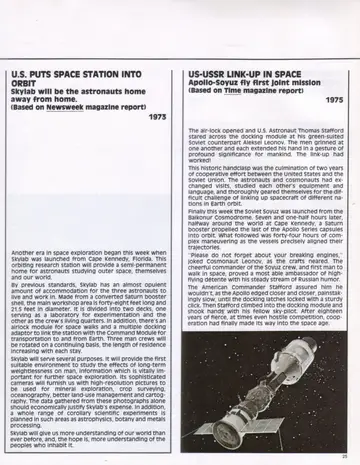
Finally this week the Soviet Soyuz was launched from the Baikonur Cosmodrome. Seven and one-half hours later, halfway around the world at Cape Kennedy, a Saturn booster propelled the last of the Apollo Series capsules into orbit. What followed was forty-four hours of complex maneuvering as the vessels precisely aligned their trajectories.
"Please do not forget about your breaking engines," joked Cosmonaut Leonov, as the crafts neared. The cheerful commander of the Soyuz crew, and first man to walk in space, proved a most able ambassador of high-flying détente with his steady stream of Russian humor.
The American Commander Stafford assured him he wouldn't, as the Apollo edged closer and closer, painstakingly slow, until the docking latches locked with a sturdy click. Then Stafford climbed into the docking module and shook hands with his fellow sky-pilot. After eighteen years of fierce, at times even hostile competition, cooperation had finally made its way into the space age.
Space Shuttle Ends Its Historic Series
Based on NASA News Release, 1992
This week, the Space Shuttle made the last of its 553 flights, thus bringing to a close the most significant space effort so far in human history. And the Earth will never be the same.
Begun at the start of the 1980's, the twelve year series used two generations of reuseable Shuttle Orbiters to launch men and materials into space. The early shuttle flights were oriented primarily toward experimentation and demonstration of the possible uses of the gravity-free vacuum of space. Later missions were directed more towards economically fruitful applications.
Looking specifically at some of its achievements, early shuttle flights were responsible for Spacelab, designed and built by the European Space Agency, a complete scientific laboratory that fit into the spacious 18.29 m by 4.25 m cargo hold. This small space station made significant discoveries about long-term space radiation and the nature of the Earth's upper atmosphere. In addition, the series of orbiting optical and radio telescopes, unimpeded by the atmosphere's blanket, have been sending back invaluable astronomical data for a decade with more benefits from the series still to come. And for the first time, colleges and universities, corporations and even individuals, were able to put into orbit various satellites of space-worthy merit.
Later in the series, the shuttle carried prototypes for what should someday be major space industries in such areas as contamination-free pharmaceuticals, perfect lens manufacturing, and a revolutionary new generation of electronic microcircuits. In fact, the satellite-city, which is currently under design consideration, will be constructed to accommodate these budding space industries.
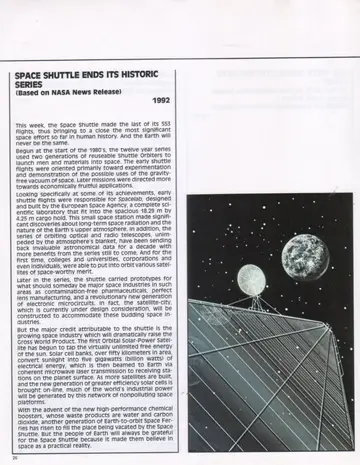
But the major credit attributable to the shuttle is the growing space industry which will dramatically raise the Gross World Product. The first Orbital Solar-Power Satellite has begun to tap the virtually unlimited free energy of the sun. Solar cell banks, over fifty kilometers in area, convert sunlight into five gigawatts (billion watts) of electrical energy, which is then beamed to Earth via coherent microwave laser transmission to receiving stations on the planet surface. As more satellites are built, and the new generation of greater efficiency solar cells is brought on-line, much of the world's industrial power will be generated by this network of nonpolluting space platforms.
With the advent of the new high-performance chemical boosters, whose waste products are water and carbon dioxide, another generation of Earth-to-orbit Space Ferries has risen to fill the place being vacated by the Space Shuttle. But the people of Earth will always be grateful for the Space Shuttle because it made them believe in space as a practical reality.
Mystery Ship Leaves Solar System
Based on United News Service report, 1996
In an apparent postscript to the recently ended Eugenic Wars, radar experts at NASA's Johnson Space Center in Houston, Texas, reported today a rocket was launched from Khanton, the capital of Khan Noonian Singh's collapsed empire. After several revolutions of the Earth, the spacecraft accelerated out of orbit along a trajectory that NASA scientists calculate will take the unknown ship out of the Solar System. The purpose of this flight, its destination, or whether it is manned or unmanned, remain mysteries as of this time. However, it is certain on its present course and speed, no human could live long enough to reach any stellar destination.
Goddard Moonbase Operational
Based on London Times report, 1998
United Nations Representatives of the nine major spacefaring nations met a half million kilometers from their home countries today to witness an historic first: the opening of man's first interplanetary permanent research station, the Goddard Moonbase.
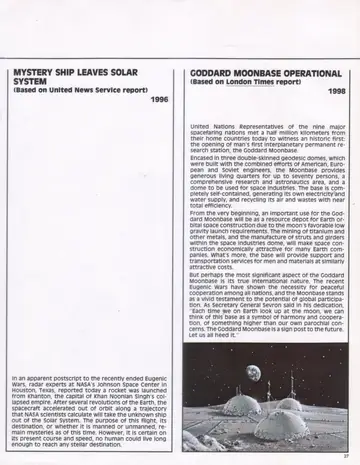
Encased in three double-skinned geodesic domes, which were built with the combined efforts of American, European and Soviet engineers, the Moonbase provides generous living quarters for up to seventy persons, a comprehensive research and astronautics area, and a dome to be used for space industries. The base is completely self-contained, generating its own electricity and water supply, and recycling its air and wastes with near total efficiency.
From the very beginning, an important use for the Goddard Moonbase will be as a resource depot for Earth orbital space construction due to the moon's favorable low gravity launch requirements. The mining of titanium and other metals, and the manufacture of struts and girders within the space industries dome, will make space construction economically attractive for many Earth companies. What's more, the base will provide support and transportation services for men and materials at similarly attractive costs.
But perhaps the most significant aspect of the Goddard Moonbase is its true international nature. The recent Eugenic Wars have shown the necessity for peaceful cooperation among all nations, and the Moonbase stands as a vivid testament to the potential of global participation. As Secretary General Sevron said in his dedication, "Each time we on Earth look up at the moon, we can think of this base as a symbol of harmony and cooperation, of something higher than our own parochial concerns. The Goddard Moonbase is a sign post to the future. Let us all heed it."