7.3 Official Logs
Starship and personnel logs chronicling the era’s key events, from the destruction of Starbase 1 and the Romulan War to the doomed Dual Worlds, the Galactic Cultural Exchange, the galaxy’s oldest civilization, subspace radio, and the extra-galactic probe.
Horizon Journeys to Edge of Galaxy (2102)
USS Garibaldi, Horizon Class; Stuart Mann, Captain.
As its designers had predicted, the USS Horizon became the flagship in the UFP’s exploration program. After its first three-year mission, to a fairly close but previously unexplored sector of Quadrant III, the Horizon was refitted for long-duration flight and sent out once more, toward the edge of the galaxy. Captain Stuart Mann went on to become Admiral Mann, and then Chief of Staff of Star Fleet Command. The Horizon itself was retired to the Federation Spaceflight Museum on Memory Alpha, where this pioneer in interstellar travel may be viewed. The following log represents just one encounter of many this famous starship logged with new worlds.
Captain’s Log: Iotia. A crazy world we leave behind as we warp on our course to the tip of the Milky Way’s Orion arm. So long, Iotia, I enjoyed you more than any of the other twelve civilizations we’ve discovered thus far this mission. Certainly more than the slingshotting Davitos who wouldn’t stop hurling knife-edged rocks at our shuttlecraft. A pitiful defense, but it kept us inside all the same. Felt ridiculous too, you can imagine, bested by a gang of vicious Davids.
But Iotia, at Iotia they made us feel right at home. Is your hair comfortable? they would ask. How are your Earth chairs fashioned? And the next day there would be a dozen Earth-like chairs in our guest quarters. Or walking in their Chief Administrator Byxmyx’s garden, I told him about a formal English garden I visited once on Earthside R&R. Overnight, he ripped up his own garden and laid out one like that, with the closest Iotian equivalent of pink ivy and spiny boxwood. Talk about hospitality.
Before we took our leave, Byxmyx asked if he could borrow a few books about Earth, which from our reports he found altogether admirable. I “lent” him some from my personal library, knowing full well we would never return. But his friendliness was infectious. Funny, too, but I could swear he had picked up a few of my vocal inflections. And he even began to limp a little, as I still do from that nasty fall I took on Alpha Cruci a few stardates ago. Well, they say imitation is the sincerest form of flattery.
Starbase 1 Destroyed by Romulan Warships (2103)
USS Garibaldi, Horizon Class; Tonsum Han, Commodore.
Commodore’s Log: Our relief fleet has arrived too late. Starbase 1 has been destroyed. There are no survivors. There is only an expanding ring of blasted debris where Starbase 1 used to be. Who are these Romulans mentioned before their warp communications were jammed? Let me review the transmissions.
First: Deployment Alert: Delta II reported under heavy attack by unknown enemy force. Dispatching Starbase Perimeter Fleet at warp capacity to reinforce planet defenses. They’re not going to get away with it this time.
Obviously a well thought-out decoy to strip the Starbase’s primary protection. With the destruction of Delta VII some years before, the enemy must have known a second attack there would be fully responded to. Then, the last, interrupted message:
Mayday! Mayday! Starbase 1 under attack by seven enemy starships. Unable to effectively counter in absence of Perimeter Fleet. We’ve been set up. The first assault knocked out our starboard laser banks, and I’m expecting a second any moment. These alien ships look like some sort of bird of prey. There’s no doubt in my mind these are the Romulans who I’ve heard . . . TRANSMISSION JAMMED.
So we’ve lost one of our most strategic outposts to a calculated ambush by a large military force. No space pirate has seven starships armed heavily enough to destroy an entire starbase. No, these mysterious Romulans are obviously an advanced and ruthless race. They appear to regard the Federation as an adversary to be vanquished mercilessly. I strongly recommend a Mobilization Alert throughout the Federation and all facilities brought to combat readiness. These Romulans are not going to stop at a single starbase. Like it or not, it looks like war is inevitable.
Advance Laser Weaponry Introduced (2104)
USS Poisson, Cavalry Class; Centauri Firing Range; Theodore Weller, Captain.
Captain’s Log — Confidential to Star Fleet Command (Declassified stardate 3492.4). Analysis of Shipboard Laser Prototype:
This has not been a pleasant assignment for me, helping to design a new weapons system that holds such incredible potential for destruction and killing. But whatever destroyed Starbase 1 is an obviously powerful and ruthless foe, and if we’re not prepared, the same fate, I’m sure, awaits us and our home planets.
We’ll be prepared. Rigorous tests and firing demonstrations at the Centauri Firing Range have proven the effectiveness and versatility of the new lasers. For up to 50,000 kilometers, the laser discharge holds the energy potential to penetrate a three-meter thick trititanium block. With computer-sync, the lasers can be warp-accelerated at their target, so this weapon may be used on warp drive vessels. It has a spread departure of 2.3 x 10⁻⁹, which means the coherent high-energy beam widens approximately half a meter in 50,000 km. This is an excellent focus, and the designers are to be commended for the efficiency of the prototype.
The recharge delay is also very acceptable. For the Poisson, we have about a ten second time lapse before we could fire the forward laser again. But on large starships with greater matter/antimatter energy stores, this delay can be reduced to a second or two at the most.
We have also been experimenting with ways to defend against this weapon, and it appears that a modification of standard shielding may deflect the laser’s destructive potential. The laser energy waves are susceptible to magnetic fields, which can deform and diffuse the beam’s power. I recommend a large increase in ship shielding specifically designed with this capability in mind.
There will be a trade-off in the installation of massive shipboard laser weapons. There is only so much energy available to starships for propulsion, life support, shielding and lasers. Obviously, these last two will place a substantial strain on the energy supplies. It may be that a compromise will have to be made between lasers and shielding, switching energy input from one to the other as need dictates.
These lasers are most effective weapons. I hope we never have to use them . . . but I’m sure we will.
Romulan War: First Confrontation (2106)
USS Patton, Marshall Class; Joseph Spadora, Captain.
Star Fleet Alert — WARNING: CODE 1 PRIORITY — Hostile Romulan War Fleet encountered in Tri-Beta Sector advancing on Rigel Star System. Intentions believed to be Invasion and Conquest. Consider Most Dangerous. Repeat — WARNING: CODE 1 PRIORITY — Hostile Romulan War Fleet encountered in Tri-Beta Sector.
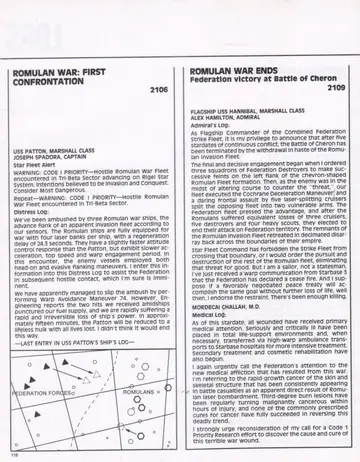
Distress Log: We’ve been ambushed by three Romulan war ships, the advance flank of an apparent invasion fleet according to our sensors. The Romulan ships are fully equipped for war with four laser banks per ship, with a regeneration delay of 24.3 seconds. They have a brash attitude and control response than the Patton, but exhibit slower acceleration, top speed and warp engagement period. In this encounter, the enemy vessels employed both head-on and evasive flanking maneuvers. I enter this information into this Distress Log to assist the Federation in subsequent hostile contact, which I’m sure is imminent.
We have apparently managed to slip the ambush by performing Warp Avoidance Maneuver 74. However, Engineering reports the two we received amidships punctured our fuel supply, and we are rapidly suffering a rapid and irreversible loss of ship’s power. In approximately fifteen minutes, the Patton will be reduced to a lifeless hulk with all lives lost. I didn’t think it would end this way. —LAST ENTRY IN USS PATTON’S SHIP’S LOG—
Romulan War Ends: Federation Victory at Battle of Cheron (2109)
Flagship USS Hannibal, Marshall Class; Alex Hamilton, Admiral.
Admiral’s Log: As Flagship Commander of the Combined Federation Strike Fleet, it is my privilege to announce that after five stardates of continuous conflict, the Battle of Cheron has been terminated by the withdrawal in haste of the Romulan Invasion Fleet.
The final and decisive engagement began when I ordered three squadrons of Federation Destroyers to make successive feints on the left flank of the chevron-shaped Romulan Fleet formation. Then, as the enemy was in the midst of altering course to counter the “threat,” our fleet executed the Cochrane Deceleration Maneuver, and a daring frontal assault by five laser-splitting cruisers split the opposing fleet into two vulnerable arms. The Federation fleet pressed the advantage, and after the Romulans suffered equivalent losses of three cruisers, five destroyers and four heavy scouts, they elected to end their attack on Federation territory. The remnants of the Romulan Invasion Fleet retreated in decimated disarray back across the boundaries of their empire.
Star Fleet Command has forbidden the Strike Fleet from crossing that boundary, or I would order the pursuit and destruction of the rest of the Romulan fleet, eliminating that threat for good. But I am a sailor, not a statesman. I’ve just received a warp communication from Starbase 3 that the Federation has declared a cease fire. And I suppose if a favorably negotiated peace treaty will accomplish the same goal without further loss of life, well then, I endorse the restraint. There’s been enough killing.
Mordecai Challah, M.D. Medical Log: As of this stardate, all wounded have received primary medical attention. Seriously and critically ill have been placed in total life-support environments and, when necessary, transferred via high-warp ambulance transports to Starbase hospitals for more intensive treatment. Secondary treatment and cosmetic rehabilitation have also begun.
I again urgently call the Federation’s attention to the new medical affliction that has resulted from this war. I’m referring to the rapid-growth cancer of the skin and skeletal structure that has been consistently appearing in battle casualties as an apparent direct result of Romulan laser bombardment. Third-degree burn lesions have been regularly turning malignantly cancerous within hours of injury, and none of the commonly prescribed cures for cancer have fully succeeded in reversing this deadly trend. I strongly urge reconsideration of my call for a Code 1 Priority Research effort to discover the cause and cure of this terrible war wound.
Discovery of Dual Worlds (2115)
USS Gemini, Libran Class; Carlos Dos Passos, Captain.
The Pyrimiis Star System was the first system discovered to have two inhabited planets in the same orbital trajectory. It was an extremely unstable situation, as outlined below, and is a celestial rarity, especially considering that both were populated. Seventeen other such dual worlds have subsequently been found, none of which supported life.
Captain’s Log: I’m recording an Official Lifeform Encounter, but it is the first I take little pleasure in so doing. I picture our arrival at a new planet as cause for celebration; instead, we bring these two planets their death sentence.
Pyrimiis I and Pyrimiis II are the only two planets in this star system, and they travel in the identical orbit, something I’ve never seen before. The inhabitants of Pyrimiis I are intelligent humanoids, in a stage of development roughly corresponding to the Renaissance period on Earth. They have discovered the principle of the telescope and have been eagerly viewing their solar neighbor. Pyrimiis II is less advanced, but they likewise consider a close bond to exist between them and their twin planet.
There’s a close bond all right. Computer calculations demonstrate that without a doubt, these two planets are on a collision course. A minute difference in daily rotation has finally upset the eon-old balance that’s kept the planets in synchronized orbit, and in fifteen more revolutions (13.7 Solar Years), the gravitational attraction between planets will draw them into each other with catastrophic results. Already surface sensor scans show increased tidal activity and an alarmingly high amount of seismic disturbance.
The tragic part of all this is the response I got when I informed the planets of the impending destruction of their worlds. It seems that on both planets, independent of one another, a religion has sprung up worshipping the mystical union of these brother planets. The coming collision is not seen in deadly terms but rather as a final reunion with sundered halves of the same race and world. My offer of planetary spacelift fell on deaf ears, and they positively forbid any interference in what they see as the greatest event in their history. Well, it’ll be the greatest all right. It will also be the last.
Galactic Cultural Exchange Begins Touring Federation (2118)
USS Hurok, Broadway Class; Vladimir Kossensko, Impresario.
Personal Log: Saturn save me from bureaucrats.
Here I am, Impresario for the greatest touring circus the galaxy has ever seen. Andorian acrobats I have, and Petaluma jugglers. Tellarite Mugato-tamers and Rigellian serpent-charmers. Dead-eye sharpshooters and master illusionists, daredevil cannonballers, fireeaters, diving fools and dagger-darters. Plus the most fabulous midway ever assembled under one dome, just barely containing the largest, strangest, fiercest creatures in the explored expanses of interstellar space. Dazzling costumes, sparkling music, impeccable stage timing and seven rings of continuous entertainment for children of every age and world.
Not to mention the clowns. Most especially the clowns. Sad clown, happy clowns, baggy-panted, pie-catching, skin-slipping clowns, the delight of millions of circus-goers everywhere. The clowns always end up stealing the show. For what could be more universal than laughter?
Enter the bureaucrat, the drone in charge of scheduling for the Cultural Exchange Project. This is a Federation-sponsored tour is it not? he figures. At Rigel, we ravished them. Tellar was ours totally. Andor asked us for encore after encore. Vulcan.
Vulcan is a member of the UFP, after all. Therefore, the brilliant bureaucrat decided they too were entitled to see the greatest circus in the galaxy. A flawless bit of logic.
So for five interminable performances, we staged the greatest spectacle of them all before a Vulcan audience who computed risk-assessments of the acrobats and daredevils, discussed comparative anatomy on the midway, and analyzed the mathematical permutations of the juggling acts. But the clowns, the clowns they couldn’t fathom. Clowns, you see, are not logical.
By the final show, I had a circus troupe at the very brink of mutiny, led by the illogical clowns. I consider it the sheerest luck we managed to warp out of Vulcan orbit before any of them were driven to murder. Saturn save me from bureaucrats.
Galaxy’s Oldest Civilization Discovered (2120)
USS Schlieman, Placido Class; Dr. Helmut Kreutzer, Anthropology and Archeology Officer.
Anthropology and Archeology Log: Our first surface visit to planet 522-IV has generated some extraordinary data. And to think we almost bypassed this world for lack of lifeform readings! What it appears we’ve stumbled across is, quite simply, the near-perfectly preserved remains of the oldest civilization ever found in the galaxy.
Isotope dating pointed to staggering antiquity, but I found more specific information in an engraved starmap faceted into one of the structure’s transparent diamond ceilings. Computer extrapolation of the star shift, caused by the recession of the galaxy, has produced an incredible figure: that starmap is 7.5 billion years old. Seven point five billion years. The Earth itself is only four and one-half billion years old. Three thousand millennia before that, a race walked the streets of the hauntingly beautiful city we visited this stardate.
An extremely advanced race, also. The city’s buildings are of some ageless, hardened lead alloy that time has barely touched. And in general, all fabricated materials show little corrosion or degeneration. The machinery, of course, has long since stopped functioning, but it seems all facets of physical upkeep and industrial production were taken care of by self-regulating, self-replicating machines.
But this preservation is only one impressive part of this dead race. Exquisitely sculpted psionic crystals throughout the city indicate a civilization of remarkable psionic abilities. When activated by any crystal-directed thought, the monuments telepathically recount tales showing universal telepathy and mental communication between the planet and its moon, 200,000 kilometers distant. One crystal even shows them literally moving mountains by thought.
The question we found ourselves asking again and again as we toured the deserted streets is — what happened? Here was an advanced society with, one must imagine, all possible lifethreats held in easy check. And it seems one day they all just vanished, got up, left their exquisite homes and parks, and disappeared without a trace into the silent corridors of time. Why?
Breakthrough in Communications: Subspace Radio Installed on Starships (2122)
USS Bellweather, Placido Class; Dr. Stephan Mortimer, Science Officer.
Subspace radio, the technological quantum jump in interstellar communications, has been in use for over ninety years. In that time, it has undergone a continuing evolution in warp speed, accuracy of transmission and reception, and range. Presently, subspace radio can travel at warp 30 and reaches to every part of the explored galaxy.
Science Log: The tremors have ceased. It looks like the earthquake has been successfully spiked, and that the fifteen million inhabitants of Gamma Spica living along the quake’s fault line have been spared catastrophic death. I guess congratulations are in order, so I would like to acknowledge the real hero of this stardate: subspace radio.
When we discovered Gamma Spica, that world was helplessly awaiting the imminent upheaval of a major earthquake through the middle of their Great Valley, the only inhabitable part of the planet. Now, I knew enough about plate tectonics to predict our ship’s lasers could neutralize the quake impetus if fired at the correct critical point along the fault line. But how to determine that point? The Bellweather’s sensors could gather the necessary data, but on-board computers just didn’t have the memory banks to calculate the precise target center. No matter how great the calculating capacity of a computer, without the right software and program the computer can’t come up with the needed determinations.
We could have written a software program on board — I think I remember enough of my beginning computer course at Star Fleet Academy to do that — but the program writing itself would have taken too long for the threatened population of Gamma Spica.
Subspace radio to the rescue. With old-fashioned warp communication, the time delay in relays between here and Starbase 12, the closest Central Computer terminal, would have been over two stardates, and in less than one, millions would have perished. But bless transtator physics for its breakthrough in communications application. Its warp 15 transmission speed got us the needed answer in three solar hours. The lasers were programmed and did the trick. Gamma Spica has been saved.
First Evidence of Extra-Galactic Civilizations (2124)
USS Greyhound, Castor Class; Dr. William Pomeroy, Science Officer.
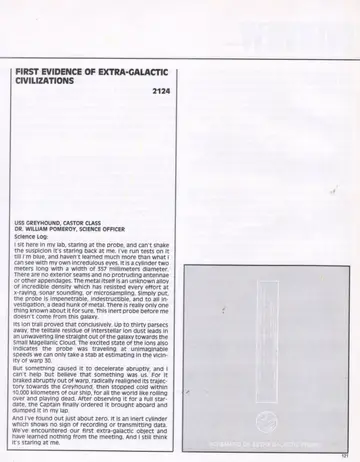
Science Log: I sit here in my lab, staring at the probe, and can’t shake the suspicion it’s staring back at me. I’ve run tests on it till I’m blue, and haven’t learned much more than what I can see with my own incredulous eyes. It is a cylinder two meters long with a width of 357 millimeters diameter. There are no exterior seams and no protruding antennae or other appendages. The metal itself is an unknown alloy of incredible density which has resisted every effort at x-raying, sonar sounding, or microsampling. Simply put, the probe is impenetrable, indestructible, and to all investigation, a dead hunk of metal.
There is really only one thing known about it for sure. This inert probe before me doesn’t come from this galaxy. Its ion trail proved that conclusively. Up to thirty parsecs away, the telltale residue of interstellar ion dust leads in an unwavering line straight out of the galaxy towards the Small Magellanic Cloud. The excited state of the ions also indicates the probe was traveling at unimaginable speeds we can only take a stab at estimating in the vicinity of warp 30.
But something caused it to decelerate abruptly, and I can’t help but believe that something was us. For it braked abruptly out of warp, radically realigned its trajectory towards the Greyhound, then stopped cold within 10,000 kilometers of our ship, for all the world like rolling over and playing dead. After observing it for a full stardate, the Captain finally ordered it brought aboard and dumped it in my lap. And I’ve found out just about zero. It is an inert cylinder which shows no sign of recording or transmitting data. We’ve encountered our first extra-galactic object and have learned nothing from the meeting. And I still think it’s staring at me.