3.4 Official Logs
A series of reconstructed logs and news reports chronicling the major events of 2003-2025: the signing of the United Space Initiative, the birth of the first spacechild, the opening of the first city in space, the spread of Marsbase and the Space Homesteading Act, the discovery of antimatter beyond Pluto, the evidence of alien mining at Saturn, the fossil evidence of Martian life, the loss of the UNSS Courageous, and the solving of Jupiter's Red Spot.
The United Space Initiative
United Nations, Planet Earth, 2003.
Over 200 years old, this document was a landmark in man's spaceflight progress and historic precursor to the United Federation of Planets. From this point on, the combined resources of all spacefaring nations were finally focused on the exploration of the Solar System, and eventually beyond.
Archive Log:
We the peoples of the United Nations, pursuant to our charter obligations to employ international means for the advancement of all peoples, do hereby declare:
THE UNITED SPACE INITIATIVE
This document calls for cooperation in space as follows:
Article 1—Research
All space research activities shall be coordinated to allow the maximum exchange of ideas and information. This shall include all research:
- a. in orbit about the Earth, its moon, or other celestial bodies
- b. at any research bases established on the moon, or other celestial bodies
- c. from interplanetary and interstellar probes
- d. from all other interstellar research, if and when such activity becomes technologically feasible.
Article 2—Joint Settlement
1. This Initiative reaffirms the 1967 Outer Space Treaty, declaring that space belongs to no nation but shall be utilized freely and to the benefit of all peoples.
2. All joint settlements, either in orbit, on the moon or on other planets or locations throughout the Solar System, shall be declared International zones and fall under the jurisdiction of the United Nations.
3. Local autonomy of settlements peopled by one nation or group shall not be covered by Article 2.2. However, all exchanges among autonomous settlements shall fall under the jurisdiction of the United Nations.
Article 3—Exploration and Security
1. Recognizing the future advisability of interplanetary and interstellar exploration and security, this Initiative calls for the establishment of a Solar Fleet, at such time as it becomes technologically feasible to explore the Solar System and beyond, to maintain the rule of law throughout the planets and to protect against unknown hostilities.
2. This Solar Fleet shall include, but not be limited to:
- a. a fleet of ships of a calculated range of classes
- b. a Solar Fleet Command
- c. Solar Bases for the deployment and servicing of the Fleet
- d. a monitoring system to assure solar integrity
- e. an academy to be established in the future to train officers in the specialized fields of space exploration and security.
IN FAITH WHEREOF the representatives of the governments of the United Nations have unanimously signed the present UNITED SPACE INITIATIVE.
DONE at the City of New York, the fifteenth day of October, two thousand and three.
The First Spacechild
Farside Moonbase, 2005. Hans Hovendaal, M.D., Chief Medical Officer.
Medical Log:
It is my very great pleasure to announce that human history was made today with the birth of the first baby born in space.
Radio Telescope Technician 1st Class Rita Ashworth gave birth this morning to a 3.2 kg. boy. Mrs. Ashworth employed natural childbirth, and both mother and baby are doing extremely well. Dr. Weldon Ashworth, of the Astro-Telemetry Section, said their son will be named Jules, after the famous science-fiction writer, Jules Verne, who first envisioned man coming here.
The birth of the first human in space has been realistically considered for years, dating back to the 1970's. In fact, we at the Farside Moonbase have had the capability for doing the job for over a year, but had no expectant mothers. It is to their credit the Ashworths decided six months ago to remain here to have the child. I know it was a trying experience for them, for even the fanside of the moon is no longer a safe haven from the constant inquiries of the world's press.
As assisting physician, I can report the birth was an exceptionally easy one, though I took the precaution of completing the delivery in the operating room in case complications resulted from unknown extraterrestrial causes. The operating room was kept slightly decompressed, and the lower pressure eased the mother's contractions considerably. In general, the moon's lower gravity seemed to help the whole birth process.
But the more difficult question both doctors and potential patients have asked still remains: What effect will being born and raised away from Earth have on children? The Ashworths, of course, know there are risks, which they weighed very carefully before deciding on this course of action. They should be commended for their courage. I personally will be rigorously monitoring young Jules' progress for any unusual growth signs or other anomalies.
For now, I'm proud to be the first to introduce to the world Jules Ashworth, the first space baby. A new generation of man has begun.
First City in Space
250 people move into Tsiolkovskygrad. More are expected. 2007. Boris Karpev, City Supervisor.
Supervisor's Log:
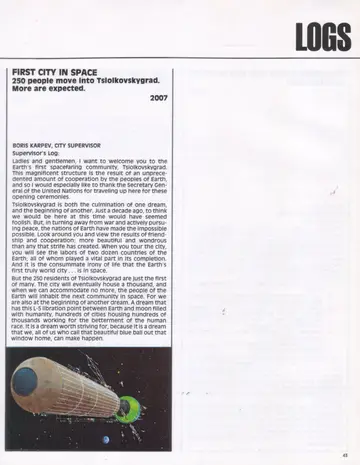
Ladies and gentlemen, I want to welcome you to the Earth's first spacefaring community, Tsiolkovskygrad. This magnificent structure is the result of an unprecedented amount of cooperation by the peoples of Earth, and so I would especially like to thank the Secretary General of the United Nations for traveling up here for these opening ceremonies.
Tsiolkovskygrad is both the culmination of one dream, and the beginning of another. Just a decade ago, to think we would be here at this time would have seemed foolish. But, in turning away from war and actively pursuing peace, the nations of Earth have made the impossible possible. Look around you and view the results of friendship and cooperation; more beautiful and wondrous than any that strife has created. When you tour the city, you will see the labors of two dozen countries of the Earth; all of whom played a vital part in its completion. And it is the consummate irony of life that the Earth's first truly world city . . . is in space.
But the 250 residents of Tsiolkovskygrad are just the first of many. The city will eventually house a thousand, and when we can accommodate no more, the people of the Earth will inhabit the next community in space. For we are also at the beginning of another dream. A dream that has this L-5 libration point between Earth and moon filled with humanity, hundreds of cities housing hundreds of thousands working for the betterment of the human race. It is a dream worth striving for, because it is a dream that we, all of us who call that beautiful blue ball out that window home, can make happen.
Marsbase Opens New Era of Space Exploration
2012. Marsbase 1, Mark Glynn, Director.
Director's Log:
What with erecting the protective geodesic dome that houses Marsbase 1, unloading a year's worth of supplies for a crew of fifteen, getting the automatic refueling plant operational, and calibrating all the delicate scientific sensors, there hasn't been time enough to eat or sleep, much less commence this Log. This, therefore, is the first entry, and following Standard Operating Procedure I am entering into the Log the specific objectives for this first interplanetary base. They are:
- 1. Explore the geology and environment of Mars in depth
- 2. Take astronomical measurements to correlate with those from the Earth and moon
- 3. Make exploratory excursions to the Martian moons, Phobos and Deimos, to establish the feasibility of mining them for condritic minerals and other useful materials
- 4. Examine the long-term effects of living on another planet
- 5. Conduct an intensive search for any signs of Martian life, past or present.
About Objective #4, I can state the short-term effects of Mars are very bearable, even pleasant. Because of the thin atmosphere, there is a beautiful clarity and sharpness to the rocky landscape, and the low pressure and one-third-earth gravity make all physical exertion ridiculously easy. And unlike the frigid moon, daytime temperatures get as high as 20° C., almost like a spring day back on Earth.
As scientists, we can't let personal desires or aspirations interfere with our work. But there is a great unspoken hope among our research team that life in some form will be found on Mars. Writing this at my desk, where I'm being warmed by the noonday sun streaming through the porthole, it's hard for me not to believe that Martian life could exist.
The Final Frontier Opens
Enactment of the Space Homesteading Act, 2014.
This act made space attractive to individuals by creating the powerful incentive of a free space homestead for enterprising pioneers. However, while the exploration of space opened up a realm of near limitless resources for mankind, unlike the frontier of the old American West, more than sheer willingness and romantic dreams were required. Space presented a much more hazardous environment then ever before faced by man and demanded better educated, better skilled and technologically oriented individuals with a high degree of motivation. But above the practical considerations, the Act recognized that space was truly public domain belonging to all people. Anyone wishing to stake a claim and willing to fulfill the five-year residency requirement was then entitled to a piece of space.
The Act proved to be so popular that in the decade following its enactment, the population in space multiplied by 4.5 times to be followed in the next decade by a five-fold jump. (For the complete history of this "People's Act," see The Space Immigrants—The Story of the Homestead Act, by John Bukor, published in 2214.)
Archive Log:
Recognizing the merit and necessity of providing the citizens of the Solar System with such an opportunity, the General Assembly hereby passes the:
SPACE HOMESTEADING ACT OF 2014
Article 1—Definitions
1. A Space Homestead shall be defined as any Solar System body whose volume and/or area is up to, but not exceeding, 100 km. in diameter and approved for homesteading purposes by the U.N. Homestead Commission.
2. Right to such space shall be contingent upon:
- a. the fulfillment of five earth years residency within such volume; and
- b. the construction of at least one permanent personal dwelling environment.
Article II—Rights and Limitations
1. A Space Homestead entitles its owner to exclusive right over all traffic through, and material contained within, its volume and/or area. This specifically includes those parts of the Asteroid Belt approved for homesteading.
2. All homesteaders are entitled to unimpeded access to the Sun.
3. This Homestead Act strictly limits the amount of space a homesteader may claim to the volume and/or areas specified in this Act.
Article III—Homesteading Incentives
1. Transportation to any sector approved for homesteading purposes shall be provided by the United Nations Solar Fleet for the person and immediate family.
2. A low-interest loan, at rates determined by the Homestead Commission, shall be made available to the Homesteader, if so desired.
Antimatter Found Beyond Orbit of Pluto
First generation interstellar probe makes incredible discovery. 2017. UNP U Thant Probe, Stellar Series.
The earliest series of interstellar probes was called, appropriately enough, the Stellar Series. This project, designed by the brilliant space scientist, Jackson Roykirk, was the first to employ the controversial computer capability for elementary independent thought, a capacity then feared by many in a machine. A total of ten of these well designed probes were launched during the years 2015-2022. One, the Nomad, was damaged in a meteor storm and contact subsequently lost with it in 2026. Amazingly, this probe was recently discovered in Sector 21C altered in a way that required it to self-destruct. Another, the U Thant, inadvertently stumbled upon the hitherto unsuspected existence of large amounts of antimatter between stars, and this discovery, recorded in the following Telemetry Log, had repercussions which decades later altered the entire scope of spaceflight.
Weekly Telemetry Readout Log:
- Distance from Pluto: 120.4 A.U.
- Speed: 0.104c
- Elapsed Time since Pluto Flyby: 14 days
- Dist from Barnard's Star: 5.162 x 10¹⁰ km.
- Time till Barnard's Star: 2.449 days
- Power System: 25.7% efficiency
- Navigation System: 99.36% accuracy
- Instrumentation: All monitors functioning
- Communication System: Comp-sync laser at 98.1% opt
- Propulsion System: Accepted performance levels
Interstellar Dust Readout:
- H 90.7% — Fe .07
- He 8.42 — Ni .05
- H2O .46 — Ca .007
- OH .29 — Others .003
Damage Report:
Interstellar gas collector ruptured by explosion—Cause Analysis: matter/antimatter annihilation.
Priority Input—Discovery:
Matter/antimatter annihilation indicates detectable quantities of antimatter in interstellar void.
Repeat: ANTIMATTER FOUND IN INTERSTELLAR VOID.
—End Transmission
Earth-Saturn Mission Makes Remarkable Find
2020. UNSS Lewis and Clark, Aventeur Class. Shaun Jeoffrey Christopher, Colonel.
Colonel's Log:
A geological survey party has just returned from the Fourth Radian Moon Ring area breathless with extraordinary news. We are not the first visitors to these moons of Saturn.
On an orbiting asteroid approximately twenty kilometers in diameter, the survey party came across mine shafts. Yes, deep mine shafts drilled entirely through the rock. And the holes were perfect cylinders, probably cut with some laser-like apparatus alien to Earth technology. It seemed whoever mined this rock removed its contents like you would core an apple.
But that's not all! On a second moon, dotted with outcroppings of metallic salts, there were signs everywhere of surface activity. I have some holographs the mystified crew took, and I can clearly make out some type of tread marks and what looks like some old-fashioned strip mining scars.
As yet, we have no estimation of the date this mining activity took place. Nor have we a clue as to who, or what, was exploiting the moons of Saturn. But this much we do know. Unless there is still some undiscovered advanced industrial civilization hiding from our probes on the outer planets, we have been visited by an extrasolar race. A race of beings who not only carve up planetary bodies at will, but who can travel between the stars at will. Which means that somewhere out there is a civilization a hundred fold, a thousand fold, greater than we are. And the age old question has today been answered: indeed, man is not alone.
Evidence of Life Found on Mars
2021. Marsbase 1, Dr. John Oppenheimer, Science Officer.
Science Log:
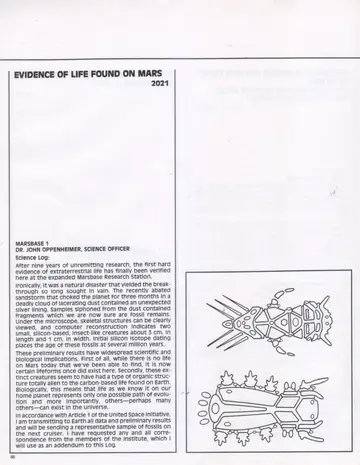
After nine years of unremitting research, the first hard evidence of extraterrestrial life has finally been verified here at the expanded Marsbase Research Station. Ironically, it was a natural disaster that yielded the breakthrough so long sought in vain. The recently abated sandstorm that choked the planet for three months in a deadly cloud of lacerating dust contained an unexpected silver lining. Samples siphoned from the dust contained fragments which we are now sure are fossil remains. Under the microscope, skeletal structures can be clearly viewed, and computer reconstruction indicates two small, silicon-based, insect-like creatures about 3 cm. in length and 1 cm. in width. Initial silicon isotope dating places the age of these fossils at several million years.
These preliminary results have widespread scientific and biological implications. First of all, while there is no life on Mars today that we've been able to find, it is now certain lifeforms once did exist here. Secondly, these extinct creatures seem to have had a type of organic structure totally alien to the carbon-based life found on Earth. Biologically, this means that life as we know it on our home planet represents only one possible path of evolution and more importantly, others—perhaps many others—can exist in the universe.
In accordance with Article 1 of the United Space Initiative, I am transmitting to Earth all data and preliminary results and will be sending a representative sample of fossils on the next cruiser. I have requested any and all correspondence from the members of the Institute, which I will use as an addendum to this Log.
Worst Tragedy in 65 Years of Spaceflight
Spaceship with 62 aboard cannot return home. 2022. UNSS Courageous, Wheeler Class. Fitzsimmons Wallabee, Captain.
Captain's Log:
I have before me the Engineering Damage Report, and it is, for all intents and purposes, the Courageous' death certificate. Yesterday, we discovered a shielding flaw in the engine room during a weekly maintenance check, and before we could return to L-5 docking for repair, a massive solar flare penetrated into the reaction chamber, with deadly consequences. Because acceleration continues at an ever increasing rate, I am dispatching my final log before we lose radio contact home. Any further communication will be by Record Markers we will leave in our wake.
I've informed the crew of the grimness of our plight, and they've all taken the news well—at least as well as could be expected. Helmsman Boyle joked that we've broken the Solar speed record. And Science Officer Portillo has put the time to use measuring the effect this great speed has on the distant star field. Even under sentence of death, this marvelous crew maintains a sense of humor and scientific rigor. I would like to take this opportunity to recommend them all for the Solar Medal of Honor.
Navigation has calculated that upon leaving the Solar System, the Courageous has become a modern-day Flying Dutchman, doomed to sail powerless to its end at the edge of the galaxy.
On a more personal note, I would like to say farewell to my wife, Margaret, and our children, Robert and George. I love you all and will take your memory to my final destination. This is the UNSS Courageous over and out.
Haddad Koire, Engineering Officer.
Engineering Log:
Today's massive solar flare penetrated the shielding flaw in the engine room, inflicting the following damage:
—The fiber-optic computer tubes linking Engineering with Inertial Guidance and Navigation fused, resulting in complete loss of ship control.
—The heat valve to the fission magnetochamber melted, as did the Emergency Shut-down circuit, causing runaway fission reaction.
Reparative Strategy—Electromagnetic clamps fitted around the field valve have slowed input enough to prevent fission engines from turning critical and initiating a nuclear explosion. Acceleration continues at a steady rate.
Prognosis—Hopeless. Fuel supply will be exhausted within the hour, well before emergency procedures can have any effect. Acceleration will cease at a final velocity of .86c (2.5 x 10⁸ m/sec).
Jupiter's Red Spot Reveals Its Secrets
2025. Ganymede Temporary Research Outpost, Dr. Lloyd Elkins, Science Supervisor.
Science Log:
At last we're solving the riddle of the Red Spot of Jupiter. For 400 years, man has speculated over this huge enigma, three times as vast as the Earth itself. But now the data's begun to stream back from the twelve probes we've sent into the giant surface blemish, and the hard facts received are settling this astronomical mystery for good.
The first data is confirming a long-held conjecture: the Spot is the Jovian equivalent of a permanent hurricane. Within the Red Spot, the atmosphere is constantly being whipped into winds of hundreds of kilometers per hour, which rotate around local vortexes—the eye of the storm—and these vortexes themselves revolve around one another according to the magnetic field fluctuations of the inner core.
Of course atmosphere means something quite different on Jupiter, a planet composed almost entirely of hydrogen. The deeper our probes penetrate into the interior of this gaseous world, the stranger the readings we get back. A thousand kilometers in, the hydrogen atmosphere liquifies due to the enormous gravitational pressures, and over 65,000 km. further, the liquid hydrogen becomes liquid metallic hydrogen, a state never before encountered in either nature or laboratory.
This last I'm really excited about, since I've spent my professional career speculating on how the laws of chemistry and physics, as we know them from terrestrial conditions, are radically altered by extreme conditions, like the gravity of Jupiter or the heat of the sun. Liquid metallic hydrogen is the best conductor of magnetism and electricity that could possibly exist, so that small deformations in the iron-silicate core of Jupiter are conducted and magnified by the time they reach the "surface." From the data we're receiving, the Red Spot appears to be a magnetically generated and sustained phenomenon, able to continue for centuries because it is a product of inner core processes and not merely an atmospheric entity. But while the mystery of the Red Spot has been finally solved, for me it in no way diminishes the awesome beauty of this greatest of planetary markings.