4.2 Stellar Explorations: Alpha Centauri
A profile of Alpha Centauri, the trinary system that is Earth's closest stellar neighbor and home to the humanlike civilization that became a founding member of the Federation, together with a map of the era's interstellar exploration routes and a recounting of how fusion propulsion opened the way to the stars.
Alpha Centauri
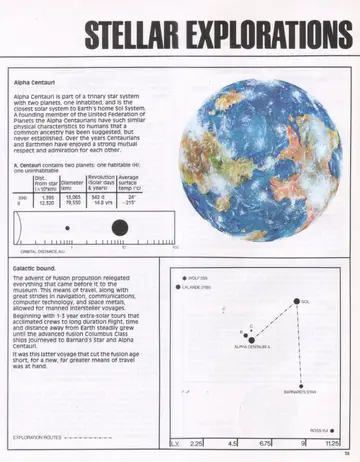
Alpha Centauri is part of a trinary star system with two planets, one inhabited, and is the closest solar system to Earth's home Sol System. A founding member of the United Federation of Planets the Alpha Centaurians have such similar physical characteristics to humans that a common ancestry has been suggested, but never established. Over the years Centaurians and Earthmen have enjoyed a strong mutual respect and admiration for each other.
A Centauri contains two planets: one habitable (H); one uninhabitable.
- Planet I (H): distance from star 1,395 (x10³ km); diameter 13,065 km; revolution 342 d; average surface temp 2°C.
- Planet II: distance from star 12,320 (x10³ km); diameter 78,550 km; revolution 14.8 yrs; average surface temp -215°C.
Galactic Bound
The advent of fusion propulsion relegated everything that came before it to the museum. This means of travel, along with great strides in navigation, communications, computer technology, and space metals, allowed for manned interstellar voyages. Beginning with 1-3 year extra-solar tours that acclimated crews to long duration flight, time and distance away from Earth steadily grew until the advanced fusion Columbus Class ships journeyed to Barnard's Star and Alpha Centauri.
It was this latter voyage that cut the fusion age short, for a new, far greater means of travel was at hand.