8.2 Stellar Explorations: Alpha Virginis II
A profile of Alpha Virginis II, a geologically unstable world whose stable atmosphere produced the highly evolved, peaceable flying Canaris, together with a note on the era's tourism boom and the giant Declaration and Stellarford Class liners that served it.
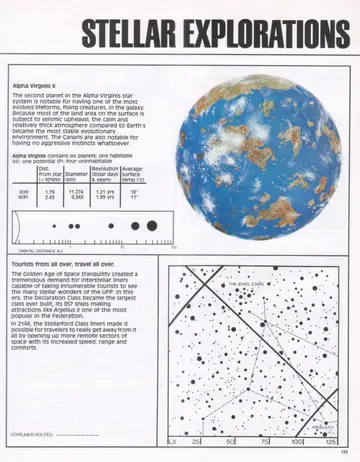
Alpha Virginis II
The second planet in the Alpha Virginis star system is notable for having one of the most evolved lifeforms, flying creatures, in the galaxy. Because most of the land area on the surface is subject to seismic upheaval, the calm and relatively thick atmosphere compared to Earth's became the most stable evolutionary environment. The Canaris are also notable for having no aggressive instincts whatsoever.
Alpha Virginis contains six planets: one habitable (H); one potential (P); four uninhabitable. Planet II (H) lies 1.79 x 10⁸ km from its star, with a diameter of 11,274 km, a revolution of 1.21 solar years, and an average surface temperature of 18° C. Planet III (P) lies 2.43 x 10⁸ km from its star, with a diameter of 9,343 km, a revolution of 1.89 solar years, and an average surface temperature of 11° C.
Tourists From All Over, Travel All Over
The Golden Age of Space tranquility created a tremendous demand for interstellar liners capable of taking innumerable tourists to see the many stellar wonders of the UFP. In this era, the Declaration Class became the largest class ever built, its 957 ships making attractions like Argelius II one of the most popular in the Federation.
In 2144, the Stellarford Class liners made it possible for travelers to really get away from it all by opening up more remote sectors of space with its increased speed, range and comforts.