8.3 Official Logs
A collection of first-person logs and reports from 2126-2150 documenting the supernova of Phi Puma and loss of the USS Kepler, the first Prime Directive court martial, the Worlds in Evolution dinosaur excursions, the galactic-fault explanation for the mystery novas, the first transporter breakthrough and a doctor's opposition to it, a Neutral Zone interplanetary war, first contact with the flying Canaris, the maiden voyage of the luxury liner USS King Charles, the tricorder halting the Rigel II plague, and the failure of the three-nacelle Tritium Class.
Galaxy's Greatest Supernova (2127)
Research ship vaporized by explosion. USS Kepler, Newton Class. Wilhelm Henke, Science Officer.
The collapse of the red giant Phi Puma has been proceeding for 57.5 minutes, and our sensors are monitoring every reading possible for good reason: this is the most important astronomical event in Federation history, in human history as well. Only twenty-five stars a year in the whole galaxy go nova, and only a small fraction of those are sufficiently large to collapse into a black hole, that most fascinating of stellar phenomena. We're incredibly lucky to have one happen within starship range.
Having dipped below the critical threshold of nuclear fusion, this star, which has been burning for billions of years, will, in only a few short hours, totally contract into itself—so rapid a contraction and the mass of the imploded star so great a gravitational force that no radiation—no light, radio waves, nothing—can escape. Phi Puma will disappear from all sensors, will cease to exist in any way we can measure. It will become a black hole in space.
It's good that we're a safe 100 A.U. away from Phi Puma. The waves of gamma rays and gravitational flux are staggering, even at this distance, but the Kepler is functioning well despite the barrage. A good thing too. No starship's warp power could negotiate the enormous deformations of the space-time structure, so warp drive is out of the question.
Wait a minute. Hold on. This is curious, let me check it out. Seems like the acceleration of the star's collapse has slowed down. This could be trouble. But there it is, acceleration decreasing. But that can't be, the mass of the star—Computations from instantaneous sensor input call for a downward readjustment in mass rating of Phi Puma. Acceleration drastically decreasing. There's no doubt about it—this star isn't going to make any black hole this stardate—Phi Puma's going to go supernova—It's going to blow in the biggest stellar explosion the Federation has ever felt—I wonder how it'll affect the nearby stars; could set up a chain reaction of secondary novas!
But there's no question about how it'll affect the Kepler. We can't warp out of here. We can't budge against the gravity pull—In a few hours, the Kepler and all aboard will be vaporized.
First Violation of Prime Directive (2130)
Captain relieved of command for preventing a world war. Starbase 11, Star Fleet Strategic Space Station. Thaddeau Stoner, Commodore. Special Court Martial Log.
As President of this Star Fleet Special Court Martial, it is my duty to return the verdict in the indictment of James Smithson for violation of the Prime Directive. After hearing all testimony, and reaching after due deliberation the unanimous consent of the three-officer jury, this Court finds you guilty as charged.
I have never been called upon to pass a more difficult judgement in my thirty years in Star Fleet. Certainly this Court can appreciate the motives behind the Captain's actions. A world war is a horrible abomination, senselessly killing millions of innocents. In orbit around Vega Proxima, Captain Smithson held the technological capability to halt the first act of war, to give the planet one more chance to reconsider this violent choice. Without authority, he himself chose to harmlessly intercept and neutralize the nuclear missiles that would have doomed Vega Proxima. And none of the officers of this Court, including myself, is certain he would not have done the same.
But that is just why it is called the Prime Directive; it is the hardest as well as the highest order, and Captain Smithson's intentions do not mitigate the seriousness of his violation. Each world has its unique course of planetary growth, and if the Federation has made the exploration of new worlds a Federation goal, then its representatives must recognize and respect their limitations as benevolent outsiders. If those nuclear missiles had been aimed at a Hitler-figure who had been slaughtering millions genocidically, what seemed a benevolent action would have been heartless. We cannot know the historical and cultural complexities of a new planet.
And it is for that presumption of superiority that this Court finds you guilty, Captain Smithson. Our understanding your motives doesn't alter the fact that Vega Proxima's history has irreversibly altered by your personal decision, in direct violation of the Prime Directive you swore to uphold. Therefore, this Court relieves you of your command, your rank, and recommends you for dishonorable discharge from Star Fleet. This Court is adjourned.
Worlds in Evolution Program Begins (2133)
Educational excursion to Dinosaur World. USS Dewey, University Class. Chun Ji, Archeology and Anthropology Officer.
The Federation's “Worlds in Evolution” Program has enabled students to visit planets in different stages of geological and/or evolutionary development. Begun with a modest five-planet itinerary, the program has continually added appropriate planets as they were discovered, until today there are seven different field routes, each encompassing eighteen varied worlds. The “Worlds in Evolution” Program is the most popular educational endeavor in Federation history and is always oversubscribed with students eager to learn from its unique vantage point.
Attention Students. The captain of the Dewey informs me we have entered standard orbit around Epsilon Reptus and can embark via shuttlecraft to the planet surface in approximately one hour. Let me remind you to check out your landing gear before reaching Reptus. The “buddy system” of paired students will keep the same safety twosomes as on Tan Tauri, and ask my permission before going off on any personal expeditions. Let's not have a repeat of the delay on Tauri when we wasted a full stardate searching for Kennedy and Peterson, all right? Very well, then. This stardate's lesson concerns the Jurassic epoch of the Mesozoic Era: the Dinosaur Age.
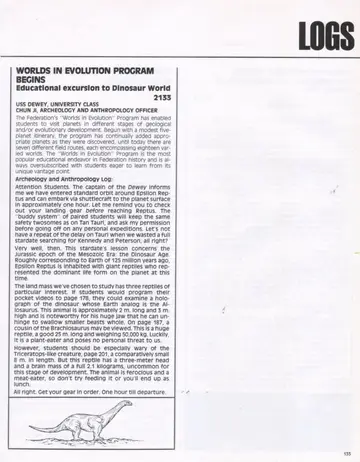
Roughly corresponding to Earth of 125 million years ago, Epsilon Reptus is inhabited with giant reptiles who represented the dominant life form on the planet at this time. The land mass we've chosen to study has three reptiles of particular interest. If students would program their pocket videos to page 178, they could examine a holograph of the dinosaur whose Earth analog is the Allosaurus. This animal is approximately 2 m. long and 3 m. high and is noteworthy for his huge jaw that he can unhinge to swallow smaller beasts whole. On page 187, a cousin of the Brachiosaurus may be viewed. This is a huge reptile, a good 25 m. long and weighing 50,000 kg. Luckily, it is a plant-eater and poses no personal threat to us. However, students should be especially wary of the Triceratops-like creature, page 201, a comparatively small 8 m. in length. But this reptile has a three-meter head and a brain mass of a full 2.1 kilograms, uncommon for this stage of development. The animal is ferocious and a meat-eater, so don't try feeding it or you'll end up as lunch. All right. Get your gear in order. One hour till departure.
Galactic Mystery Solved (2134)
Exploding stars are found to lie on galaxy “fault.” Khan Revox, Astrophysicist. Special Report to UFP Galactic Crisis Center.
The Special Task Force to Study the Mystery Novas of Sector 34.9 has reached some startling conclusions, conclusions which should clear up the mystery of the string of novas that has been besetting that sector but which will not be able to prescribe a cure.
While our galaxy experiences some twenty-five nova explosions per solar year, it is unprecedented that three such explosions should occur within one year, within one sector, and in an almost straight line through the three. There is no known galactic explanation for such a phenomenon; it's not caused by a supernova concussion and it appears to violate the law of averages.
Thanks to my colleague, Dr. Granville Webern, whose pioneering work in galactic tectonics is gaining widespread attention, I believe we have found a satisfactory explanation for the mystery. What these three novas illustrate and are caused by, is nothing less than a galactic “fault line” along the whole of the Omega finger of the Milky Way's Orion arm. Due to uneven stresses caused by the angular momentum of the rotating galaxy, and by local magnetic forces, it is becoming clear that a deformation in the space-time structure of certain neighborhoods can produce linear compression waves. These lines of extreme stress can extend through an entire finger, through an entire arm and theoretically, even through a whole galaxy, though none such can be viewed within our Milky Way. Stars located along these compression fronts are subjected to enormous pressures, and it is little wonder that some are unbalanced enough to go nova. This is what we believe is happening in Sector 34.9.
However, while that is the cause of the novas, we have absolutely no solution to suggest. The forces that are causing this fault are on the galactic level, a strength vastly greater than any counter-force the Federation could imagine. This Special Task Force recommends evacuation of the whole sector. We do not yet know how to predict which stars will succumb to the galactic compression pressures, so the whole sector must be considered an extremely dangerous region. Sector warnings should be posted immediately; another star may go nova while this is being read, and right now, there is nothing we can do about this galactic peril except avoid it.
Transporter Theory Has Initial Breakthrough (2135)
Deneva Research Station. Janet Hester, Research Team Coordinator. Preliminary Summary of Deneva Research Team #4.
Exploring the possibilities of molecular reintegration, this research team wishes to report significant results with experiments involving single-cell protozoa. Through the use of complex computer analysis and the latest advances in Abramson's transtator physics and warp-assisted energy transmission, this team had previously been able to structurally disintegrate a small inanimate object, transmit its encoded sequence signal through space (2.5 meters so far) and recombine the object with excellent molecular integrity. Just recently, however, we have had our first breakthrough with the transmission of organic life. A single-cell protozoa has been transported through space and survived, though all attempts at higher organisms have been consistent failures so far.
But the implications of these experiments are immense. If this transport system can be perfected, and life forms can also be transported, then ship-to-ship, surface-orbit, perhaps even interplanetary travel would be revolutionized. Men and materials would be able to beam down to a planet and back, wherever they chose, at the speed of light. Conclusion: Preliminary results very encouraging. This research team will petition the Deneva Science Review Board to allow the expansion of these experiments to include more complex lifeforms. No theoretical or practical objection to the transport of animate life is valid any longer. All experiments will of course proceed following the most conservative protocol through the evolutionary scale, if the results so warrant.
Harding Richardson, M.D., Chief Medical Officer. Medical Log.
I have just read the preliminary report of Research Team #4, and I feel it is my sacred obligation as a Doctor of Medicine to register my adamant opposition to their request to experiment on complex lifeforms.
I have been a practicing physician for forty-six solar years, in every quadrant of the galaxy, and the one thing I can safely say I've learned is that science will never explain the nature of life. This research team sees no objection to dabbling with higher life, when they themselves admit imperfections in the replication mechanics. It doesn't take an old sawbones like myself to see the weakness in their argument, and I trust the Science Review Board will see the same.
Centuries of effort haven't been able to fit the soul of man into an equation. There are limits to progress, and I for one, think we've gone far enough with this whole transporter nonsense. Man will never be transported.
UFP and Romulan Empire Tense Over Interplanetary War (2138)
Conflict in Neutral Zone causes concern. USS Alert, Castor Class. Liam O'Neill, Admiral.
We know the Romulans are out there. They know we're here. And I'm fairly sure they won't start anything. Our long-range sensors show six Romulan craft to our fleet of ten cruisers and destroyers, and those numbers aren't going to encourage them to cross the Neutral Zone. No, they're just sitting on their side, watching. And waiting.
Blast these stupid little wars. The third planet in Beta Cersus has claimed the fourth as its sovereign territory. The fifth planet insists it belongs to them. The fourth planet happens to be a lifeless, resource-barren rock, but no matter. It's enough to fight over, so fight they will. Just this stardate, our long-range sensors have picked up a “major” battle in which each side lost three ships. For a worthless chunk of matter.
Now, I frankly wouldn't care if these imbeciles wiped each other out; it would reduce the number of warring worlds by two as far as I'm concerned. But unfortunately, Beta Cersus is smack in the middle of the Romulan-Federation Neutral Zone, and I know the Romulans are just itching for any pretext to start a real war. Their vulture ships are just biding their time over there, waiting for any excuse to cry foul and start shooting.
But it won't happen as long as I'm in charge of this sector's security. At the start of this interplanetary war, I called the opposing commanders together and read them the Riot Act. You want to kill each other? Fine, I told them, the Prime Directive says you're free to. But outside your star system is neutral territory, and there will be no hostilities in that region. None. If you want to fight, I told them, keep it in your own home.
And they have. They're blasting away at each other within the neat limits I spelled out to them. And the Romulans haven't made any move to step in and help one side or another. They better not, either. Violation of the Neutral Zone is classified as an act of war, and I will respond accordingly. There will be no more Patton ambushes. We're ready for the Romulans.
Intelligent Flying Creatures Found on Alpha Virginis (2141)
USS Icarus II, Placido Class. Jan Oonlarger, Captain.
I'm entering in the log, an Official Notification of a New Lifeform Encounter. In the Alpha Virginis System, we've met an evolved and very intelligent species who call themselves Canaris. And they are, as far as I know, the first instance of a planet's dominant lifeform being winged humanoids.
In fact, our meeting with the Canaris took place in the air. The sensor scan of the planet registered some odd shifting lifeform readings, so a shuttlecraft was dispatched to the surface for closer investigation. Before we made it to the surface, however, we were met by a full hundred flying creatures who encircled the hovering craft. It seems the Canaris had mistaken the ship for some type of alien flying creature and had come to welcome it to their world. It took quite some sign language to convince them that we gravity-shackled, wingless humans were in fact the living masters of the shuttlecraft, for there are no evolved lifeforms found on the seismically shifting Alpha Virginis II's surface. Once the misunderstanding was cleared up, the Canaris extended their friendship to us and the UFP.
Jose Freitag, M.D., Medical Officer. Medical Log.
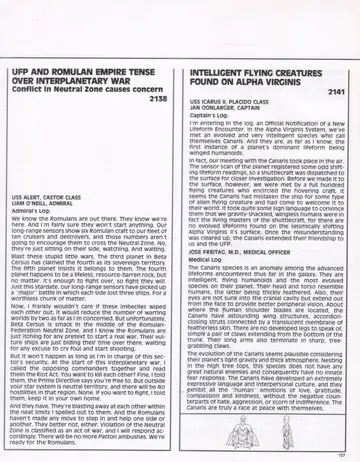
The Canaris species is an anomaly among the advanced lifeforms encountered thus far in the galaxy. They are intelligent, flying humanoids and the most evolved species on their planet. Their head and torso resemble humans, the latter being thickly feathered. Also, their eyes are not sunk into the cranial cavity but extend out from the face to provide better peripheral vision. About one-quarter the size of humans, the Canaris have astounding wing structures, accordion-closing struts connected by a translucent membrane of featherless skin. There are no developed legs to speak of, simply a pair of claws extending from the bottom of the trunk. Their long arms also terminate in sharp, tree-clutching claws.
The evolution of the Canaris seems plausible considering their planet's light gravity and thick atmosphere. Nesting in the high tree tops, this species does not have any great natural enemies and consequently have no innate fear response. The Canaris have developed an extremely expressive language and interpersonal culture, and they exhibit all the “human” emotions of love, gratitude, compassion and kindness, without the negative counterparts of hate, aggression, or scorn of indifference. The Canaris are truly a race at peace with themselves.
Interstellar Spaceship's Big Success (2144)
Monthly service to Federation planets booked full. USS King Charles, Stellarford Class. Farnsworth Dillingham, Correspondent. Personal Log.
This stardate finds your roving reporter enjoying the pampered life aboard the luxury starliner USS King Charles, courtesy of my editor's expense account. Since every credit spent boils his Scottish blood, I have spared myself no extravagance offered on the maiden voyage of this elegant interstellar ship, reputed to be the finest in the Federation, to Andor, nearly a solar year away.
Not that the King Charles is overwhelming in its opulence. It's still a spaceship, and like all spaceships to date, hasn't completely solved the problem of artificial gravity and environment. Try as they might to freshen the air with odor-eating microbes and space scents, it still tastes like the canned air it is. And the ship's gravity keeps things in place, but just barely. Morning course corrections are still likely to clear desk tops and spill change out of the pockets of the unwary traveller's trousers.
One area the King Charles has leaped heads and tentacles above its predecessors is food. A complete kitchen, a well-stocked larder, and its own Cordon Rouge chef make dining on the King Charles a true gourmet experience. No freeze-dried protein packets on this cruise: it's Fettucini Alfredo and Coq au Vin all the way. I've gained two kilograms already.
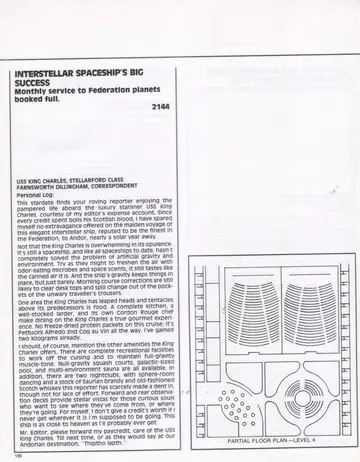
I should, of course, mention the other amenities the King Charles offers. There are complete recreational facilities to work off the cuisine and to maintain full-gravity muscle-tone. Null-gravity squash courts, galactic-sized pool, and multi-environment sauna are all available. In addition, there are two nightclubs, with sphere-room dancing and a stock of Saurian brandy and old-fashioned scotch whiskey this reporter has scarcely made a dent in, though not for lack of effort. Forward and rear observation decks provide stellar vistas for those curious souls who want to see where they've come from, or where they're going. For myself, I don't give a credit's worth if I never get wherever it is I'm supposed to be going. This ship is as close to heaven as I'll probably ever get.
Mr. Editor, please forward my paycredit, care of the USS King Charles. Till next time, or as they would say at our Andorian destination, “Thiptho lapth.”
New Tricorder Halts Worst Planet Plague in Federation History (2147)
USS Clara Barton, Castor Class. Haras Keolar, M.D., Medical Officer. Medical Log.
Thanks to the tricorder, the cause of this mysterious plague on Rigel II has been identified, and with the first shipment of serum being prepared to the tricorder's specifications, the scourge which has decimated a quarter of the planet should soon be obliterated.
I hate to think how many more Rigellians would have died before a pre-tricorder diagnosis could have been offered. There used to be rather severe limits on the research capabilities of a starship, and landing parties had it even worse. They had to make do with an only slightly updated version of the doctor's black bag. Without the tricorder, the more complex data analysis of blood samples, environmental parameters, and the like, would have had to have been transmitted via subspace radio to a research outpost for analysis and recommendations. Thousands could have died in the delay. I shudder at the idea, as anyone would who had seen just one plague victim slowly die in agony, as I have hundreds.
But these tricorders. Don't ask me how they do it, but these hand-held beauties apparently hold the whole of current Federation knowledge. They can read external and internal life signs, analyze systems malfunctioning and tissue health, and output a working diagnosis. I'm impressed. Who knows how long it would have taken me to associate this plague with Kassaba Fever; it's a strain I've never encountered and has some confusingly different symptoms. The tricorder was not confused, though. Blocking serum is being manufactured aboard the Clara Barton and within the week, the planet plague of Rigel II will be a thing of the past.
UFP Launches 3rd Generation Warp Ships (2148)
Short lived class proves to be an “Edsel.” USS Tritium, Tritium Class. Rex Opperman, Chief Engineer. Engineering Log.
What a fabulous idea! Three nacelles! A third more power than those old-fashioned ships. Greater acceleration. Faster warp engagement. Warp 4 capability. Looks great on the drawing board. A marvelous new generation of starships, ten years in the designing and making. Only one problem. They don't work.
Perhaps if they were absolutely perfect, the three-nacelle design might work, might do all the great things claimed for it. But nothing made by man is perfect, and in this case, nothing less than perfect will do. You would have thought the designers would have realized this. The symmetry of the matter/antimatter reaction and the balanced duality of the warp principle are fundamental principles of warp mechanics. Two self-adjusting nacelles have proven a very efficient engine design, the slight discrepancies between nacelle construction averaging out. But to throw a third nacelle between the two? Instead of removing the discrepancies, the third nacelle accentuates them, its power peaks corresponding to the points of highest warp field fluctuation. As a result, the ship steers almost as bad as a Star Fleet tug. And the warp vibrations set up by the third nacelle's negative reinforcement mean this ship can't be sailed above warp 3 without practically shaking itself to pieces. The Tritium is a real Lemarian lemon, if there ever was one. Or to use a phrase my great-grandfather liked to describe a fiasco: this one's an Edsel.