6.3 Official Logs
A collection of first-person logs and reports from the era documenting the discovery of the Rigel Trading Planet, the experience of the first Earth-alien crews, the diplomatic struggle to incorporate the United Federation of Planets at Babel, the deadly space war games disaster, the opening of Star Fleet Academy, the first starship class built with combined UFP expertise, the opening of Starbase 1, the piracy of the transport Diana, and the predictions of the Earth Centenary Conference.
Rigel Trading Planet Discovered (2079)
UNSS Marco Polo, Merchant Class. Lorenzo Malfatti, Captain.
Rigel is, of course, one of the founding members of the United Federation of Planets. A twelve-planet system, Rigel is known for its trade, mining and, strangely enough, bureaucrats. For more information on this system, see Volume III: Rigel.
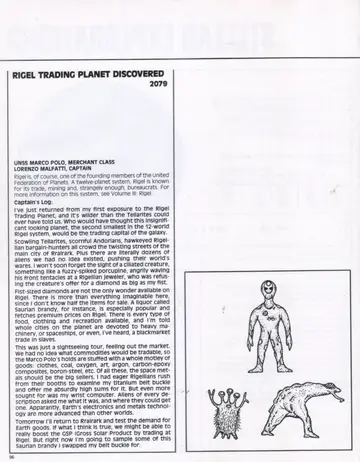
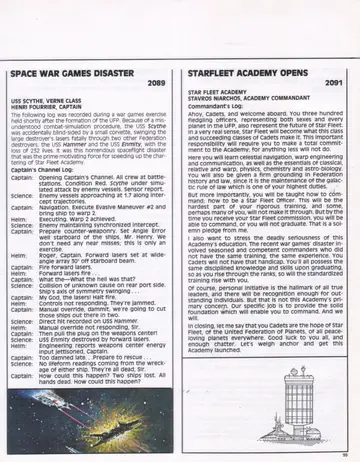
Captain's Log: I've just returned from my first exposure to the Rigel Trading Planet, and it's wilder than the Tellarites could ever have told us. Who would have thought this insignificant looking planet, the second smallest in the 12-world Rigel system, would be the trading capital of the galaxy. Scowling Tellarites, scornful Andorians, hawkeyed Rigellian bargain-hunters all crowd the twisting streets of the main city of Rralrark. Plus there are literally dozens of aliens we had no idea existed, pushing their world's wares. I won't soon forget the sight of a ciliated creature, something like a fuzzy-spiked porcupine, angrily waving his front tentacles at a Rigellian jeweler, who was refusing the creature's offer for a diamond as big as my fist.
Fist-sized diamonds are not the only wonder available on Rigel. There is more than everything imaginable here, since I don't know half the items for sale. A liquor called saurian brandy, for instance, is especially popular and fetches premium prices on Rigel. There is every type of food, clothing and recreation available, and I'm told whole cities on the planet are devoted to heavy machinery, or spaceships, or even, I've heard, a blackmarket trade in slaves.
This was just a sightseeing tour, feeling out the market. We had no idea what commodities would be tradable, so the Marco Polo's holds are stuffed with a whole motley of goods: clothes, coal, oxygen, art, argon, carbon-epoxy composites, boron-steel, etc. Of all these, the space metals should be the big sellers. I had eager Rigellians rush from their booths to examine my titanium belt buckle and offer me absurdly high sums for it. But even more I sought for was my wrist computer. Aliens of every description asked me what it was, and where they could get one. Apparantly, Earth's electronics and metals technology are more advanced than other worlds.
Tomorrow I'll return to Rralrark and test the demand for Earth goods. If what I think is true, we might be able to really boost the GSP (Gross Solar Product) by trading at Rigel. But right now I'm going to sample some of this saurian brandy I swapped my belt buckle for.
First Earth-Alien Crews: Generally We Work Well with Our Neighbors from Space (2083)
UNSS Pollux, Messier Class. Shu Tse Sum, Captain.
Captain's Log: The Vulcan Communications Officer Mr. Supak has finished his first month of active duty aboard the Pollux, and this Log stands as his preliminary evaluation. Solar Fleet Headquarters asked me to include my subjective reactions in my review, so that is to be found here along with the standard critique.
Mr. Supak's duty performance as Communications Officer has been superb. He has not made a single operational mistake or oversight—in fact, he once corrected me on a bit of procedure—and all communications have been flawlessly transmitted and received. I could not ask for more.
Except I find myself inwardly doing just that, asking for more from the Vulcan, and I'm not even sure more of what—more involvement, or more intuitive initiative, or more something. He mans his console day after day, performing his duty, and nothing else. Ever. I would have thought that I couldn't ask for otherwise from a subordinate. But emotionless excellence is harder to coexist with than I anticipated. If only he would smile.
Supak, Communications Officer.
Communications Log: Pursuant to UNSF Directive DL-1142—“All participants in the interstellar exchange of crew members are requested to log, at monthly intervals, their reactions to the aforesaid exchange.” I enter this log as my evaluation of duty aboard the UNSS Pollux, Shu Tse Sum, Captain.
I have been able to suitably discharge my responsibilities as Communications Officer and have responded to all commands issued me by superiors. The work is interesting, and I have gained thirteen new insights into communications theory and practice.
However, I must submit my difficulty in responding to certain statements addressed me by the Earth crew. They refer to them as “shooting the breeze,” or “kidding around,” but I can only understand them as a most illogical arrangement of ungrammatical syntax and complete nonsense. The Engineer, for instance, states when he reluctantly initiates an action: “Might as well, too windy to haul gravel.” 48.7 hours of reflection have yet to reveal to me the meaning of that statement.
In summary, my duties are engaging, but the rampant illogical emotionalism on board does strain me. I therefore must reserve judgement at this time as to the advisability of integrating Vulcan and Earth crews. There may well be no future merit in the arrangement.
Incorporation of United Federation of Planets (2087)
The polished document that is the Articles of Incorporation of the United Federation of Planets does not reflect the struggle and uncertainty that preceded its adoption. The delegates to the Babel Conference spent incredible amounts of time and energy drafting an outline for the future that was agreeable to all participants. This log, subsequently declassified, illustrates the delicate state of negotiations that led to final compromise and incorporation.
Harmon Axelrod, Secretary General.
Proclamation Log: As your newly-elected Secretary General, it is my very great pleasure to officially proclaim the incorporation of the United Federation of Planets this stardate at Babel. I welcome, as founding member planets, the Earth, Vulcan, Tellar, Andor, Rigel and Alpha Centauri. I am sure this number will grow as new lifeforms are encountered and as we demonstrate the utility and wisdom of this Federation.
But what exactly is this utility, this wisdom? Why have we joined together here? We are very different planets, with different needs and aspirations. But there are some goals we all share in common, and perhaps the first is the mutual respect we have for each others' uniqueness. The United Federation of Planets has not been inaugurated to diminish a planet's sovereignty but to assist it in its galactic development.
Galactic health and the promotion of social progress are also high priorities of the UFP. If I may use the initials that will no doubt soon be our Federation's standard reference. To guarantee all citizens good health and social equity is a noble ideal, and the possibility of making it reality is, I feel, within this organization's power.
Lastly, the United Federation of Planets will provide for the allied security of its member planets. The dark side of exploration is the possibility, and we must face it, of encountering violent or aggressive worlds. With the commissioning of a Star Fleet and the construction of the strategic Star Base network, the Federation will go a long way to guard the integrity of its members. I have no doubt there are grave perils in the galaxy. We will be ready for them.
I would like to applaud all the delegates to this historic Babel Interplanetary Conference. Out of the diplomatic give and take has emerged a viable, even visionary, blueprint for the future. We now have a United Federation of Planets; let's make its dreams come true.
Humphrey Stannis, Ambassador.
Supplemental Log: —CONFIDENTIAL—Ambassador's Report on Progress of Negotiations at Interplanetary Conference at Babel (Declassified Stardate 3345.7)
It has been a long and not very productive Conference so far. While I remain optimistic about the successful outcome of the Conference, progress has thus far been painfully slow. Blue-skinned Andorians lisp savagely at green-skinned Vulcans, who logically debate with the illogical Tellarites, who bully the Rigellians, who are blackmailing us for ten billion credits for a pro-incorporation vote. The current status of negotiations is as follows:
ANDOR—The Andorians are pressing their claim for some of the Rigel territories, even though they have never been within ten parsecs of the territories in question. The Andorians claim sovereignty over all stars visible to the eye from Andor. This has yet to be resolved.
RIGEL—Although plainly terrified by the aggressiveness of the Andorians, Rigel continues to maintain its neutrality with respect to a United Federation of Planets. Their Ambassador has indicated that as little as eight billion credits might overcome Rigel's reservations.
TELLAR—Tellarites continue their tradition of arguing for argument's sake. I scored a debating point when I suggested to the Tellarite Ambassador that a United Federation of Planets would provide a permanent forum for debate. He immediately disagreed, which I take as a positive sign.
VULCAN—Vulcan remains a staunch proponent for incorporation. Although the constant bickering among greedy or violent planets must be distasteful to the Vulcan sensibility, they consistently maintain the logical advantages of such a union are the preeminent consideration.
ALPHA CENTAURI—Along with Vulcan, Alpha Centauri is committed to a United Federation of Planets. After all, their planet and ours have enjoyed a similar but unincorporated alliance for almost forty years, so they are well aware of the advantages of federation.
EARTH—I continue to recommend federation. The chance for hostility and absence of any economic or political coordination in the present chaos cannot be allowed to endure. I believe we must all stand together or separately fall at each other's throats.
Space War Games Disaster (2089)
USS Scythe, Verne Class. Henri Fourrier, Captain.
The following log was recorded during a war games exercise held shortly after the formation of the UFP. Because of a misunderstood combat-simulation procedure, the USS Scythe was accidentally blind-sided by a small corvette, swinging the large destroyer's lasers fatally through two other Federation destroyers, the USS Hammer and the USS Enmity, with the loss of 232 lives. It was this horrendous spaceflight disaster that was the prime motivating force for speeding up the chartering of Star Fleet Academy.
Captain's Channel Log:
Captain: Opening Captain's Channel. All crew at battlestations. Condition Red. Scythe under simulated attack by enemy vessels. Sensor report.
Science: Enemy vessels approaching at 1.7 along intercept trajectories.
Captain: Navigation. Execute Evasive Maneuver #2 and bring ship to warp 2.
Helm: Executing. Warp 2 achieved.
Science: Enemy maintaining synchronized intercept.
Captain: Prepare counter-weaponry. Set Angle Error well starboard of the ships, Mr. Henry. We don't need any near misses; this is only an exercise.
Helm: Roger, Captain. Forward lasers set at wide-angle array 30° off starboard beam.
Captain: Fire forward lasers.
Helm: Forward lasers fire . . .
Captain: What the—What the hell was that?
Science: Collision of unknown cause on rear port side. Ship's axis of symmetry swinging . . .
Captain: My God, the lasers! Halt fire.
Helm: Controls not responding. They're jammed.
Captain: Manual override, dammit, we're going to cut those ships out there in two.
Science: Direct hit recorded on USS Hammer.
Helm: Manual override not responding, Sir.
Captain: Then pull the plug on the weapons center!
Science: USS Enmity destroyed by forward lasers.
Helm: Engineering reports weapons center energy input jettisoned, Captain.
Captain: Too damned late. Prepare to rescue . . .
Science: No lifeform readings coming from the wreckage of either ship. They're all dead, Sir.
Captain: How could this happen? Two ships lost. All hands dead. How could this happen?
Starfleet Academy Opens (2091)
Star Fleet Academy. Stavros Niarchos, Academy Commandant.
Commandant's Log: Ahoy, Cadets, and welcome aboard. You three hundred fledgling officers, representing both sexes and every planet in the UFP, also represent the future of Star Fleet. In a very real sense, Star Fleet will become what this class and succeeding classes of Cadets make it. This important responsibility will require you to make a total commitment to the Academy; for anything less will not do.
Here you will learn celestial navigation, warp engineering and communication, as well as the essentials of classical, relative and warp, physics, chemistry and astro-biology. You will also be given a firm grounding in Federation history and law, since it is the maintenance of the galactic rule of law which is one of your highest duties.
But more importantly, you will be taught how to command; how to be a Star Fleet Officer. This will be the hardest part of your rigorous training, and some, perhaps many of you, will not make it through. But by the time you receive your Star Fleet commission, you will be able to command, or you will not graduate. That is a solemn pledge from me.
I also want to stress the deadly seriousness of this Academy's education. The recent war games disaster involved seasoned and competent commanders who did not have the same training, the same experience. You Cadets will not have that handicap. You'll all possess the same disciplined knowledge and skills upon graduating, so as you rise through the ranks, so will the standardized training rise with you.
Of course, personal initiative is the hallmark of all true leaders, and there will be recognition enough for outstanding individuals. But that is not this Academy's primary concern. Our specific job is to provide the solid foundation which will enable you to command. And we will.
In closing, let me say that you Cadets are the hope of Star Fleet, of the United Federation of Planets, of all peace-loving planets everywhere. Good luck to you all, and enough chatter. Let's weigh anchor and get this Academy launched.
First Starship Class Built with Combined UFP Expertise Enters Service (2093)
USS Horizon, Horizon Class. Serge Kosygin, Chief Engineering Officer.
Engineering Log: The Horizon's Engineering Validation Phase has been concluded and I, for one, am convinced that this bear can pounce to the edge of the galaxy and back as easy as scooping honey from a hollow tree.
All performance monitors registered above computer-design specs, and the Fault Detection circuitry didn't record a single component breakdown for the whole flight-preliminary test sequence. And I pushed these new warp engines, pushed them a Pluto of a lot harder than I ever would have considered working a first generation warp engine. After running at maximum warp 3 for a hundred revolutions around the Centauri Test Orbit, I redlined the Horizon into warp 3.25 for five more orbits without exceeding stress parameters. These engines burn.
I especially like the Horizon's new semi-independent modules. With the engines separate from the bridge, and lower hull, a much greater efficiency can be squeezed out of the warp engines, because we don't have to worry about gamma wastes contaminating the living areas. They'll be easier to maintain, too.
My validation assessment is they're unqualified Condition Green Go. Launch can proceed on schedule, and I'm confident the Horizon will become the flagship explorer in the Federation. If only they could improve the food as much.
Starbase 1 Begins Operations: Huge Station Ends Year Long Tow to Sector 3A. Personnel Take Up Residence (2095)
Starbase 1. Felix Pjindik, Commodore.
Commodore's Log: The Starbase program is off to a fine start. I've just completed my first tour of all facilities and am very satisfied with my findings. Starbase 1 is a technological wonder. It is a stellar-designer's dream come true. And none too soon. We've just opened for business and already the Maintenance Deck is working overtime refitting two starships with the new warp engines. Chief Engineer Hobbes tells me his boys are getting so good at swapping engines they can overhaul a starcruiser in a week or so. I hope he's right.
On the other hand, Sick Bay has only five patients right now: one coronary recovery, an alcohol-detoxification case—a drunk helmsman on R&R who's going to catch a nova's worth of trouble from his captain when he's discharged—and three radiation victims spacelifted from Meta.
The Research Deck is functioning smoothly, and the Recreation Decks are, shall I say, models of sailorly relaxation. No violent incidents reported this stardate.
Finally, the Forward Alert Defense Deck reports all surrounding sectors clear of unidentified intrusion. The Advance Scout Fleet has not made any unusual contact whatsoever.
Yes, the Starbase program is off to a fine start. And I'm worried. Very worried. It's almost as if whatever or whoever's out there is lying low for now, letting us forget the still too recent incineration of Delta VII, or the spacejacking of the ore freighter Muleskinner. What are they waiting for?
I know some at Star Fleet Command think I'm being paranoid about asking for extra Scout Fleet protection. There's nothing out there but your imagination, they scoff. Well, they should save their scorn for the charred remains of the twenty-eight men, women and children of Delta VII. There is something out there. And it is hostile. I pray we are ready.
Commercial Transport Destroyed by Space Pirates: Over 500 Killed in Brutal Incident (2099)
USS Intrepid, Messier Class. Henry McKenna, Captain.
Captain's Log: I'm reporting the retrieval of the remains of the Transport Diana. The crew and all 500 passengers have been murdered, and the cargo holds have been split open and completely plundered, along with all valuable personal effects. I would classify this as a Class 1 Space Piracy offense, and I'm forwarding all evidence to Star Fleet Security Council for their investigation and prosecution.
Two extremely disturbing facts stand out about this particular piracy. The first is, whatever tool was used to slice the ship's hull, it is not to be found in any alien technologies I know of. The precision of the cut seems to indicate some sort of advanced laser drill specifically designed for plunder. These are sophisticated space pirates. (Shortly thereafter, they were discovered to be the Romulans.)
The second is the sheer horror of seeing so many bodies lying about. Never have I encountered such a sight in all my service in space. I can only conclude there is a horrible menace behind this act of piracy. All inhabitants of this sector should be alerted to the presence of this unknown, violent danger. Accordingly, I am requesting increased patrols throughout the sector, until these pirates are caught or killed. Let's hope that won't be too long.
Major Earth Spaceflight Conference: Limits to Growth of Exploration Predicted (2100)
Starbase 5. Dr. Milton Kornheiser, Speaker.
Archive Log: I would like to thank the organizers of this Earth Centenary Conference for inviting me to speak on the future of spaceflight. I have very much enjoyed the other speakers' discussions of terraforming, pre-warp history, interstellar politics and the like, and I hope I can be as informative, if not provocative, as they have been.
After twenty-five years of designing interstellar spacecraft, I feel confident in my ability to foretell what the coming century will bring. First of all, there are some theoretical limitations which coming generations of ships will not be able to exceed. Even if the matter/antimatter reaction becomes 100% efficient in terms of its exhaust products, we will not be able to achieve speeds greater than a factor of approximately warp 4. The energy just isn't there. This, in turn, places a limit on the extent of new exploration and plans such as the exploration of the galactic center are, I'm afraid, destined to remain little more than wishful thinking.
Now I don't want to sound too pessimistic. Given the number of civilizations and interesting star systems we have already encountered, warp 4 speeds will mean a very large assortment of new worlds within our feasible reach. What new Vulcans or Rigels await our discovery out there is anyone's conjecture. And advances in technology that are already on the computer simulators, will allow bigger and longer-ranging ships to be built; vessels which will shame our present state-of-the-art.
However, I've heard so much wild speculation during this Conference I feel it my responsibility to inject a note of cold realism. Speeds of warp 7 or warp 10 or even higher that have been bandied about as if they were just around the corner are theoretical impossibilities. One speaker even blithered on about the alchemy of molecular reintegration; destroying a being for the purpose of transporting his remains elsewhere, as if the splintered bundle of loose molecules could ever be restitched into a living creature. This sort of idea belongs in a magic show, not a scientific conference.
In summing up, I look forward to a century of ever-bigger ships, traveling as fast as warp 4, and bringing us to more and more new worlds. Modest goals, to be sure, but goals I am sure we will attain before the century is over.