4.1 Ships: UNSS Tycho Brahe, UNSS Icarus, UNSS Fisher, UNSS Prince of Wales
An illustrated ships chronology of the period, presenting a year-by-year timeline of events and spacecraft from 2026 to 2050 alongside detailed specification panels and color plates for the principal ships of the era, including the UNSS Tycho Brahe, the UNSS Icarus, the UNSS Fisher and the spaceliner Prince of Wales.
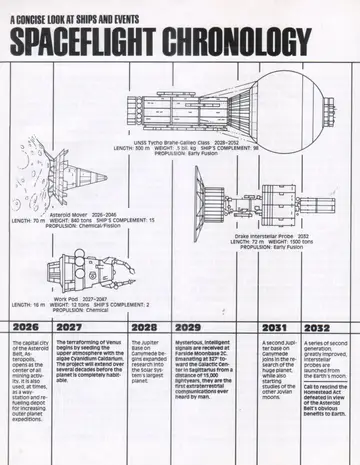
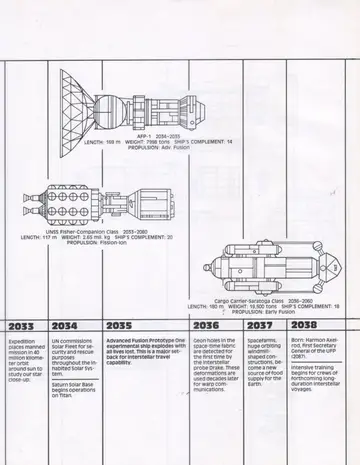
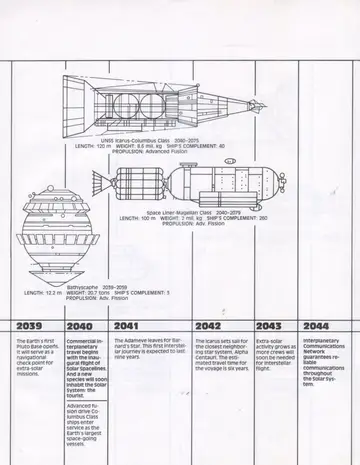
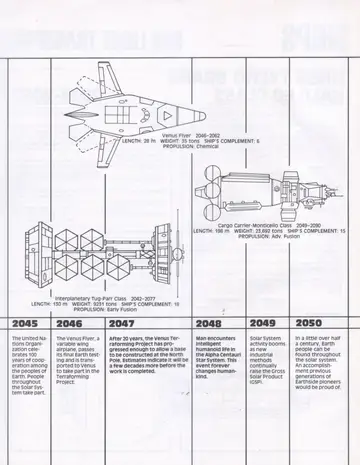
A Concise Look at Ships and Events: Spaceflight Chronology
2026—The capital city of the Asteroid Belt, Asteropolis, opens as the center of all mining activity. It is also used, at times, as a way-station and refueling depot for increasing outer planet expeditions.
2027—The terraforming of Venus begins by seeding the upper atmosphere with the algae Cyanidium Caldarium. The project will extend over several decades before the planet is completely habitable.
2028—The Jupiter base on Ganymede begins expanded research into the Solar System's largest planet.
2029—Mysterious, intelligent signals are received at Farside Moonbase 2C. Emanating at 327° toward the Galactic Center in Sagittarius from a distance of 15,000 light years, they are the first extraterrestrial communications ever heard by man.
2031—A second Jupiter base on Ganymede joins in the research of the huge planet, while also starting studies of the other Jovian moons.
2032—A series of second generation, greatly improved, interstellar probes are launched from the Earth's moon. Call to rescind Homestead Act defeated in view of the Asteroid Belt's obvious benefits to Earth.
2033—Expedition places manned mission in 40 million kilometer orbit around sun to study our star close-up.
2034—UN commissions Solar Fleet for security and rescue purposes throughout the inhabited Solar System. Saturn Solar Base begins operations on Titan.
2035—Advanced Fusion Prototype One experimental ship explodes with all lives lost. This is a major setback for interstellar travel capability.
2036—Geon holes in the space-time fabric are detected for the first time by the interstellar probe Drake. These deformations are used decades later for warp communications.
2037—Spacefarms, huge orbiting windmill-shaped constructions, become a new source of food supply for the Earth.
2038—Born: Harmon Axelrod, first Secretary General of the UFP (2087). Intensive training begins for crews of forthcoming long-duration interstellar voyages.
2039—The Earth's first Pluto Base opens. It will serve as a navigational check point for extra-solar missions.
2040—Commercial interplanetary travel begins with the inaugural flight of Solar Spacelines. And a new species will soon inhabit the Solar System: the tourist. Advanced fusion drive Columbus Class ships enter service as the Earth's largest space-going vessels.
2041—The Adameve leaves for Barnard's Star. This first interstellar journey is expected to last nine years.
2042—The Icarus sets sail for the closest neighboring star system, Alpha Centauri. The estimated travel time for the voyage is six years.
2043—Extra-solar activity grows as more crews will soon be needed for interstellar flight.
2044—Interplanetary Communications Network guarantees reliable communications throughout the Solar System.
2045—The United Nations Organization celebrates 100 years of cooperation among the peoples of Earth. People throughout the Solar System take part.
2046—The Venus Flyer, a variable wing airplane, passes its final Earth testing and is transported to Venus to take part in the Terraforming Project.
2047—After 20 years, the Venus Terraforming Project has progressed enough to allow a base to be constructed at the North Pole. Estimates indicate it will be a few decades more before the work is completed.
2048—Man encounters intelligent humanoid life in the Alpha Centauri Star System. This event forever changes humankind.
2049—Solar System activity booms as new industrial methods continually raise the Gross Solar Product (GSP).
2050—In a little over half a century, Earth people can be found throughout the solar system. An accomplishment previous generations of Earthside pioneers would be proud of.
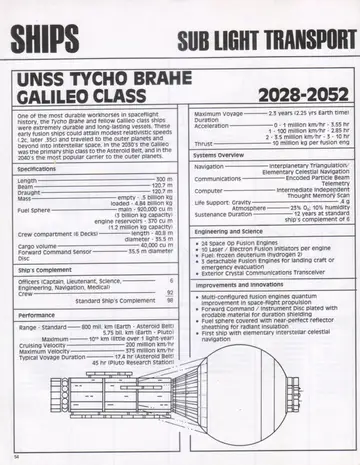
UNSS Tycho Brahe: Galileo Class (2028-2052)
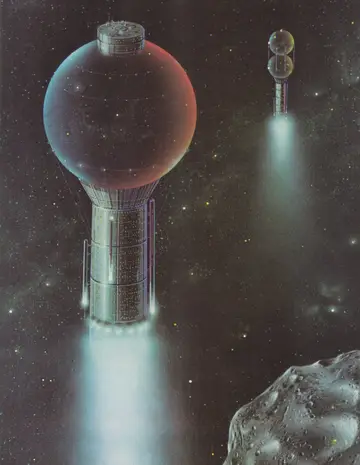
One of the most durable workhorses in spaceflight history, the Tycho Brahe and fellow Galileo class ships were extremely durable and long-lasting vessels. These early fusion ships could attain modest relativistic speeds (.2c, later .35c) and traveled to the outer planets and beyond into interstellar space. In the 2030's the Galileo was the primary ship class to the Asteroid Belt, and in the 2040's the most popular carrier to the outer planets.
Engineering and Science
- 24 Space Op Fusion Engines
- 10 Laser / Electron Fusion Initiators per engine
- Fuel: frozen deuterium (hydrogen 2)
- 3 detachable Fusion Engines for landing craft or emergency evacuation
- Exterior Crystal Communications Transceiver
Improvements and Innovations
- Multi-configured fusion engines quantum improvement in space-flight propulsion
- Forward Command / Instrument Disc plated with erodable material for duration shielding
- Fuel sphere covered with near-perfect reflector sheathing for radiant insulation
- First ship with elementary interstellar celestial navigation
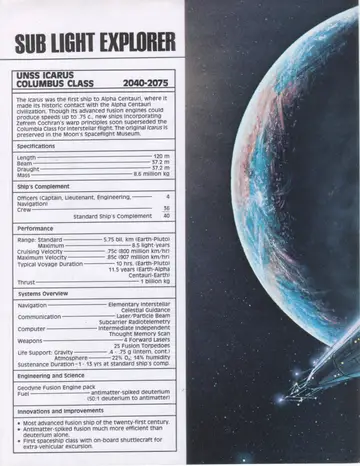
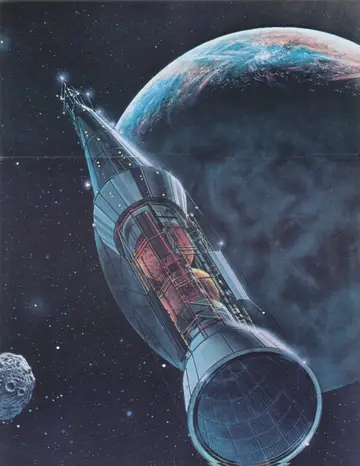
UNSS Icarus: Columbus Class (2040-2075)
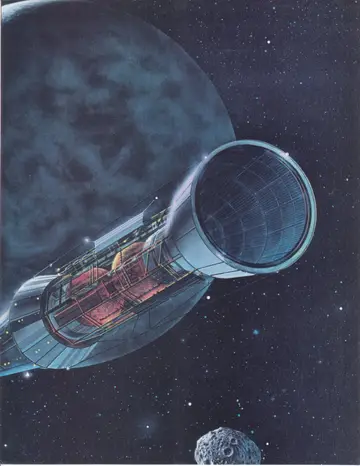
The Icarus was the first ship to Alpha Centauri, where it made its historic contact with the Alpha Centauri civilization. Though its advanced fusion engines could produce speeds up to .75 c., new ships incorporating Zefrem Cochrane's warp principles soon superseded the Columbus Class for interstellar flight. The original Icarus is preserved in the Moon's Spaceflight Museum.
Engineering and Science
Geodyne Fusion Engine pack. Fuel: antimatter-spiked deuterium (50:1 deuterium to antimatter).
Innovations and Improvements
- Most advanced fusion ship of the twenty-first century.
- Antimatter-spiked fusion much more efficient than deuterium alone.
- First spaceship class with on-board shuttlecraft for extra-vehicular excursion.
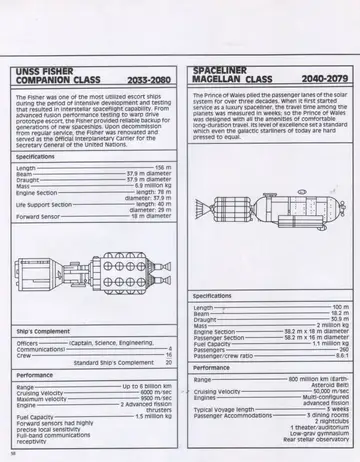
UNSS Fisher: Companion Class (2033-2080)
The Fisher was one of the most utilized escort ships during the period of intensive development and testing that resulted in interstellar spaceflight capability. From advanced fusion performance testing to warp drive prototype escort, the Fisher provided reliable backup for generations of new spaceships. Upon decommission from regular service, the Fisher was renovated and served as the Official Interplanetary Carrier for the Secretary General of the United Nations.
UNSS Prince of Wales: Magellan Class (2040-2079)
The Prince of Wales plied the passenger lanes of the solar system for over three decades. When it first started service as a luxury spaceliner, the travel time among the planets was measured in weeks; so the Prince of Wales was designed with all the amenities of comfortable long-duration travel. Its level of excellence set a standard which even the galactic starliners of today are hard pressed to equal.