4.3 Official Logs
A collection of first-person logs and reports from the era documenting the early success of Venus cloud seeding, the discovery of extraterrestrial signals at Farside Moonbase, the success of asteroid mining and the Homestead Act debate, the loss of the Advanced Fusion Prototype One, the Drake probe's detection of space-time "holes," the inaugural commercial spaceliner flight, and the historic first contact with the Alpha Centaurians.
Cloud Seeding of Venus Meets Initial Success (2027)
UNSS Tiller, DY-500 Class. Dr. William Slater, Science Officer.
Science Log: One of our truly outstanding interplanetary scientific projects has become a reality. The attempt to make our sister planet, Venus, habitable for humans is reaping its first results: the rains have started. It's been one year and seventeen days since twenty programmed probes seeded the upper Venerian atmosphere with billions of the blue-green algae Cyanidium caldarium. At the same time, our associates have been periodically bombarding the planet with huge ice asteroids from the Asteroid Belt. These will provide additional water for the arid world and, because of their impact, have already doubled the rate of rotation, which will generate a protective Van Allen belt for the planet.
For the past year, our orbiting survey team has been carefully monitoring the terraforming—the algaes' truly astronomical reproduction rate that has thinned the carbon dioxide clouds and created an oxygen atmosphere, and the slow growth in water vapor from the almost instantly vaporized asteroids (the surface temperature is 500°C.). Finally, the vapor pressure has become too great to remain gaseous. And so the rains have begun.
The planet is covered with clouds now, but these are billowing steam clouds produced when the rains approached the literally red-hot planet surface. Over the next several years, this cycle of rain and evaporation will repeat itself, each time lowering the temperature until finally, the rains will be able to remain to nourish the soil, and the inferno that was Venus will be replaced by sparkling oceans and rich oxygen atmosphere. Or so it is hoped.
I must confess my skepticism to the success of this whole project. Some of my colleagues are completely confident this radical terraforming will come off without a hitch, but I see a number of serious problems. Without an ozone layer, the artificially induced Van Allen belt might not provide enough radiation shielding. On top of that, the planet surface has high concentrations of corrosive hydrochloric and sulfuric acids. What good will sparkling acid oceans be to anyone? We might be able to make Venus look like Eden, but I doubt very much whether anyone will ever be able to live comfortably here.
Extraterrestrial Signals Received at Moonbase: After 60 Years, Project SETI Has First Success (2029)
Farside Moonbase 2C. Dr. Salvatore Marciano, Communications Coordinator.
For well over a century, these signals remained undeciphered until the invention of duotronic computers in the late twenty-second century. It turned out to be a quaternary code describing the star's lifeforms, history, culture and spiritual values. Sadly, it also predicted the race's demise, which was over five thousand years ago. Their genetic vitality had been slowly fading over the millennia, and these very advanced lifeforms could predict with tragic certainty the time when they would no longer be able to maintain sufficient vigor to remain in existence. A full decoding of this Sagittarian signal can be found at Memory Alpha.
Communications Log: I am overjoyed to report today that the huge electromagnetic ears of Project SETI have finally discovered a galactic voice. It is intelligent, it is powerful and it is very, very far away.
Like many breakthroughs throughout history, this came as an accidental result of another experiment. Here at Farside Moonbase 2C, we've been continuing the search for galactic life begun on Earth in the twentieth century. As the scientific community is well aware, several directions have been followed: listening on various radio spectra, examining possible visual signs, searching for unusual groupings of elements. It was this last approach that provided the vital clue. The artificial element Technetium 99 is found in very few stars, our sun being unaccountably one of them. The Chief of Radio Telescope Operations, Dr. Ashworth, has been mapping these so-called S-stars for some time, and he found a peculiar triangle of them at 327° toward the galactic center in Sagittarius.
He programmed the massive Farside radio telescope on the grouping and, to his astonishment, picked up a periodic signal emanating from its center. The signal is at the twenty-one centimeter frequency of the hydroxyl group (OH), an essential component for organic life. And the message, which repeats itself every 5.28 Earth days, is a definitely intelligent, modulated transmission. So intelligent, in fact, that Moonbase computers have been unable thus far to decode it.
The implications are staggering. This radio source appears to be roughly 15,000 light-years away from us, visible only as a hazy white dot on the infrared photos. But that image represents a civilization that was vastly more powerful 10,000 years before the dawn of our civilization than we are now. And they are calling out to the galaxy. This is a very distant, highly intelligent civilization purposely announcing its presence. And I must wonder, "Why?"
Asteroid Mining a Great Success: Call to Rescind Homestead Act Severely Criticized (2032)
Asteropolis, Asteroid Belt Capital Satellite. Svetlana Krensky, Governor.
Governor's Log: I thank the General Assembly for allowing me to submit this Log into the proceedings of the Committee to Reexamine the Space Homesteading Act.
I am well aware certain critics wish to rescind this historic act. They claim preferential treatment for space settlers, windfall profits for greedy speculators, and an unfair balance of payments between the Earth and the Asteroid Belt.
Well, there is some truth to these criticisms. Many settlers have taken advantage of the opportunities of space development to become very wealthy, and I'm sure some of them were less than completely scrupulous. This is human nature, and that stays the same whether in the Asteroid Belt or back on Earth. But most settlers have worked unbelievably hard to get where they are today. They've suffered the deprivations and deadly dangers of space, and given their youth and vitality to the making of a successful homestead. They are a special breed, these homesteaders, and I don't think many of us would trade places with them for all the riches in the Solar System.
But there are more overriding reasons for continuing the Space Homesteading Act, reasons that are extremely important to all of Earth. Let us not forget that before Asteroid mining, practically all raw materials for industrial processes had to come from the Earth itself, with the consequent pollution and ravaging of the landscape. Air quality and the fundamental quality of life for all mankind was adversely affected by the necessity of almost destroying our world to feed our industry.
The Asteroid Belt has done away with that terrible tradeoff. No longer is the Earth a receptacle for industrial pollutants. Ore mined here in the Asteroid Belt is freighted back to orbiting platforms for refining and for the manufacturing of space-related materials. The Earth as a result has been able to redirect its resources towards cleaning up the global ecology, and the planet is slowly returning to its pre-industrial purity. Without the intrepid space homesteaders supplying the Earth with needed resources, the deterioration of air, water and living quality would have inexorably destroyed the world.
I cannot believe anyone would wish us to return to that sorry state of affairs. No, space homesteading is working. Man is inhabiting his home Solar System and helping Earth realize its full potential as the home of humanity. Thank you.
Experimental Fusion Ship Explodes: Major Setback for Interstellar Travel (2035)
UNSS Fisher, Companion Class. Richard Hanna, Captain.
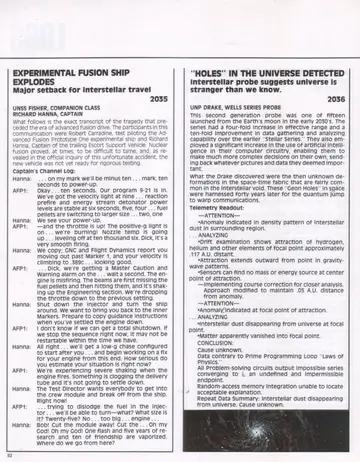
What follows is the exact transcript of the tragedy that preceded the era of advanced fusion drive. The participants in this communication were Robert Carradine, test piloting the Advanced Fusion Prototype One experimental ship and Richard Hanna, Captain of the trailing Escort Support Vehicle. Nuclear fusion proved, at times, to be difficult to tame, and, as revealed in the official inquiry of this unfortunate accident, the new vehicle was not yet ready for rigorous testing.
Captain's Channel Log:
Hanna: ...on my mark we'll be minus ten... mark, ten seconds to power-up.
AFP1: Okay... ten seconds. Our program 9-21 is in. We've got the velocity light at nine . . . reaction prefire and energy stream detonator power levels are stable at six seconds, five, four . . . fuel pellets are switching to larger size... . two, one—
Hanna: We see your power-up.
AFP1: —and the throttle is up! The positive-g light is on . . . we're burning! Nozzle temp is going up . . . leveling off at ten thousand six. Dick, it's a very smooth firing.
Hanna: We copy: GNC and Flight Dynamics report you moving out past Marker 1, and your velocity is climbing to .389c . . . looking good.
AFP1: ...Dick, we're getting a Master Caution and Warning alarm on the . . . wait a second. The engine is misfiring. The beams are first missing the fuel pellets and then hitting them, and it's shaking up the Engineering section. We're dropping the throttle down to the previous setting.
Hanna: Shut down the injector and turn the ship around. We want to bring you back to the inner Markers. Prepare to copy guidance instructions when you've settled the engine down.
AFP1: I don't know if we can get a total shutdown. If we stop the sequence right now, it may not be restartable within the time we have.
Hanna: All right . . . we'll get a low-g chase configured to start after you . . . and begin working on a fix for your engine from this end. How serious do you estimate your situation is right now?
AFP1: We're experiencing severe shaking when the engine fires. Something is clogging the delivery tube and it's not going to settle down.
Hanna: The Test Director wants everybody to get into the crew module and break off from the ship. Right now!
AFP1: ...trying to dislodge the fuel in the injector... we'll be able to turn—what? What size is it? Twenty-five? No . . . too big. .. engine...
Hanna: Bob! Cut the module away! Cut the... Oh my God! Oh my God!
One flash and five years of research and ten of friendship are vaporized. Where do we go from here?
"Holes" in the Universe Detected: Interstellar Probe Suggests Universe Is Stranger Than We Know (2036)
UNP Drake, Wells Series Probe.
This second generation probe was one of fifteen launched from the Earth's moon in the early 2030's. The series had a four-fold increase in effective range and a ten-fold improvement in data gathering and analyzing capability over the earlier "Stellar Series." They also employed a significant increase in the use of artificial intelligence in their computer circuitry, enabling them to make much more complex decisions on their own, sending back whatever pictures and data they deemed important.
What the Drake discovered were the then unknown deformations in the space-time fabric that are fairly common in the interstellar void. These "Geon Holes" in space were harnessed forty years later for the quantum jump to warp communications.
Telemetry Readout:
—ATTENTION—
Anomaly indicated in density pattern of interstellar dust in surrounding region.
...ANALYZING
Drift examination shows attraction of hydrogen, helium and other elements of focal point approximately .117 A.U. distant.
Attraction extends outward from point in gravity-wave patterns.
Sensors can find no mass or energy source at center point of attraction.
—Implementing course correction for closer analysis. Approach modified to maintain .05 A.U. distance from anomaly.
—ATTENTION—
Anomaly indicated at focal point of attraction.
...ANALYZING
Interstellar dust disappearing from universe at focal point. Matter apparently vanished into focal point.
CONCLUSION:
Cause unknown.
Data contrary to Prime Programming Loop "Laws of Physics."
All Problem-solving circuits output impossible series converging to an undefined and impermissible endpoint.
Random-access memory integration unable to locate acceptable explanation.
Repeat Data Summary: Interstellar dust disappearing from universe. Cause unknown.
Solar Spacelines Inaugurates Commercial Service: Weekly Flights to Mars and Jupiter Begin (2040)
UNSS Prince of Wales, Magellan Class. Lars Olmstead, Captain.
Captain's Log: Good afternoon ladies and gentlemen. As Captain of the Prince of Wales spaceliner, I want to welcome you aboard her maiden voyage. Our inaugural flight plan, as you can see on the screen below me, will take us first to Marsbase One, a journey of some six days, then on to the capital city of the Asteroid Belt, Asteropolis, thirty days farther, and then for our remaining passengers, to our final destination in Jupiter orbit, the Ganymede Outpost.
Quite naturally, all the members of the crew are delighted about the opening of commercial cruises throughout the Solar System. I myself am a twenty-two-year veteran of the Earth/moon route and have, I don't mind saying, dreamed of the day when service between the planets would start. Not only for the adventure of it, but to be able to pilot a ship such as this. It's even hard for me to believe this is an interplanetary spaceship and not some grand hotel. We have two opulent dining rooms, stage and screen theater, null-gravity gymnasium, stellar observatory, even a wine cellar. And more.
After we establish standard trajectory, the Cruise Director, Mr. Anthony, will be by to give you a complete rundown of the facilities on board. In the meantime, I ask that you remain in your seat harnesses until we've completed initial thrust sequence, about thirty minutes, and for your safety, I ask that you return to this Main Maneuvering Module whenever a major course correction or docking is scheduled.
We will be leaving Piccadilly Platform shortly on the first leg of our journey. I look forward to speaking with all of you during the course of this flight, and seating for dinner at the huge Captain's Table has been arranged on a rotating basis to assure this.
I hope you enjoy your flightcruise. Next stop is Mars.
First Encounter with Humanoid Life: 6 Year Journey to Alpha Centauri Forever Changes Humankind (2048)
UNSS Icarus, Columbus Class. Roger Tauber, Captain.
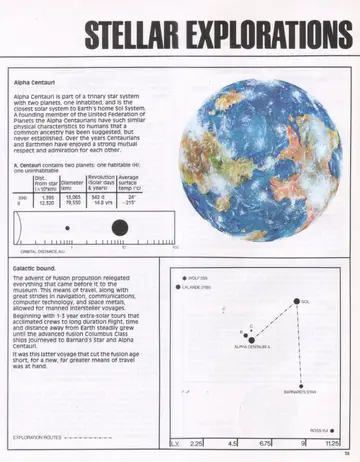
Captain's Log: With great pride, I am entering into the Log an Official Date of Notification. After traveling for five years, ten months and two days, the Icarus has just made the first contact with extraterrestrial, intelligent life: the Alpha Centaurians.
We had not expected any sort of evolved life here, since the trinary Centauri Star System produces strong, fluctuating radiation and complicated gravitational fields that can be fatal to biological development. So it was to our great surprise that once we were within 7 A.U. of Alpha Centauri, life is indeed what we found.
Inside that critical radius, we began to be bombarded by a vast array of signals emanating from a planet, signals whose complexity pointed unmistakably to an advanced civilization. I ordered a general alert, with battlestations ready, and we cautiously approached the planet at flank speed.
At 1.5 A.U. from the planet, scanners picked up four alien vessels rapidly converging on the Icarus. I decided against evasive or defensive action and ordered the fusion engines to dead stop, hoping to demonstrate our lack of hostile intentions.
The gambit paid off. After surrounding our ship, the alien vessels hailed us on all standard frequencies in an unknown language, then one dispatched a small craft which traveled half the distance to our ship. Understanding the gesture, I boarded our shuttlecraft and went to meet, well, I had no idea who or what I was to meet.
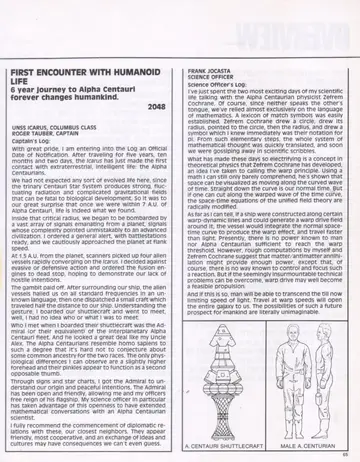
Who I met when I boarded their shuttlecraft was the Admiral (or their equivalent) of the interplanetary Alpha Centauri fleet. And he looked a great deal like my Uncle Alex. The Alpha Centaurians resemble homo sapiens to such a degree that it's hard not to conjecture about some common ancestry for the two races. The only physiological differences I can observe are a slightly higher forehead and their pinkies appear to function as a second opposable thumb.
Through signs and star charts, I got the Admiral to understand our origin and peaceful intentions. The Admiral has been open and friendly, allowing me and my officers free reign of his flagship. My science officer in particular has taken advantage of this openness to have extended mathematical conversations with an Alpha Centaurian scientist.
I fully recommend the commencement of diplomatic relations with these, our closest neighbors. They appear friendly, most cooperative, and an exchange of ideas and cultures may have consequences we can't even guess.
Frank Jocasta, Life Science Officer.
Science Officer's Log: I've just spent the two most exciting days of my scientific life talking with the Alpha Centaurian physicist Zefrem Cochrane. Of course, since neither speaks the other's tongue, we've relied almost exclusively on the language of mathematics. A lexicon of match symbols was easily established. Zefrem Cochrane drew a circle, drew its radius, pointed to the circle, then the radius, and drew a symbol which I knew immediately was their notation for pi. From such elementary steps, the whole system of mathematical thought was quickly translated, and soon we were gossiping away in scientific scribbles.
What has made these days so electrifying is a concept in theoretical physics that Zefrem Cochrane has developed, an idea I've taken to calling the warp principle. Using a math I can still only barely comprehend, he's shown that space can be visualized as moving along the curved wave of time. Straight down the curve is our normal time. But if one can cut along the warped wave of the time curve, the space-time equations of the unified field theory are radically modified.
As far as I can tell, if a ship were constructed along certain warp-dynamic lines and could generate a warp drive field around it, the vessel would integrate the normal space-time curve to produce the warp effect, and travel faster than light. Presently, there is no power known to man nor Alpha Centaurian sufficient to reach the warp threshold. However, rough computations by myself and Zefrem Cochrane suggest that matter/antimatter annihilation might provide enough power, except that, of course, there is no way known to control and focus such a reaction. But if the seemingly insurmountable technical problems can be overcome, warp drive may well become a feasible propulsion.
And if this is so, man will be able to transcend the till now limiting speed of light. Travel at warp speeds will open the entire galaxy to us. The possibilities of such a future prospect for mankind are literally unimaginable.