10.3 Official Logs
A collection of first-person logs and reports from 2176-2200 documenting the discovery of dilithium's properties, the Babel Conference crisis and its resolution with addresses by Admiral Shepherd and Carter Winston, a Federation health notice on the lingering Phi Puma supernova hazard, the largest space rescue in history aboard the lifeships of the Starliner Juliana, the launch of the Constitution Class USS Enterprise with logs from its officers, the time gate found by the USS Wells, the creation of a comet after the USS Ajax exploded, the off-limits declaration of the Talos Star System under General Order #7, and the development of the phaser.
Dilithium Properties Discovered (2176)
Obscure crystal is potentially tremendous energy source. Rigel XII Mining Complex. Wendell Herzog, Geophysicist. Science Log.
I am entering into the Log, for validation and follow-up by Federation societies, a discovery that I believe will revolutionize warp mechanics: dilithium crystals.
Until now, there's been a seemingly unbreachable limit to the amount of warp drive to be attained from matter/antimatter annihilation. No matter how efficient the mixing, how clean the waste products, a maximum of about 4.8 warp was all that could be coaxed out of the process. No longer. If my calculations are valid, then warps of 8 or 9, or perhaps even higher, may soon be within the reach of spaceflight technology.
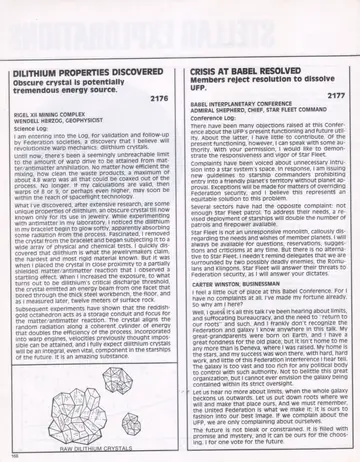
What I've discovered, after extensive research, are some unique properties of dilithium, an obscure crystal till now known only for its use in jewelry. While experimenting with antimatter in my laboratory, I noticed the dilithium in my bracelet begin to glow softly, apparently absorbing some radiation from the process. Fascinated, I removed the crystal from the bracelet and began subjecting it to a wide array of physical and chemical tests. I quickly discovered that dilithium is what the jewelrymakers claim, the hardest and most rigid material known. But it was when I placed the crystal in close proximity to a partially shielded matter/antimatter reaction that I observed a startling effect. When I increased the exposure, to what turns out to be dilithium's critical discharge threshold, the crystal emitted an energy beam from one facet that bored through the thick steel workbench, the floor, and as I measured later, twelve meters of surface rock.
Subsequent experiments have shown that the reddish-gold octahedron acts as a storage conduit and focus for the matter/antimatter reaction. The crystal aligns the random radiation along a coherent cylinder of energy that doubles the efficiency of the process. Incorporated into warp engines, velocities previously thought impossible can be attained, and I fully expect dilithium crystals will be an integral, even vital, component in the starships of the future. It is an amazing substance.
Crisis at Babel Resolved (2177)
Members reject resolution to dissolve UFP. Babel Interplanetary Conference. Admiral Shepherd, Chief, Star Fleet Command. Conference Log.
There have been many objections raised at this Conference about the UFP's present functioning and future utility. About the latter, I have little to contribute. Of the present functioning, however, I can speak with some authority. With your permission, I would like to demonstrate the responsiveness and vigor of Star Fleet.
Complaints have been voiced about unnecessary intrusion into a star system's space. In response, I am issuing new guidelines to starship commanders prohibiting entry into a friendly planet's territory without planet approval. Exceptions will be made for matters of overriding Federation security, and I believe this represents an equitable solution to this problem.
Several sectors have had the opposite complaint: not enough Star Fleet patrol. To address their needs, a revised deployment of starships will double the number of patrols and firepower available.
Star Fleet is not an unresponsive monolith, callously disregarding the needs and wishes of member planets. I will always be available for questions, reservations, suggestions and criticisms at any time. But there is no alternative to Star Fleet. I needn't remind delegates that we are surrounded by two possibly deadly enemies, the Romulans and Klingons. Star Fleet will answer their threats to Federation security, as I will answer your dictates.
Carter Winston, Businessman.
I feel a little out of place at this Babel Conference. For I have no complaints at all. I've made my fortune already. So why am I here?
Well, I guess it's all this talk I've been hearing about limits, and suffocating bureaucracy, and the need to “return to our roots” and such. And I frankly don't recognize the Federation and galaxy I know anywhere in this talk. My great-grandparents were born on Earth, and I have a great fondness for the old place, but it isn't home to me any more than is Deneva, where I was raised. My home is the stars, and my success was won there, with hard, hard work, and little of this Federation interference I hear tell. The galaxy is too vast and too rich for any political body to control with such authority. Not to belittle this great organization, but I cannot ever envision the galaxy being contained within its strict oversight.
Let us hear no more about limits, when the whole galaxy beckons us outwards. Let us put down roots where we will and make that place ours. And we must remember, the United Federation is what we make it; it is ours to fashion into our best image. If we complain about the UFP, we are only complaining about ourselves.
The future is not bleak or constrained. It is filled with promise and mystery, and it can be ours for the choosing. I for one vote for the future.
Supernova Aftermath Still Galactic Hazard (2179)
UFP Central Health Authority.
The Phi Puma supernova that vaporized the Kepler had repercussions that persisted for decades as the radiation concussion spread in all directions at the speed of light. While Bayard's Planet was the only world that had to be entirely evacuated, systems further away still felt strong effects from this largest stellar cataclysm in Federation history. So periodically, the UFP would issue warnings to all systems who were to experience the stellar shock in the near future and even today, certain seismically unstable systems are still alerted to the supernova's dangerous afteraffects.
Federation Health Notice: Notice to All Planets in Sector 3.G4; Quadrant II. The effects of the Phi Puma supernova will pass through this sector in the coming solar year. All inhabited regions are hereby cautioned to:
- Monitor all solar and/or seismic upheavals very carefully. No chain reaction novas are expected in this sector, but existing structural faults are likely to be severely stressed.
- Expect disruption of electromagnetic transmission and increased sunspot activity.
- Recalibrate all programmed trajectories of all orbiting bodies to compensate for the stellar concussion.
Furthermore, on the days of peak radiation barrage, sector inhabitants are warned to:
- Remain indoors if possible. There will be alpha radiation included in the barrage, and it cannot penetrate interiors.
- Never under any circumstances look directly toward the supernova. Serious eye injury or even blindness may result.
- Suspend all magnetohydrodynamic (MHD) processes to protect equipment from damage.
- Avoid interplanetary travel. Navigational sensors will be affected unpredictably, and other ship systems will suffer similar unknowable stresses.
- Have a stock of radiation blocking doses on hand in case of accidental overexposure.
The supernova concussion is an extremely serious galactic health hazard, and every possible precaution should be taken to prepare for its arrival. Are you ready?
Largest Space Rescue in History (2184)
600 safely recovered from interstellar void. USS Deerslayer, Voyager Class. Roger Trautmann, Captain. Captain's Log.
The greatest space rescue operation has come to a successful conclusion. After twenty stardates of unrelenting search with the combined Rescue Fleet of fifteen Federation vessels, I can finally report we've located and secured the lifeships from the Starliner Juliana, with all passengers and all but five crew members alive. While there has been some cases of dehydration and vitamin deficiencies, the survivors are generally in good health and spirits considering what they have gone through.
The man most responsible for our success is one of the casualties, the skipper of the Juliana Captain Demetrius Kovanas. We're still piecing together the specific details of the Juliana's breakdown, but it appears that some unexpected local discontinuity in the warp fabric violently transported the large cruise ship to a totally unfamiliar sector of space, well off their flight itinerary. The disruption also shattered the dilithium assembly, killing all crew on the Engineering Deck and causing a rapid and complete power loss aboard ship. The order was given to abandon ship.
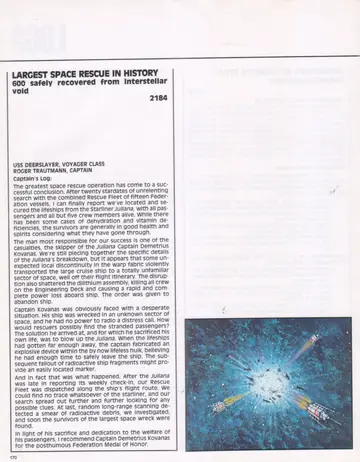
Captain Kovanas was obviously faced with a desperate situation. His ship was wrecked in an unknown sector of space, and he had no power to radio a distress call. How would rescuers possibly find the stranded passengers? The solution he arrived at, and for which he sacrificed his own life, was to blow up the Juliana. When the lifeships had gotten far enough away, the captain fabricated an explosive device within the by now lifeless hulk, believing he had enough time to safely leave the ship. The subsequent fallout of radioactive ship fragments might provide an easily located marker.
And in fact that was what happened. After the Juliana was late in reporting its weekly check-in, our Rescue Fleet was dispatched along the ship's flight route. We could find no trace whatsoever of the starliner, and our search spread out further and further looking for any possible clues. At last, random long-range scanning detected a smear of radioactive debris, we investigated, and soon the survivors of the largest space wreck were found.
In light of his sacrifice and dedication to the welfare of his passengers, I recommend Captain Demetrius Kovanas for the posthumous Federation Medal of Honor.
Constitution Class Launched (2188)
Enterprise to be flagship of 4th generation warp fleet. USS Enterprise, Constitution Class. Robert April, Captain. Captain's Log.
As we approach Starbase 4 at the conclusion of this shakedown cruise of the Enterprise, I'd like to report on this ship's systems. Concerning the ship's systems functioning, beginning with myself. Straight out, this is simply the best starship I have ever sailed. From my command station at the center of the bridge, I have had the pleasure of commanding the Enterprise through stardates of complex stress tests and emergency simulations, and the maneuverability, responsiveness and overall spaceworthiness of the vessel are staggering. Everything is better—helm handling, warp capability, shielding, phaser power, even the food. While I've let my Officers evaluate their respective systems, I think I can speak for the whole crew when I state my conviction that the Enterprise and its fellow Constitution Class vessels represent a great leap forward in galactic security and exploration.
Charles Fourrier, Chief Engineering Officer. Engineering Log.
Since the engineering on the Enterprise differs from all previous starships on account of the integration of dilithium into the warp engines, I cannot make substantive comparisons with older systems. It is safe to say, however, that the Enterprise's engineering is vastly superior to all previous starships. Stress tests have achieved warp 8.5 without serious breakdown, though a flow sensor did malfunction at that speed. The two-nacelle design delivers symmetrical matter/antimatter field flux, and the warp engagement delay and warp acceleration are substantially better than I've ever known. In disaster simulation, the auxiliary impulse unit delivered as much lifesaving power and sub-warp maneuverability as I could expect. In sum, the Enterprise's engines are better designed, stronger and faster than any previous starship in Federation history. They are beautiful.
Karen Van Fleet, Communications Officer. Communications Log.
Communications on board the Enterprise is excellent. Subspace radio transmission of warp 30 is now possible, due to the increased warp power designated for communications. Telemetry encoding has been flawless; even communications three day's travel away, 221.7 light-years, are transmitted and received without error, in sharp contrast to the garbled messages previous ships would on occasion receive at a quarter the distance. Space noise damping is -90 decibels, and frequency response on all hailing and sideband channels is accurate to 10-3 MHz. I would rate Enterprise communications as excellent, bordering on superb.
Luis Ferarra, Helmsman. Helmsman's Log.
The Enterprise is a joy to steer. Its turning radius is sharper than you would expect in such a large craft, and the helm's response is quicker than any I've ever sat behind. I'm not crazy about having the Captain's chair directly behind mine, since it's hard to shake the feeling he's looking over my shoulder all the time, but the time delay between the giving of a command and its execution is fast. The Enterprise's laser banks have fired faster than anything I've ever fired.
Gregor Allinsky, Science Officer. Science Log.
Some significant improvements have been designed into the Science Console, a much greater capability. The sensors, in both tight focused and wide scan, can sweep fore and aft of the ship to distances up to 30 light-years, while the capability of close-range sensors is simply unbelievable, as they can detect individual molecules in the interstellar void. But the most extraordinary new ability is the data bank, which contains practically the whole of present galactic knowledge, making my task as Science Officer immeasurably easier. My duty tour aboard the Enterprise will be a pleasure.
Sarah April, M.D., Medical Officer. Medical Log.
I am on the whole satisfied with the Sick Bay and auxiliary medical facilities available on the Enterprise. Landing party tricorders are more powerful and have a much greater diagnostic range because of the duotronic-assisted translator circuits. The Sick Bay's Metabolic Analyzer is excellent, as is most surgical and post-operative equipment. However, the Enterprise has a much, much greater range than any previous starship. It is going to go farther and run into more kinds of trouble than any previous ship, and I have my doubts that the Sick Bay is capable of rising to all the demands that will inevitably be placed on it. I am going to continue examining this situation, and I'm confident that some significant improvements can be made in this area.
First Time Gate Found by USS Wells (2190)
Starbase 20. Gregory Tree, Commodore. Commodore's Log.
I have impossible news to report, the circumstances of which I can positively confirm, but which are, well, impossible. The USS Wells embarked from Starbase 20 thirty-three solar days ago on a five-year exploratory mission to several unknown sectors of space. Yesterday, the ship returned, limping in on impulse power, its warp engines badly damaged. However, when the Captain reported to me, as per Star Fleet protocol, he stated that the Wells had been gone over three solar years. This is impossible.
It is also clearly irrefutable. Not only do the crew of the Wells swear to it unanimously, but the computer-kept ship's Log verifies it, and the engineering tests reveal metal stress and other operating deterioration that could only have occurred over years of interstellar travel. Clearly, the Wells has somehow traveled back in time.
And it nearly destroyed them. The Wells captain knows exactly when this time-jump happened. His ship was traveling through an empty sector when ship sensors began picking up inexplicable starboard drag on the warp engines. First, of course, he suspected engine malfunction, but his Science Officer reported that it was the local space-time geometry itself that was creating the effect, and its power was issuing from a particular point in empty space.
Investigating this phenomenon closer, the Wells approached the mysterious point, until the entire ship felt a violent wrenching. Several shuddering waves passed through the vessel, damaging the dilithium assembly. Afterwards, everything seemed the same, except the damaged warp engines dictated an early return from their mission. They almost didn't make it back either. Power levels on the ship had dipped dangerously low by the time they returned, not even able to initiate warp drive by the end.
But at the end, they and we discovered that this unexplained wrenching sent them back in time several years. There is no possibility of fraud, and no acceptable explanation according to known laws of physics. What that time gate is, and how it reverses the time flow, is a subject I'll leave to the scientists, but I'll verify the actual event: the Wells traveled through time.
Comet Is Created After Warp Cruiser Explodes (2193)
Incredible incident is first of its kind. USS Brahe, Constitution Class. Peter Sullivan, Captain. Captain's Log.
I'm reporting that we've located the remains of the USS Ajax, recently reported missing. It just seems like most every new generation of starship is hailed as the most spectacular achievement of modern technology, and every new generation has its own terrible disaster, its own sacrifice at the cost of progress. Some are lost in collision; others disappear. And some, like the Ajax, blow up.
Initial playbacks of the Ajax's final Log receptions are unrevealing, but at some point, approximately three stardates ago, to judge by the scatter velocity of the remains, the Ajax underwent an enormous on-ship explosion great enough to disintegrate the warp cruiser.
Though the boys from the Star Fleet Safety Board are good enough to pull explanations almost literally out of thin air, we might never know the cause of the accident. Well, I may not be an expert, but it seems obvious that the only force that could have caused the unforseen, cataclysmic explosion is matter/antimatter annihilation. And, if you ask me, it had something to do with that new dilithium convertor assembly. That's such a critical component in new starship design, and one that should have been tested more, that, well, I'm afraid we haven't seen the end of trouble from this “miracle” crystal.
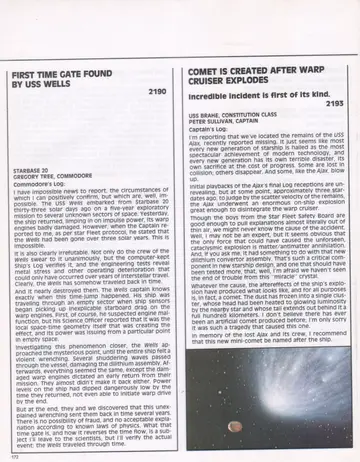
Whatever the cause, the aftereffects of the ship's explosion have produced what looks like, and for all purposes is, in fact, a comet. The dust has frozen into a single cluster, whose head had been heated to glowing luminosity by the nearby star and whose tail extends out behind it a full hundred kilometers. I don't believe there has ever been an artificial comet produced before; I'm only sorry it was such a tragedy that caused this one.
In memory of the lost Ajax and its crew, I recommend that this new mini-comet be named after the ship.
Talos Star Group Declared Off-Limits (2196)
Star Fleet Command.
There were some interstellar dangers encountered in space exploration that were, for one reason or another, simply too terrible a menace to reveal. The Talos Star System posed just such a threat, and General Order #7 was issued banning any contact whatsoever with the unknown peril, a peril so awesome that this Order carried with it, a sentence of death for breaking it, the only Order in Federation history to do so.
It was more than a decade later that the galactic danger posed by Talos was revealed. The Talosians were a race who had developed extraordinary psionic powers of illusion-making, but at the expense of their genetic vitality. No longer able to reproduce, they desperately needed breedable species to inhabit their planet, and with such psionic abilities, could have enslaved millions under the spell of their illusion. Moreover, on first contact, the Talosians seemed quite ready to do so, hence, General Order #7.
General Order #7.
Notice is hereby given to all United Federation of Planets' ships, of every class and mission, that the Talos Star System and all space within ten light-years has been declared OFF-LIMITS.
No ship or person shall trespass into this proscribed region for any purpose whatsoever. There are NO exceptions to this Prohibition.
Any transgression of General Order #7 shall be punishable by DEATH.
Repeat: The Talos Star System has been declared OFF-LIMITS.
Federation Develops Its Ultimate Weapon: The Phaser (2198)
Arcturus Test Range. Bruno Wilhelm, Science Officer. Science Log. “TOP SECRET” Confidential Report to Star Fleet Command. Declassified Stardate: 2827.8.
Contained herein is my preliminary report on the development of the new phaser weaponry. We have had excellent results with the melding of two separate weapons systems, lasers and particle-beam cannons. Lasers had the penetration but not the impact force of particle beams, and similarly particle-beams delivered a big punch, but couldn't penetrate shielding the way lasers can.
It looks like we've been able to combine both into a single device. The hardest part was aligning the frequencies of the separate systems so that they would complement one another, instead of interfering. With wideband frequency sampling and multi-core ejection nozzle, the phaser can fire a blast that will cut through all present shielding with devastating force.
Consequently, a direct hit produces a whole different type of destructive effect than lasers or particle beams. So much energy is concentrated on a single target, that the inter-molecular cohesion is ruptured: the object literally disintegrates. Anyone who watched as we vaporized a drone ship would know that this is a whole new level of weaponry.
While we've only been experimenting with large-scale systems here at Arcturus Firing Range, calculations I've been making on the side seem to indicate that the phaser can be constructed as small as a handgun. Its power would be much less, of course, but with transtator physics, there doesn't seem to be any theoretical objection to such a design. In addition, this less severe setting can be modified so that the target would not be destroyed but, rather, organic processes would be temporarily stunned. This would make the hand-held phaser a much more humane defensive instrument than currently available.
Firing and analysis will continue, but I think we've got the main problems licked. I wouldn't be surprised if phasers don't become standard equipment on starships in a few solar years.