6.1 Ships: UNSS Pollux, USS Horizon, Hospital Ship, Transport
An illustrated ships chronology of the period, presenting a year-by-year timeline of events and spacecraft from 2076 to 2100 alongside detailed specification panels and color plates for the principal ships of the era, including the UNSS Pollux (Messier Class), the flagship USS Horizon (Horizon Class), the Transport (Vanguard Class) and the Hospital Ship (Hopkins Class).
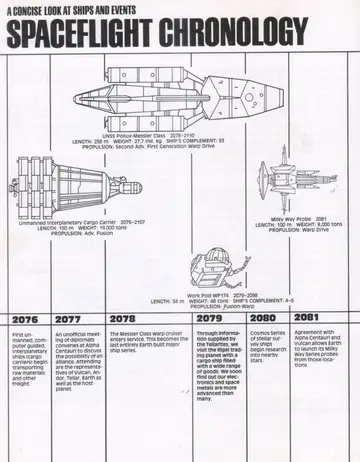
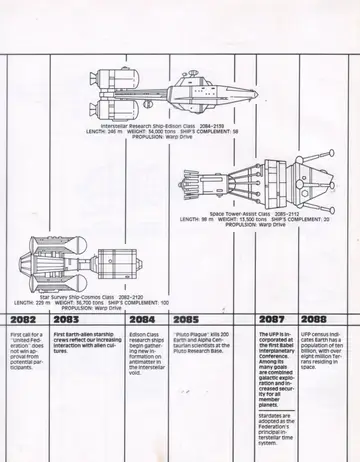
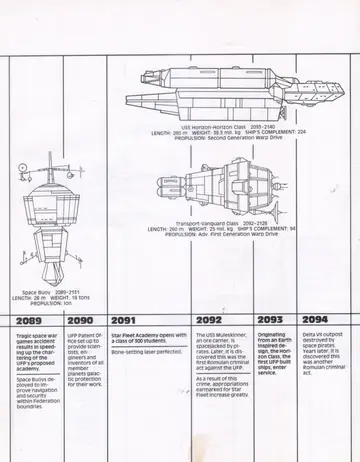
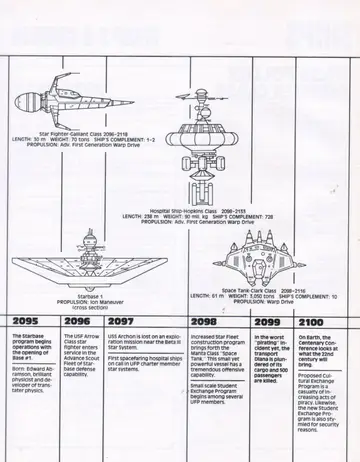
A Concise Look at Ships and Events: Spaceflight Chronology
2076—First unmanned, computer guided, interplanetary ships (cargo carriers) begin transporting raw materials and other freight.
2077—An unofficial meeting of diplomats convenes at Alpha Centauri to discuss the possibility of an alliance. Attending are the representatives of Vulcan, Andor, Tellar, Earth as well as the host planet.
2078—The Messier Class warp cruiser enters service. This becomes the last entirely Earth built major ship series.
2079—Through information supplied by the Tellarites, we visit the Rigel trading planet with a cargo ship filled with a wide range of goods. We soon find out our electronics and space metals are more advanced than many.
2080—Cosmos Series of stellar survey ships begin research into nearby stars.
2081—Agreement with Alpha Centauri and Vulcan allows Earth to launch its Milky Way Series probes from those locations.
2082—First call for a “United Federation” does not win approval from potential participants.
2083—First Earth-alien starship crews reflect our increasing interaction with alien cultures.
2084—Edison Class research ships begin gathering new information on antimatter in the interstellar void.
2085—“Pluto Plague” kills 200 Earth and Alpha Centaurian scientists at the Pluto Research Base.
2087—The UFP is incorporated at the first Babel Interplanetary Conference. Among its many goals are combined galactic exploration and increased security for all member planets. Stardates are adopted as the Federation's principal interstellar time system.
2088—UFP census indicates Earth has a population of ten billion, with over eight million Terrans residing in space.
2089—Tragic space war games accident results in speeding up the chartering of the UFP's proposed academy. Space Buoys deployed to improve navigation and security within Federation boundries.
2090—UFP Patent Office set up to provide scientists, engineers and inventors of all member planets galactic protection for their work.
2091—Star Fleet Academy opens with a class of 300 students. Bone-setting laser perfected.
2092—The USS Muleskinner, an ore carrier, is spacejacked by pirates. Later, it is discovered this was the first Romulan criminal act against the UFP. As a result of this crime, appropriations earmarked for Star Fleet increase greatly.
2093—Originating from an Earth inspired design, the Horizon Class, the first UFP built ships, enter service.
2094—Delta VII outpost destroyed by space pirates. Years later, it is discovered this was another Romulan criminal act.
2095—The Starbase program begins operations with the opening of Base #1. Born: Edward Abramson, brilliant physicist and developer of transtater physics.
2096—The USF Arrow Class star fighter enters service in the Advance Scout Fleet of Starbase defense capability.
2097—USS Archon is lost on an exploration mission near the Beta III Star System. First spacefaring hospital ships on call in UFP charter member star systems.
2098—Increased Star Fleet construction program brings forth the Manta Class “Space Tank.” This small yet powerful vessel has a tremendous offensive capability. Small scale Student Exchange Program begins among several UFP members.
2099—In the worst “pirating” incident yet, the transport Diana is plundered of its cargo and 500 passengers are killed.
2100—On Earth, the Centenary Conference looks at what the 22nd century will bring. Proposed Cultural Exchange Program is a casualty of increasing acts of piracy. Likewise, the new Student Exchange Program is also stymied for security reasons.
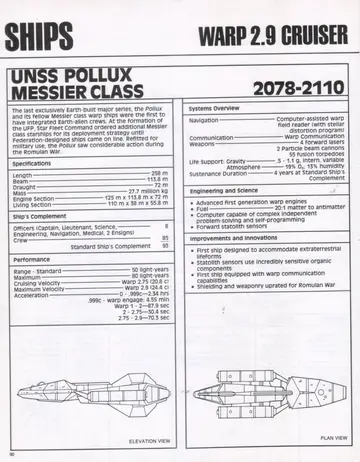
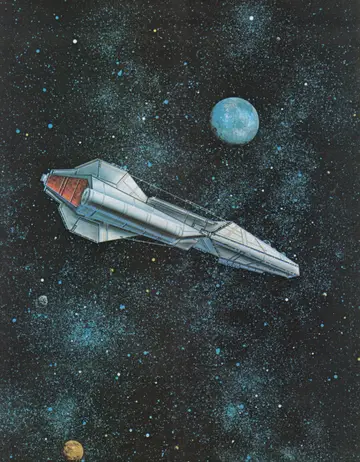
UNSS Pollux: Messier Class (2078-2110)
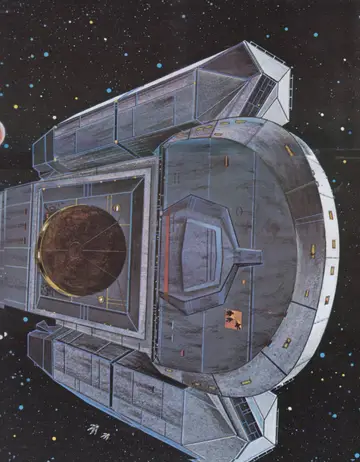
The last exclusively Earth-built major series, the Pollux and its fellow Messier class warp ships were the first to have integrated Earth-alien crews. At the formation of the UFP, Star Fleet Command ordered additional Messier class starships for its deployment strategy until Federation-designed ships came on line. Refitted for military use, the Pollux saw considerable action during the Romulan War.
Engineering and Science
- Advanced first generation warp engines
- Fuel: 20:1 matter to antimatter
- Computer capable of complex independent problem-solving and self-programming
- Forward statolith sensors
Improvements and Innovations
- First ship designed to accommodate extraterrestrial lifeforms
- Statolith sensors use incredibly sensitive organic components
- First ship equipped with warp communication capabilities
- Shielding and weaponry uprated for Romulan War
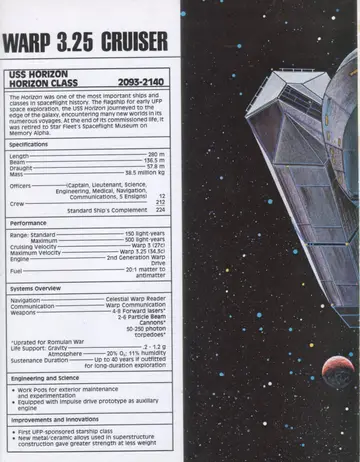
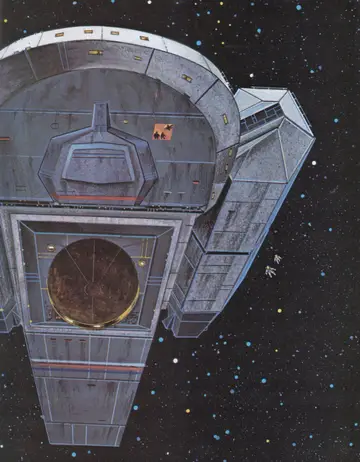
USS Horizon: Horizon Class (2093-2140)
The Horizon was one of the most important ships and classes in spaceflight history. The flagship for early UFP space exploration, the USS Horizon journeyed to the edge of the galaxy, encountering many new worlds in its numerous voyages. At the end of its commissioned life, it was retired to Star Fleet's Spaceflight Museum on Memory Alpha.
Engineering and Science
- Work Pods for exterior maintenance and experimentation
- Equipped with impulse drive prototype as auxiliary engine
Improvements and Innovations
- First UFP-sponsored starship class
- New metal/ceramic alloys used in superstructure construction gave greater strength at less weight
Transport: Vanguard Class (2092-2128)
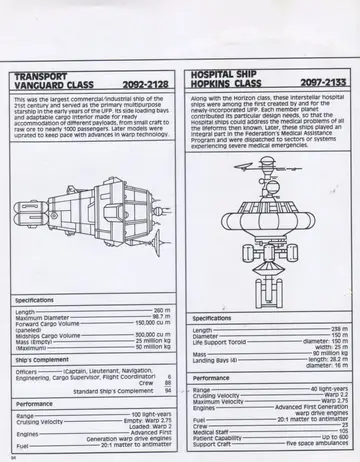
This was the largest commercial/industrial ship of the 21st century and served as the primary multipurpose starship in the early years of the UFP. Its side loading bays and adaptable cargo interior made for ready accommodation of different payloads, from small craft to raw ore to nearly 1000 passengers. Later models were uprated to keep pace with advances in warp technology.
Hospital Ship: Hopkins Class (2097-2133)
Along with the Horizon class, these interstellar hospital ships were among the first created by and for the newly-incorporated UFP. Each member planet contributed its particular design needs, so that the Hospital ships could address the medical problems of all the lifeforms then known. Later, these ships played an integral part in the Federation's Medical Assistance Program and were dispatched to sectors or systems experiencing severe medical emergencies.