3.3 Sol System Explorations: Mars
A survey of Mars as the first planet of the Sol System to be extensively explored and settled, with a comparison of the habitable inner planets and an account of how fission propulsion opened the inner system to manned exploration while the unmanned Stellar Series probes became Earth's first interstellar travelers.
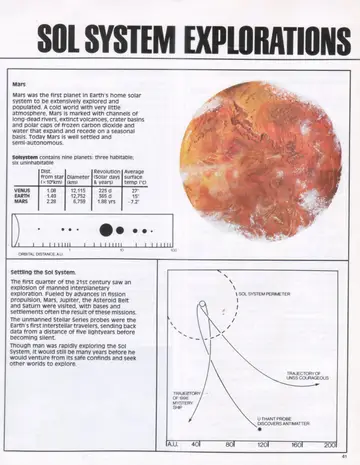
Mars
Mars was the first planet in Earth's home solar system to be extensively explored and populated. A cold world with very little atmosphere, Mars is marked with channels of long-dead rivers, extinct volcanoes, crater basins and polar caps of frozen carbon dioxide and water that expand and recede on a seasonal basis. Today Mars is well settled and semi-autonomous.
Solsystem contains nine planets: three habitable; six uninhabitable.
- Venus—Distance from star (×108 km) 1.08; Diameter 12,115 km; Revolution 225 d; Average surface temp 27°
- Earth—Distance from star (×108 km) 1.49; Diameter 12,752 km; Revolution 365 d; Average surface temp 15°
- Mars—Distance from star (×108 km) 2.28; Diameter 6,759 km; Revolution 1.88 yrs; Average surface temp -7.2°
Settling the Sol System
The first quarter of the 21st century saw an explosion of manned interplanetary exploration. Fueled by advances in fission propulsion, Mars, Jupiter, the Asteroid Belt and Saturn were visited, with bases and settlements often the result of these missions.
The unmanned Stellar Series probes were the Earth's first interstellar travelers, sending back data from a distance of five lightyears before becoming silent.
Though man was rapidly exploring the Sol System, it would still be many years before he would venture from its safe confinds and seek other worlds to explore.