Spaceflight Chron. · Chapter 13 · Glossary
13.0 Glossary
An alphabetical glossary defining the scientific, astronomical, and propulsion terms used throughout the Chronology, from antimatter and warp drive to the United Federation of Planets seal that closes the volume.
Full-page seal of the United Federation of Planets: a wreathed laurel emblem encircling a central star-chart disc.
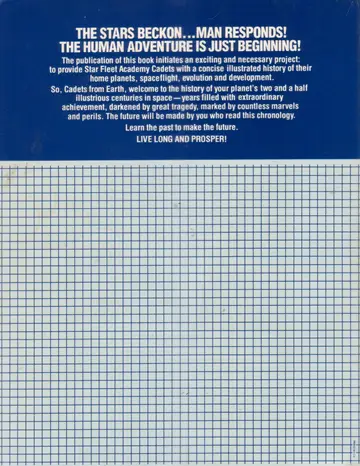
Closing inscription: "The Stars Beckon...Man Responds! The Human Adventure is Just Beginning!"—a final address to Star Fleet Academy Cadets ending "Live Long and Prosper!" set over a graph-paper field.
- Antimatter—identical but exactly opposite to matter found in our universe; when matter becomes antimatter, both are completely transformed into energy.
- Antimatter Nacelles—rear fuel tubes containing antimatter for warp engines.
- Antimatter Universe—universe with exactly opposite space-time matrix than ours (see space-time matrix).
- Astrotelemetry—the science which specializes in communications over interplanetary and astronomical distances.
- Astronomical Unit—unit of measurement based on distance between Earth and the Sun.
- Black Hole—site of a dying giant star's irreversible collapse; the gravitational attraction is so great no light or any other radiation can escape.
- Boron-Steel—extremely hard metal alloy used in early starship construction.
- Cartography—the science of map-making.
- Cepheid Variable—star whose luminosity changes over time, brightening and darkening over (usually) periodic intervals.
- Cochrane Deceleration Maneuver—textbook starship maneuver first deployed with great success during the Romulan War.
- Condritic Rock—deep space rocks, particularly common in the Sol System asteroid belt, containing many different elements (iron, nickel, silicon, traces of titanium).
- Controlled-Growth Microorganisms—organic crops of space farms that can be processed into a full range of foodstuffs.
- Dilithium Crystals—crystalline mineral used to focus matter-antimatter energy for warp drive.
- Duotronics—theoretical computer breakthrough conceived by Earth scientist Richard Daystrom; found in starships from Baton Rouge Class ships onward.
- Earth Approaching Asteroid—Wanderers from the Sol System asteroid belt. There are two classes: a) Apollo Asteroids have orbit that intersects Earth; b) Amor Asteroids have orbit outside Earth, but inside Mars.
- Elliptical Trajectory—flight path using planet fly-by for "slingshot effect" acceleration.
- Gamma Rays—high energy, ionizing electromagnetic radiation (also known as X-rays).
- General Theory of Relativity—description of geometry of four-dimensional space by twentieth century Earth physicist Einstein (see unified field equations).
- Geon Holes—discontinuities in the "walls" of geodynamometric space-time; utilized in warp communication.
- Gigawatt—one billion watts.
- Hodgkins' Law of Parallel Planet Development—principle of cultural evolution stating similar planets develop similar cultures.
- Holograph—three dimensional picture created by programmed lasers.
- Hyperspace—space outside walls of geodynamometric space-time matrix.
- Impulse Power—main propulsion for small, sub-warp craft; also back-up power on warp drive starships.
- Libration Points—gravitational balance points between orbiting bodies, such as Earth and Moon, resulting in weightlessness.
- Local Space-Time Geometry—mathematical laws describing physical conditions of surrounding space-time matrix.
- Null Gravity—a condition of natural or induced weightlessness.
- Octahedron—an eight-sided structure, such as the eight-faceted dilithium crystal.
- OH Group—hydroxyl group: one of the basic units of organic life, consisting of bonded oxygen and hydrogen.
- Parallel Universes—universes coexistent with our own but in a different space-time matrix (see antimatter universe).
- Parsec—a standard unit of interstellar distance, equivalent to 3.26 light years.
- Phasers—Federation's most advanced weapons system using synergistic combination of lasers and particle-beam cannons.
- Project SETI—an early search for extra-terrestrial intelligence succeeding finally with the reception of the "Sagittarian signals" (see Chapter 3, Log 2).
- Psionic Power—generic term for extra-evolved mental powers, ranging from telepathy to telekinesis (mind moving matter) and beyond.
- Radio Astronomy—the part of astronomy that studies electromagnetic signals in the radio wave bandwidth, which can be perceived to the limits of the known universe.
- S-Stars—unusual class of stars (the Sun among them) containing significant quantities of radioactive technetium-99.
- Solar Year—old-fashioned dating system based on the Earth's time of revolution around the Sun.
- Solid Crystal Recordings—psionically triggered records made from crystals encoded three-dimensionally along lattice structures.
- Space-Time Matrix—a term referring to four-dimensional reality, derived from theoretical mathematics.
- Special Theory of Relativity—twentieth century Earth physicist Einstein's brilliant formulation stating that because of the constant speed of light, all physical frameworks are relative to one another.
- Stardate—relativistic dating system based on both chronology and location (see space-time matrix).
- Subspace Radio—warp-speed communications whose signals travel via warp-accelerated, computer-encoded particles.
- Technetium-99—unstable radioactive element created in the cores of certain types of stars (see S-Stars).
- Time Gate—local deformation of space-time matrix, allowing instantaneous entry to the past or, theoretically, the future.
- Transtator Physics—breakthrough in electromechanical physics that revolutionized technology; found in tricorders, transporters, etc.
- Trititanium—exceptionally hard metal alloy used in starship construction.
- Unified Field Equations—twenty-first century mathematical solutions to the General Theory of Relativity.
- Universal Cube Law—velocity principle underlying warp dynamics; warp 2 = 2³c. = 8c.; warp 3 = 3³c. = 27c.; etc.
- Warp Drive—spaceship propulsion using controlled matter-antimatter annihilation to achieve faster-than-light speeds.
- Warp Principle—an integration of the normal space-time curve producing faster-than-light speeds (warp 2 = 2³c. = 8c.; warp 3 = 3³c. = 27c.; etc.).