2.2 USS Enterprise Coordinate System
Explains the external XYZ vertex/vector reference scheme and the internal fifteen-digit locator address system used aboard the Enterprise.
External Coordinate System
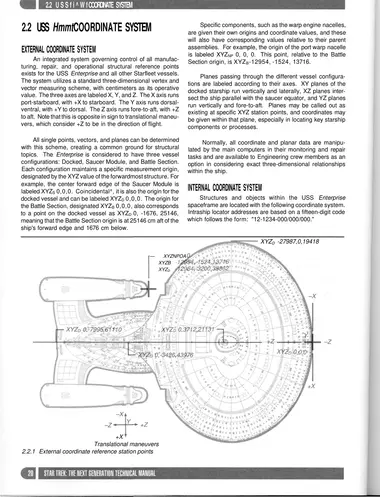
An integrated system governing control of all manufacturing, repair, and operational structural reference points exists for the USS Enterprise and all other Starfleet vessels. The system utilizes a standard three-dimensional vertex and vector measuring scheme, with centimeters as its operative value. The three axes are labeled X, Y, and Z. The X axis runs port-starboard, with +X to starboard. The Y axis runs dorsalventral, with +Y to dorsal. The Z axis runs fore-to-aft, with +Z to aft. Note that this is opposite in sign to translational maneuvers, which consider +Z to be in the direction of flight.
All single points, vectors, and planes can be determined with this scheme, creating a common ground for structural topics. The Enterprise is considered to have three vessel configurations: Docked, Saucer Module, and Battle Section. Each configuration maintains a specific measurement origin, designated by the XYZ value of the forwardmost structure. For example, the center forward edge of the Saucer Module is labeled XYZS 0,0,0. Coincidentally, it is also the origin for the docked vessel and can be labeled XYZD 0,0,0. The origin for the Battle Section, designated XYZB 0,0,0, also corresponds to a point on the docked vessel as XYZD 0, -1676, 25146, meaning that the Battle Section origin is at 25146 cm aft of the ship's forward edge and 1676 cm below.
Specific components, such as the warp engine nacelles, are given their own origins and coordinate values, and these will also have corresponding values relative to their parent assemblies. For example, the origin of the port warp nacelle is labeled XYZNP 0, 0, 0. This point, relative to the Battle Section origin, is XYZB-12954, -1524, 13716.
Planes passing through the different vessel configurations are labeled according to their axes. XY planes of the docked starship run vertically and laterally, XZ planes intersect the ship parallel with the saucer equator, and YZ planes run vertically and fore-to-aft. Planes may be called out as existing at specific XYZ station points, and coordinates may be given within that plane, especially in locating key starship components or processes.
Normally, all coordinate and planar data are manipulated by the main computers in their monitoring and repair tasks and are available to Engineering crew members as an option in considering exact three-dimensional relationships within the ship.
Internal Coordinate System
Structures and objects within the USS Enterprise spaceframe are located with the following coordinate system. Intraship locator addresses are based on a fifteen-digit code which follows the form: "12-1234-000/000/000."
The first group of two digits refers to the deck number. Possible values within the Primary Hull range from 01 (Deck 1, the Main Bridge) to 16 (the captain's yacht docking port on the underside of the saucer). Within the Engineering Hull, deck numbers range from 08 (the Battle Bridge at the top of the dorsal) to 42 (Deck 42, the bottom of the Engineering Hull).
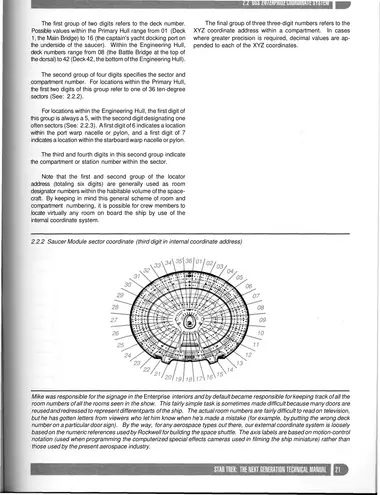
The second group of four digits specifies the sector and compartment number. For locations within the Primary Hull, the first two digits of this group refer to one of 36 ten-degree sectors (See: 2.2.2).
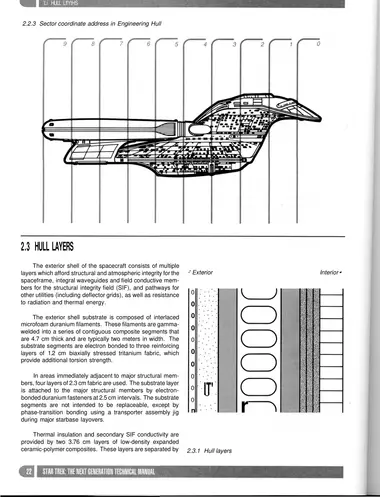
For locations within the Engineering Hull, the first digit of this group is always a 5, with the second digit designating one of ten sectors (See: 2.2.3). A first digit of 6 indicates a location within the port warp nacelle or pylon, and a first digit of 7 indicates a location within the starboard warp nacelle or pylon.
The third and fourth digits in this second group indicate the compartment or station number within the sector.
Note that the first and second group of the locator address (totaling six digits) are generally used as room designator numbers within the habitable volume of the spacecraft. By keeping in mind this general scheme of room and compartment numbering, it is possible for crew members to locate virtually any room on board the ship by use of the internal coordinate system.
Mike was responsible for the signage in the Enterprise interiors and by default became responsible for keeping track of all the room numbers of all the rooms seen in the show. This fairly simple task is sometimes made difficult because many doors are reused and redressed to represent different parts of the ship. The actual room numbers are fairly difficult to read on television, but he has gotten letters from viewers who let him know when he's made a mistake (for example, by putting the wrong deck number on a particular door sign). By the way, for any aerospace types out there, our external coordinate system is loosely based on the numeric references used by Rockwell for building the space shuttle. The axis labels are based on motion-control notation (used when programming the computerized special effects cameras used in filming the ship miniature) rather than those used by the present aerospace industry.
The final group of three three-digit numbers refers to the XYZ coordinate address within a compartment. In cases where greater precision is required, decimal values are appended to each of the XYZ coordinates.