16.4 Lifeboats
Design and capabilities of the standardized ASRV escape lifeboats, including propulsion, life support, gaggle-mode docking, and recovery beacons.
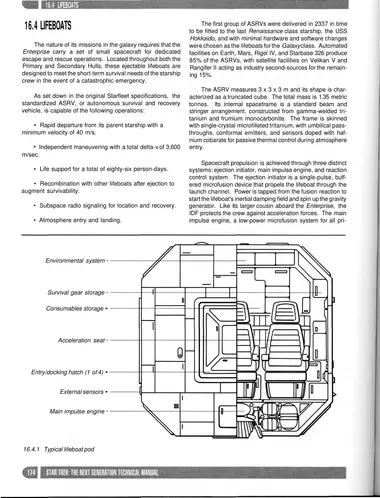
The nature of its missions in the galaxy requires that the Enterprise carry a set of small spacecraft for dedicated escape and rescue operations. Located throughout both the Primary and Secondary Hulls, these ejectable lifeboats are designed to meet the short-term survival needs of the starship crew in the event of a catastrophic emergency.
As set down in the original Starfleet specifications, the standardized ASRV, or autonomous survival and recovery vehicle, is capable of the following operations:
- Rapid departure from its parent starship with a minimum velocity of 40 m/s.
- Independent maneuvering with a total delta-v of 3,600 m/sec.
- Life support for a total of eighty-six person-days.
- Recombination with other lifeboats after ejection to augment survivability.
- Subspace radio signaling for location and recovery.
- Atmosphere entry and landing.
The first group of ASRVs were delivered in 2337 in time to be fitted to the last Renaissance class starship, the USS Hokkaido, and with minimal hardware and software changes were chosen as the lifeboats for the Galaxy class. Automated facilities on Earth, Mars, Rigel IV, and Starbase 326 produce 85% of the ASRVs, with satellite facilities on Velikan V and Rangifer II acting as industry second-sources for the remaining 15%.
The ASRV measures 3 x 3 x 3 m and its shape is characterized as a truncated cube. The total mass is 1.35 metric tonnes. Its internal spaceframe is a standard beam and stringer arrangement, constructed from gamma-welded tritanium and frumium monocarbonite. The frame is skinned with single-crystal microfilleted tritanium, with umbilical passthroughs, conformal emitters, and sensors doped with hafnium cobarate for passive thermal control during atmosphere entry.
Spacecraft propulsion is achieved through three distinct systems: ejection initiator, main impulse engine, and reaction control system. The ejection initiator is a single-pulse, buffered microfusion device that propels the lifeboat through the launch channel. Power is tapped from the fusion reaction to start the lifeboat's inertial damping field and spin up the gravity generator. Like its larger cousin aboard the Enterprise, the IDF protects the crew against acceleration forces. The main impulse engine, a low-power microfusion system for all primary spacecraft maneuvering, is rated at a maximum 950 kg thrust and is fed from a 75 kg deuterium fuel supply. The reaction control system performs all precise attitude and translation motions required for combined operations with other lifeboats and maneuvering during planetary landing.
Life support on the ASRV is maintained by its automatic environmental system, providing complete atmospheric composition, pressure, humidity, and temperature control. Stored food and water supplies as well as a waste management system are included. Lightweight environment suits are stowed with portable survival packs for planetside operation. The normal lifeboat crew capacity is four, with provisions for as many as six if necessary.
One important feature of the ASRV design, the in-line twin hatches, allows it to dock with other lifeboats to form larger clusters. This capability, nicknamed "gaggle mode" by experienced pilots, dramatically increases in-space survival rates by affording access to wounded crew members by medical personnel, combining consumables supplies, and adding propulsion options. Gaggle mode must be terminated prior to atmosphere entry, as the structural loads cannot be handled by the combined craft.
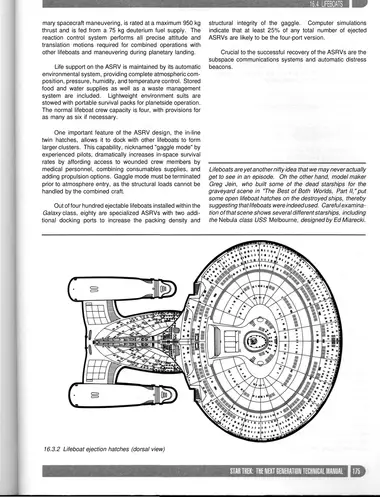
Out of four hundred ejectable lifeboats installed within the Galaxy class, eighty are specialized ASRVs with two additional docking ports to increase the packing density and structural integrity of the gaggle. Computer simulations indicate that at least 25% of any total number of ejected ASRVs are likely to be the four-port version.
Crucial to the successful recovery of the ASRVs are the subspace communications systems and automatic distress beacons.
Lifeboats are yet another nifty idea that we may never actually get to see in an episode. On the other hand, model maker Greg Jein, who built some of the dead starships for the graveyard scene in "The Best of Both Worlds, Part II," put some open lifeboat hatches on the destroyed ships, thereby suggesting that lifeboats were indeed used. Careful examination of that scene shows several different starships, including the Nebula class USS Melbourne, designed by Ed Miarecki.