14.2 Shuttlebays
Details the Enterprise's main and secondary shuttlebays, their doors, control booths, tractor-beam handling, and maintenance and spare-parts facilities.
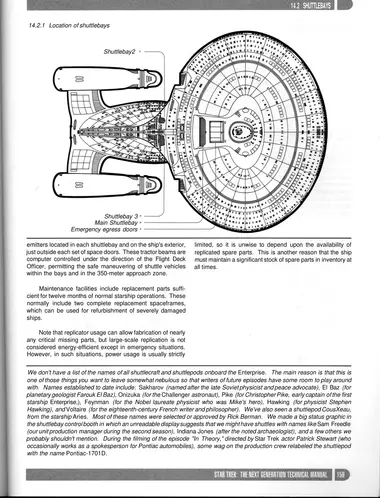
The Galaxy class USS Enterprise has three major facilities intended for the support of auxiliary shuttlecraft operations from the ship.
The Main Shuttlebay, located in the center and aft sections of Deck 4 in the Primary Hull, includes launch support, recovery, and maintenance facilities for shuttle operations.
Two additional secondary shuttlebays are located in the center and aft sections (both port and starboard) of Deck 13 in the dorsal area of the Secondary Hull.
Shuttlebay exterior space doors are triple-layered compressible extruded duranium. Inner doors are composed of lightweight neofoam sheeting in an expanded tritanium framework. During active shuttlebay operations, atmospheric integrity is maintained by means of an annular forcefield, which permits both doors to remain open for vehicular ingress and egress without depressurizing the bay.
Shuttlebay Two also includes a dedicated maintenance bay for servicing sensor array pallets. Two shuttlepods are provided for extravehicular removal and replacement of these pallets. Additionally, two adjacent maintenance bays provide work facilities for preparation and servicing of mission-specific sensor instrumentation.
Shuttlebay Three includes hardware for short-term conversion to Class H, K, or L environmental conditions, intended for use in emergency evacuation situations.
Each shuttlebay has its own operations control booth, which is supervised by an on-duty Flight Deck Officer. Each Flight Deck Officer is responsible for operations within that particular shuttlebay, but must report to the main shuttlebay officer for launch and landing clearance. In turn, the main shuttlebay officer must seek clearance from the Operations Manager on the Main Bridge.
Launch maneuvers and landing approach piloting is managed by a number of precision short-range tractor beam emitters located in each shuttlebay and on the ship's exterior, just outside each set of space doors. These tractor beams are computer controlled under the direction of the Flight Deck Officer, permitting the safe maneuvering of shuttle vehicles within the bays and in the 350-meter approach zone.
Maintenance facilities include replacement parts sufficient for twelve months of normal starship operations. These normally include two complete replacement spaceframes, which can be used for refurbishment of severely damaged ships.
Note that replicator usage can allow fabrication of nearly any critical missing parts, but large-scale replication is not considered energy-efficient except in emergency situations. However, in such situations, power usage is usually strictly limited, so it is unwise to depend upon the availability of replicated spare parts. This is another reason that the ship must maintain a significant stock of spare parts in inventory at all times.
We don't have a list of the names of all shuttlecraft and shuttlepods onboard the Enterprise. The main reason is that this is one of those things you want to leave somewhat nebulous so that writers of future episodes have some room to play around with. Names established to date include: Sakharov (named after the late Soviet physicist and peace advocate), El Baz (for planetary geologist Farouk El Baz), Onizuka (for the Challenger astronaut), Pike (for Christopher Pike, early captain of the first starship Enterprise,), Feynman (for the Nobel laureate physicist who was Mike's hero), Hawking (for physicist Stephen Hawking), and Voltaire (for the eighteenth-century French writer and philosopher). We've also seen a shuttlepod Cousteau, from the starship Aries. Most of these names were selected or approved by Rick Berman. We made a big status graphic in the shuttlebay control booth in which an unreadable display suggests that we might have shuttles with names like Sam Freedle (our unit production manager during the second season), Indiana Jones (after the noted archaeologist), and a few others we probably shouldn't mention. During the filming of the episode "In Theory," directed by Star Trek actor Patrick Stewart (who occasionally works as a spokesperson for Pontiac automobiles), some wag on the production crew relabeled the shuttlepod with the name Pontiac-1701D.