13.2 Medical Systems
Covers the Enterprise Medical department's sickbay facilities, staffing levels, and hardware including biobeds, surgical support frames, medikits, and hyposprays.
The Medical department onboard the USS Enterprise is charged with providing health care to the ship's company and all attached personnel. The extended nature of many starship voyages as well as the hazardous nature of Starfleet duty can make this a considerable challenge. Additionally, the diverse range of lifeforms both in Starfleet as well as on various destination planets dramatically increases the scope of the task.
Facilities
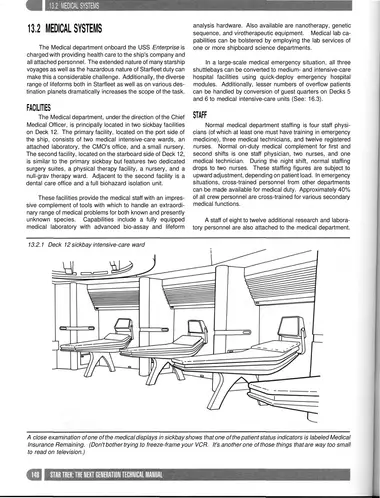
The Medical department, under the direction of the Chief Medical Officer, is principally located in two sickbay facilities on Deck 12. The primary facility, located on the port side of the ship, consists of two medical intensive-care wards, an attached laboratory, the CMO's office, and a small nursery. The second facility, located on the starboard side of Deck 12, is similar to the primary sickbay but features two dedicated surgery suites, a physical therapy facility, a nursery, and a null-grav therapy ward. Adjacent to the second facility is a dental care office and a full biohazard isolation unit.
These facilities provide the medical staff with an impressive complement of tools with which to handle an extraordinary range of medical problems for both known and presently unknown species. Capabilities include a fully equipped medical laboratory with advanced bio-assay and lifeform analysis hardware. Also available are nanotherapy, genetic sequence, and virotherapeutic equipment. Medical lab capabilities can be bolstered by employing the lab services of one or more shipboard science departments.
In a large-scale medical emergency situation, all three shuttlebays can be converted to medium- and intensive-care hospital facilities using quick-deploy emergency hospital modules. Additionally, lesser numbers of overflow patients can be handled by conversion of guest quarters on Decks 5 and 6 to medical intensive-care units (See: 16.3).
Staff
Normal medical department staffing is four staff physicians (of which at least one must have training in emergency medicine), three medical technicians, and twelve registered nurses. Normal on-duty medical complement for first and second shifts is one staff physician, two nurses, and one medical technician. During the night shift, normal staffing drops to two nurses. These staffing figures are subject to upward adjustment, depending on patient load. In emergency situations, cross-trained personnel from other departments can be made available for medical duty. Approximately 40% of all crew personnel are cross-trained for various secondary medical functions.
A staff of eight to twelve additional research and laboratory personnel are also attached to the medical department. These individuals are typically attached to various research projects, but are available to assist with medical lab assignments on a priority basis as needed.
Hardware
A key element of the medical intensive-care unit is the biobed sensor and support unit. This orthopedically designed hospital bed incorporates a basic array of biofunction sensors that can be tied into a variety of remote medical instruments including the medical tricorder (See: 13.3). Also incorporated are a number of medical gas and fluid connect points for various devices, including the surgical support frame.
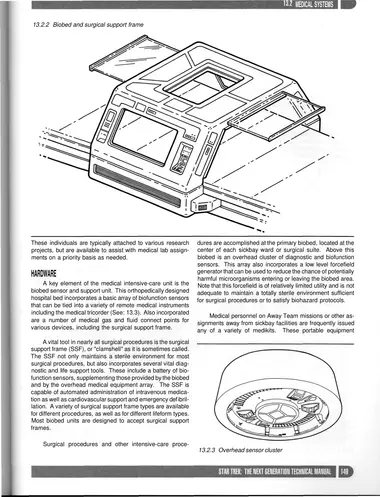
A vital tool in nearly all surgical procedures is the surgical support frame (SSF), or "clamshell" as it is sometimes called. The SSF not only maintains a sterile environment for most surgical procedures, but also incorporates several vital diagnostic and life support tools. These include a battery of biofunction sensors, supplementing those provided by the biobed and by the overhead medical equipment array. The SSF is capable of automated administration of intravenous medication as well as cardiovascular support and emergency defibrillation. A variety of surgical support frame types are available for different procedures, as well as for different lifeform types. Most biobed units are designed to accept surgical support frames.
Surgical procedures and other intensive-care procedures are accomplished at the primary biobed, located at the center of each sickbay ward or surgical suite. Above this biobed is an overhead cluster of diagnostic and biofunction sensors. This array also incorporates a low level forcefield generator that can be used to reduce the chance of potentially harmful microorganisms entering or leaving the biobed area. Note that this forcefield is of relatively limited utility and is not adequate to maintain a totally sterile environment sufficient for surgical procedures or to satisfy biohazard protocols.
Medical personnel on Away Team missions or other assignments away from sickbay facilities are frequently issued any of a variety of medikits. These portable equipment packages typically include a medical tricorder, field hypospray, respirator, defib module, sample kit, and selection of bandages and drugs for emergency field use.
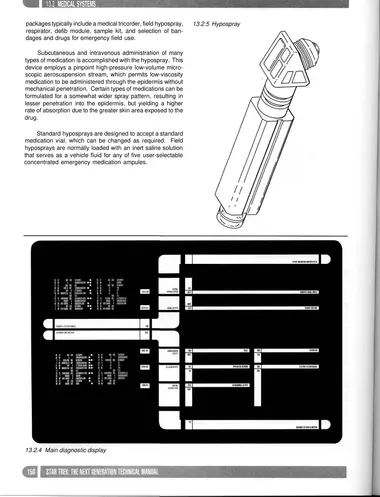
Subcutaneous and intravenous administration of many types of medication is accomplished with the hypospray. This device employs a pinpoint high-pressure low-volume microscopic aerosuspension stream, which permits low-viscosity medication to be administered through the epidermis without mechanical penetration. Certain types of medications can be formulated for a somewhat wider spray pattern, resulting in lesser penetration into the epidermis, but yielding a higher rate of absorption due to the greater skin area exposed to the drug.
Standard hyposprays are designed to accept a standard medication vial, which can be changed as required. Field hyposprays are normally loaded with an inert saline solution that serves as a vehicle fluid for any of five user-selectable concentrated emergency medication ampules.