6.3 Engineering Operations and Safety
Covers maintenance, changeout schedules, and operational power-level safety limits for the impulse engine components and the IPS overall.
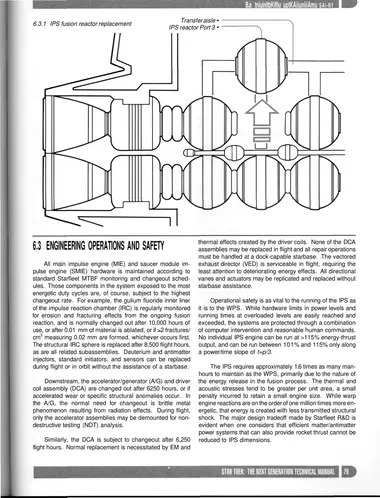
All main impulse engine (MIE) and saucer module impulse engine (SMIE) hardware is maintained according to standard Starfleet MTBF monitoring and changeout schedules. Those components in the system exposed to the most energetic duty cycles are, of course, subject to the highest changeout rate. For example, the gulium fluoride inner liner of the impulse reaction chamber (IRC) is regularly monitored for erosion and fracturing effects from the ongoing fusion reaction, and is normally changed out after 10,000 hours of use, or after 0.01 mm of material is ablated, or if >2 fractures/cm3 measuring 0.02 mm are formed, whichever occurs first. The structural IRC sphere is replaced after 8,500 flight hours, as are all related subassemblies. Deuterium and antimatter injectors, standard initiators, and sensors can be replaced during flight or in orbit without the assistance of a starbase.
Downstream, the accelerator/generator (A/G) and driver coil assembly (DCA) are changed out after 6250 hours, or if accelerated wear or specific structural anomalies occur. In the A/G, the normal need for changeout is brittle metal phenomenon resulting from radiation effects. During flight, only the accelerator assemblies may be demounted for nondestructive testing (NDT) analysis.
Similarly, the DCA is subject to changeout after 6,250 flight hours. Normal replacement is necessitated by EM and thermal effects created by the driver coils. None of the DCA assemblies may be replaced in flight and all repair operations must be handled at a dock-capable starbase. The vectored exhaust director (VED) is serviceable in flight, requiring the least attention to deteriorating energy effects. All directional vanes and actuators may be replicated and replaced without starbase assistance.
Operational safety is as vital to the running of the IPS as it is to the WPS. While hardware limits in power levels and running times at overloaded levels are easily reached and exceeded, the systems are protected through a combination of computer intervention and reasonable human commands. No individual IPS engine can be run at >115% energy-thrust output, and can be run between 101% and 115% only along a power/time slope of t=p/3.
The IPS requires approximately 1.6 times as many manhours to maintain as the WPS, primarily due to the nature of the energy release in the fusion process. The thermal and acoustic stresses tend to be greater per unit area, a small penalty incurred to retain a small engine size. While warp engine reactions are on the order of one million times more energetic, that energy is created with less transmitted structural shock. The major design tradeoff made by Starfleet R&D is evident when one considers that efficient matter/antimatter power systems that can also provide rocket thrust cannot be reduced to IPS dimensions.