10.7 Science Department Ops
Explains how the Enterprise supports secondary research teams as a mobile research platform, the facilities and instrument allocations provided, and team operational responsibilities.
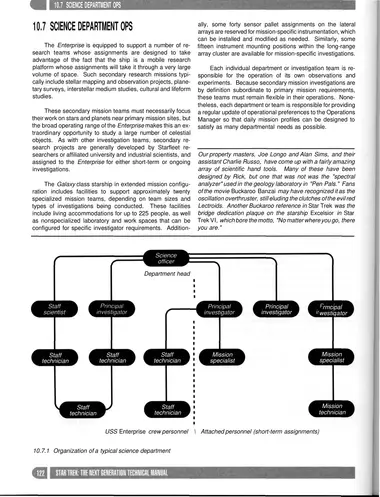
The Enterprise is equipped to support a number of research teams whose assignments are designed to take advantage of the fact that the ship is a mobile research platform whose assignments will take it through a very large volume of space. Such secondary research missions typically include stellar mapping and observation projects, planetary surveys, interstellar medium studies, cultural and lifeform studies.
These secondary mission teams must necessarily focus their work on stars and planets near primary mission sites, but the broad operating range of the Enterprise makes this an extraordinary opportunity to study a large number of celestial objects. As with other investigation teams, secondary research projects are generally developed by Starfleet researchers or affiliated university and industrial scientists, and assigned to the Enterprise for either short-term or ongoing investigations.
The Galaxy class starship in extended mission configuration includes facilities to support approximately twenty specialized mission teams, depending on team sizes and types of investigations being conducted. These facilities include living accommodations for up to 225 people, as well as nonspecialized laboratory and work spaces that can be configured for specific investigator requirements. Additionally, some forty sensor pallet assignments on the lateral arrays are reserved for mission-specific instrumentation, which can be installed and modified as needed. Similarly, some fifteen instrument mounting positions within the long-range array cluster are available for mission-specific investigations.
Each individual department or investigation team is responsible for the operation of its own observations and experiments. Because secondary mission investigations are by definition subordinate to primary mission requirements, these teams must remain flexible in their operations. Nonetheless, each department or team is responsible for providing a regular update of operational preferences to the Operations Manager so that daily mission profiles can be designed to satisfy as many departmental needs as possible.
Our property masters, Joe Longo and Alan Sims, and their assistant Charlie Russo, have come up with a fairly amazing array of scientific hand tools. Many of these have been designed by Rick, but one that was not was the "spectral analyzer" used in the geology laboratory in "Pen Pals." Fans of the movie Buckaroo Banzai may have recognized it as the oscillation overthruster, still eluding the clutches of the evil red Lectroids. Another Buckaroo reference in Star Trek was the bridge dedication plaque on the starship Excelsior in Star Trek VI, which bore the motto, "No matter where you go, there you are."