14.5 Captain's Yacht
Describes the multipurpose captain's yacht, its planform, structure, interior layout, impulse and aerodyne propulsion, and its docking and emergency-undocking rules.
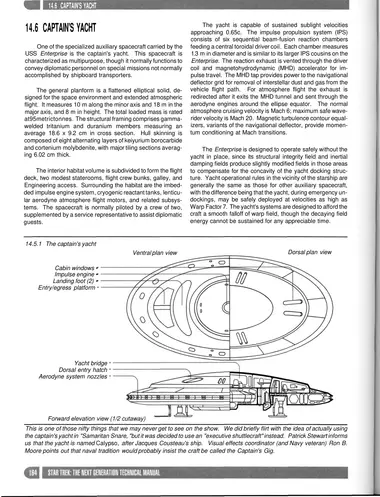
One of the specialized auxiliary spacecraft carried by the USS Enterprise is the captain's yacht. This spacecraft is characterized as multipurpose, though it normally functions to convey diplomatic personnel on special missions not normally accomplished by shipboard transporters.
The general planform is a flattened elliptical solid, designed for the space environment and extended atmospheric flight. It measures 10 m along the minor axis and 18 m in the major axis, and 8 m in height. The total loaded mass is rated at 95 metric tonnes. The structural framing comprises gamma-welded tritanium and duranium members measuring an average 18.6 x 9.2 cm in cross section. Hull skinning is composed of eight alternating layers of keiyurium borocarbide and cortenium molybdenite, with major tiling sections averaging 6.02 cm thick.
The interior habitat volume is subdivided to form the flight deck, two modest staterooms, flight crew bunks, galley, and Engineering access. Surrounding the habitat are the imbedded impulse engine system, cryogenic reactant tanks, lenticular aerodyne atmosphere flight motors, and related subsystems. The spacecraft is normally piloted by a crew of two, supplemented by a service representative to assist diplomatic guests.
This is one of those nifty things that we may never get to see on the show. We did briefly flirt with the idea of actually using the captain's yacht in "Samaritan Snare," but it was decided to use an "executive shuttlecraft" instead. Patrick Stewart informs us that the yacht is named Calypso, after Jacques Cousteau's ship. Visual effects coordinator (and Navy veteran) Ron B. Moore points out that naval tradition would probably insist the craft be called the Captain's Gig.
The yacht is capable of sustained sublight velocities approaching 0.65c. The impulse propulsion system (IPS) consists of six sequential beam-fusion reaction chambers feeding a central toroidal driver coil. Each chamber measures 1.3 m in diameter and is similar to its larger IPS cousins on the Enterprise. The reaction exhaust is vented through the driver coil and magnetohydrodynamic (MHD) accelerator for impulse travel. The MHD tap provides power to the navigational deflector grid for removal of interstellar dust and gas from the vehicle flight path. For atmosphere flight the exhaust is redirected after it exits the MHD tunnel and sent through the aerodyne engines around the ellipse equator. The normal atmosphere cruising velocity is Mach 6; maximum safe waverider velocity is Mach 20. Magnetic turbulence contour equalizers, variants of the navigational deflector, provide momentum conditioning at Mach transitions.
The Enterprise is designed to operate safely without the yacht in place, since its structural integrity field and inertial damping fields produce slightly modified fields in those areas to compensate for the concavity of the yacht docking structure. Yacht operational rules in the vicinity of the starship are generally the same as those for other auxiliary spacecraft, with the difference being that the yacht, during emergency undockings, may be safely deployed at velocities as high as Warp Factor 7. The yacht's systems are designed to afford the craft a smooth falloff of warp field, though the decaying field energy cannot be sustained for any appreciable time.