4.3 Isolinear Optical Chips
Explains isolinear optical chips, the primary software and data storage medium: their nanotech construction, capacity, FTL transmission, ruggedization, and origin.
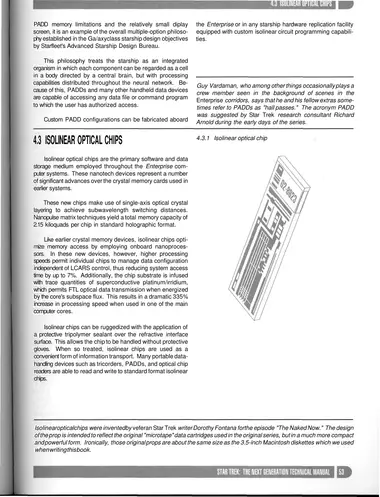
Isolinear optical chips are the primary software and data storage medium employed throughout the Enterprise computer systems. These nanotech devices represent a number of significant advances over the crystal memory cards used in earlier systems.
These new chips make use of single-axis optical crystal layering to achieve subwavelength switching distances. Nanopulse matrix techniques yield a total memory capacity of 2.15 kiloquads per chip in standard holographic format.
Like earlier crystal memory devices, isolinear chips optimize memory access by employing onboard nanoprocessors. In these new devices, however, higher processing speeds permit individual chips to manage data configuration independent of LCARS control, thus reducing system access time by up to 7%. Additionally, the chip substrate is infused with trace quantities of superconductive platinum/irridium, which permits FTL optical data transmission when energized by the core's subspace flux. This results in a dramatic 335% increase in processing speed when used in one of the main computer cores.
Isolinear chips can be ruggedized with the application of a protective tripolymer sealant over the refractive interface surface. This allows the chip to be handled without protective gloves. When so treated, isolinear chips are used as a convenient form of information transport. Many portable data-handling devices such as tricorders, PADDs, and optical chip readers are able to read and write to standard format isolinear chips.
Isolinear optical chips were invented by veteran Star Trek writer Dorothy Fontana for the episode "The Naked Now." The design of the prop is intended to reflect the original "microtape" data cartridges used in the original series, but in a much more compact and powerful form. Ironically, those original props are about the same size as the 3.5-inch Macintosh diskettes which we used when writing this book.