10.2 Long-Range Sensors
Describes the high-power active and passive subspace sensor cluster behind the main deflector, its instruments, range, and flight-hazard scanning role.
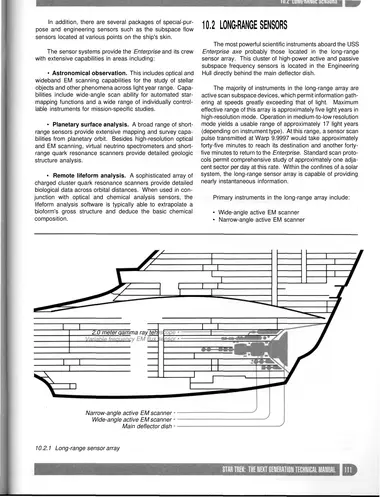
The most powerful scientific instruments aboard the USS Enterprise axe probably those located in the long-range sensor array. This cluster of high-power active and passive subspace frequency sensors is located in the Engineering Hull directly behind the main deflector dish.
The majority of instruments in the long-range array are active scan subspace devices, which permit information gathering at speeds greatly exceeding that of light. Maximum effective range of this array is approximately five light years in high-resolution mode. Operation in medium-to-low resolution mode yields a usable range of approximately 17 light years (depending on instrument type). At this range, a sensor scan pulse transmitted at Warp 9.9997 would take approximately forty-five minutes to reach its destination and another fortyfive minutes to return to the Enterprise. Standard scan protocols permit comprehensive study of approximately one adjacent sector per day at this rate. Within the confines of a solar system, the long-range sensor array is capable of providing nearly instantaneous information.
Primary instruments in the long-range array include:
- Wide-angle active EM scanner
- Narrow-angle active EM scanner
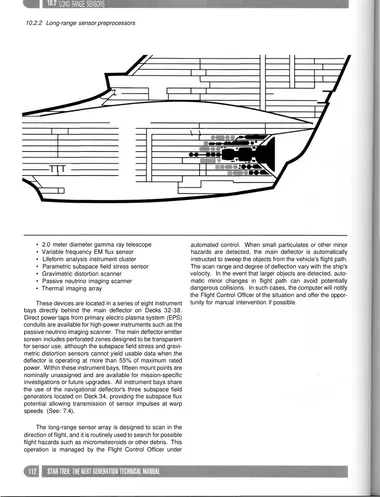
- 2.0 meter diameter gamma ray telescope
- Variable frequency EM flux sensor
- Lifeform analysis instrument cluster
- Parametric subspace field stress sensor
- Gravimetric distortion scanner
- Passive neutrino imaging scanner
- Thermal imaging array
These devices are located in a series of eight instrument bays directly behind the main deflector on Decks 32-38. Direct power taps from primary electro plasma system (EPS) conduits are available for high-power instruments such as the passive neutrino imaging scanner. The main deflector emitter screen includes perforated zones designed to be transparent for sensor use, although the subspace field stress and gravimetric distortion sensors cannot yield usable data when the deflector is operating at more than 55% of maximum rated power. Within these instrument bays, fifteen mount points are nominally unassigned and are available for mission-specific investigations or future upgrades. All instrument bays share the use of the navigational deflector's three subspace field generators located on Deck 34, providing the subspace flux potential allowing transmission of sensor impulses at warp speeds (See: 7.4).
The long-range sensor array is designed to scan in the direction of flight, and it is routinely used to search for possible flight hazards such as micrometeoroids or other debris. This operation is managed by the Flight Control Officer under automated control. When small particulates or other minor hazards are detected, the main deflector is automatically instructed to sweep the objects from the vehicle's flight path. The scan range and degree of deflection vary with the ship's velocity. In the event that larger objects are detected, automatic minor changes in flight path can avoid potentially dangerous collisions. In such cases, the computer will notify the Flight Control Officer of the situation and offer the opportunity for manual intervention if possible.