TNG Manual · Chapter 10 · Science and Remote Sensing Systems
10.5 Instrumented Probes
Describes the ship's autonomous instrumented probe spacecraft, the nine general-use probe classes, and the specifications of probe Classes I through IX.
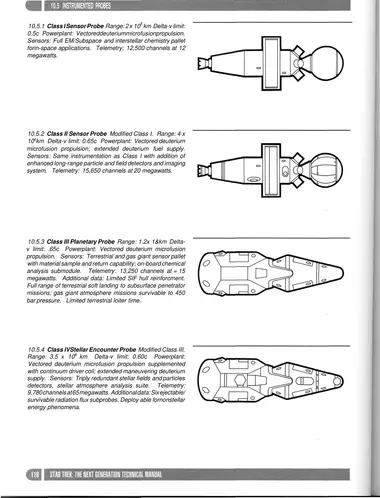
10.5.1 Class I Sensor Probe Range: 2 x 10⁵ km Delta-v limit: 0.5c Powerplant: Vectored deuterium microfusion propulsion. Sensors: Full EM/Subspace and interstellar chemistry pallet for in-space applications. Telemetry: 12,500 channels at 12 megawatts.
10.5.2 Class II Sensor Probe Modified Class I. Range: 4 x 10s km Delta-v limit: 0.65c Powerplant: Vectored deuterium microfusion propulsion; extended deuterium fuel supply. Sensors: Same instrumentation as Class I with addition of enhanced long-range particle and field detectors and imaging system. Telemetry: 15,650 channels at 20 megawatts.
10.5.3 Class III Planetary Probe Range: 1.2 x 1&km Deltav limit: .65c Powerplant: Vectored deuterium microfusion propulsion. Sensors: Terrestrial and gas giant sensor pallet with material sample and return capability; on-board chemical analysis submodule. Telemetry: 13,250 channels at = 15 megawatts. Additional data: Limited SIF hull reinforcment. Full range of terrestrial soft landing to subsurface penetrator missions; gas giant atmosphere missions survivable to 450 bar pressure. Limited terrestrial loiter time.
10.5.4 Class IV Stellar Encounter Probe Modified Class III. Range: 3.5 x 10⁶ km Delta-v limit: 0.60c Powerplant: Vectored deuterium microfusion propulsion supplemented with continuum driver coil; extended maneuvering deuterium supply. Sensors: Triply redundant stellar fields and particles detectors, stellar atmosphere analysis suite. Telemetry: 9,780 channels at 65 megawatts. Additional data: Six ejectable/survivable radiation flux subprobes. Deployable for nonstellar energy phenomena.
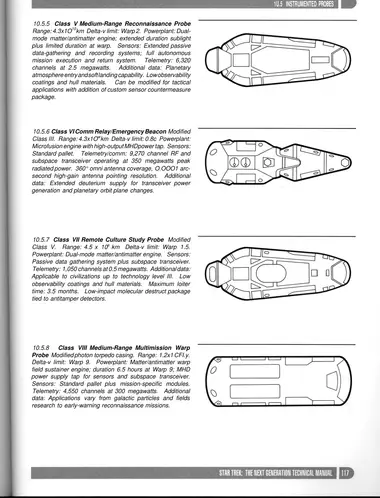
10.5.5 Class V Medium-Range Reconnaissance Probe Range: 4.3 x 10 10 km Delta-v limit: Warp 2. Powerplant: Dualmode matter/antimatter engine; extended duration sublight plus limited duration at warp. Sensors: Extended passive data-gathering and recording systems; full autonomous mission execution and return system. Telemetry: 6,320 channels at 2.5 megawatts. Additional data: Planetary atmosphere entry and soft landing capability. Low observability coatings and hull materials. Can be modified for tactical applications with addition of custom sensor countermeasure package.
10.5.6 Class VI Comm Relay/Emergency Beacon Modified Class III. Range: 4.3 x 10w km Delta-v limit: 0.8c Powerplant: Microfusion engine with high-output MHD power tap. Sensors: Standard pallet. Telemetry/comm: 9,270 channel RF and subspace transceiver operating at 350 megawatts peak radiated power. 360° omni antenna coverage, O.OOO1 arcsecond high-gain antenna pointing resolution. Additional data: Extended deuterium supply for transceiver power generation and planetary orbit plane changes.
10.5.7 Class VII Remote Culture Study Probe Modified Class V. Range: 4.5 x 10s km Delta-v limit: Warp 1.5. Powerplant: Dual-mode matter/antimatter engine. Sensors: Passive data gathering system plus subspace transceiver. Telemetry: 1,050 channels at 0.5 megawatts. Additional data: Applicable to civilizations up to technology level III. Low observability coatings and hull materials. Maximum loiter time: 3.5 months. Low-impact molecular destruct package tied to antitamper detectors.
10.5.8 Class VIII Medium-Range Multimission Warp Probe Modified photon torpedo casing. Range: 1.2 x 10 l.y. Delta-v limit: Warp 9. Powerplant: Matter/antimatter warp field sustainer engine; duration 6.5 hours at Warp 9; MHD power supply tap for sensors and subspace transceiver. Sensors: Standard pallet plus mission-specific modules. Telemetry: 6,500 channels at 230 megawatts. Additional data: Limited payload capacity; isolinear memory storage 3,400 kiloquads; fifty-channel transponder echo. Typical application is emergency log/message capsule on homing trajectory to nearest starbase or known Starfleet vessel position.
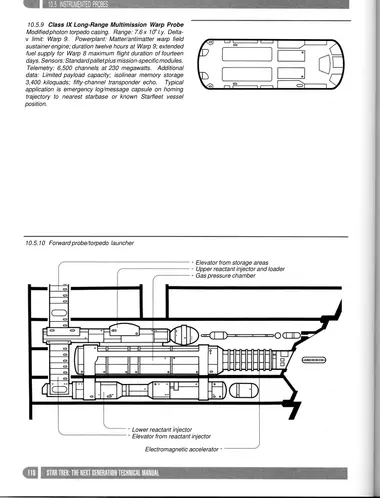
10.5.9 Class IX Long-Range Multimission Warp Probe Modified photon torpedo casing. Range: 7.6 x 10s l.y. Deltav limit: Warp 9. Powerplant: Matter/antimatter warp field sustainer engine; duration twelve hours at Warp 9; extended fuel supply for Warp 8 maximum flight duration of fourteen days. Sensors: Standard pallet plus mission-specific modules.
10.5.10 Forward probe/torpedo launcher
The detailed examination of many objects and phenomena in the Milky Way galaxy can be handled routinely by the ship's onboard sensor arrays, up to the resolution limits of the individual instruments and to the limits of available data extraction algorithms used in extrapolating values from combinations of instrument readings. Greater proportions of high-resolution data of selected sites can be gathered using close approaches by instrumented probe spacecraft. These probes are generally sized to fit the fore and aft photon torpedo launchers, providing rapid times-to-target. Three larger classes of autonomous probes are based upon existing shuttlecraft spaceframes that have been stripped of all personnel support systems and then densely packed with sensor and telemetry hardware.
General Use Probes
The small probes are divided into nine classes, arranged according to sensor types, power, and performance ratings. The features common to all nine are spacecraft frames of gamma molded duranium-tritanium and pressure-bonded lufium boronate, with certain sensor windows of triple layered transparent aluminum. Sensors not utilizing the windows are affixed through various methods, from surface blending with the hull material to imbedding the active detectors within the hull itself. All nine classes are equipped with a standard suite of instruments to detect and analyze all normal EM and subspace bands, organic and inorganic chemical compounds, atmospheric constituents, and mechanical force properties. While all are capable of at least surviving a powered atmospheric entry, three are designed to function for extended periods of aerial maneuvering and soft landing.
Many probes include varying degrees of telerobotic operation capabilities to permit realtime control and piloting of the probe. This permits an investigator to remain on board the Enterprise while exploring what might otherwise be a dangerously hostile or otherwise inaccessible environment.
The following section lists the specifications of each class. The higher class numbers are not intended to imply greater capabilities, but rather different options available to the command crew when ordering a probe launch. General use probes readied for immediate launching are stored adjacent to the photon torpedo reactant loading area on Deck 25. Other standby probes are stored on Deck 26 on standard torpedo transfer pallets. All probes are accessible to Engineering crews for periodic status checks and modifications for unique applications.