10.1 Sensor Systems
Overview of the Enterprise's three primary sensor groups (long-range, lateral, and navigational) and the broad scientific capabilities they provide.
The Galaxy Class Enterprise features one of the most sophisticated and flexible sensor packages ever developed for a Federation starship. These sensors make the Enterprise one of the most capable scientific research vessels ever built.
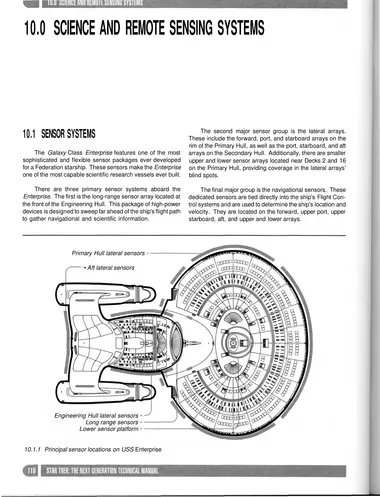
There are three primary sensor systems aboard the Enterprise. The first is the long-range sensor array located at the front of the Engineering Hull. This package of high-power devices is designed to sweep far ahead of the ship's flight path to gather navigational and scientific information.
The second major sensor group is the lateral arrays. These include the forward, port, and starboard arrays on the rim of the Primary Hull, as well as the port, starboard, and aft arrays on the Secondary Hull. Additionally, there are smaller upper and lower sensor arrays located near Decks 2 and 16 on the Primary Hull, providing coverage in the lateral arrays' blind spots.
The final major group is the navigational sensors. These dedicated sensors are tied directly into the ship's Flight Control systems and are used to determine the ship's location and velocity. They are located on the forward, upper port, upper starboard, aft, and upper and lower arrays.
In addition, there are several packages of special-purpose and engineering sensors such as the subspace flow sensors located at various points on the ship's skin.
The sensor systems provide the Enterprise and its crew with extensive capabilities in areas including:
- Astronomical observation. This includes optical and wideband EM scanning capabilities for the study of stellar objects and other phenomena across light year range. Capabilities include wide-angle scan ability for automated starmapping functions and a wide range of individually controllable instruments for mission-specific studies.
- Planetary surface analysis. A broad range of shortrange sensors provide extensive mapping and survey capabilities from planetary orbit. Besides high-resolution optical and EM scanning, virtual neutrino spectrometers and shortrange quark resonance scanners provide detailed geologic structure analysis.
- Remote lifeform analysis. A sophisticated array of charged cluster quark resonance scanners provide detailed biological data across orbital distances. When used in conjunction with optical and chemical analysis sensors, the lifeform analysis software is typically able to extrapolate a bioform's gross structure and deduce the basic chemical composition.