1.1 Spaceframe & Structural Systems
A 740-metre, 31-deck spaceframe built on a trititanium-laced duranium frame with regenerative structural integrity fields and multi-vector saucer separation.
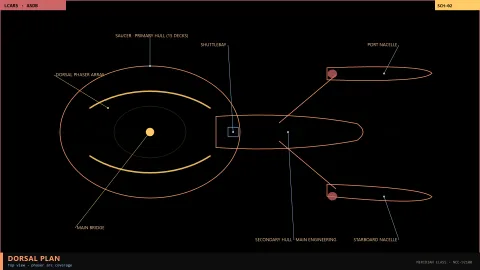
The Meridian's primary hull is a flattened ellipse 292 m across, joined by a reinforced dorsal interconnect to a tapered secondary hull carrying the engineering spaces, deflector and nacelle pylons. At 740 m overall it is larger than the Galaxy class yet carries fewer decks (31), a deliberate choice: taller compartments, wider service corridors and far more volume given over to swappable mission modules rather than fixed installations.
Materials & framework
The load-bearing skeleton is a duranium–tritanium truss laced with trititanium, the construction alloy whose adoption in the 22nd century first let starship frames survive stresses beyond the old Warp 4 hull-failure barrier. Outer hull layers follow the established sandwich of structural plating, gamma-welded biaxial sheeting and an ablative-capable outer skin, with regenerative micro-foam fills in the high-fatigue regions around the nacelle roots.
Structural integrity & inertial damping
A distributed network of structural integrity field (SIF) and inertial damping field (IDF) generators stiffens the frame under high-warp and combat loads, with triple redundancy across independent power feeds. The grid is rated to hold hull integrity through an emergency saucer separation at warp.
Multi-vector separation
The Meridian extends the Galaxy-class saucer-separation concept toward multi-vector operation: the primary hull, the battle section and the detachable mission spine can operate as three coordinated combat or survey elements and re-dock under their own power, a capability descended from both saucer separation and the Prometheus multi-vector studies.